
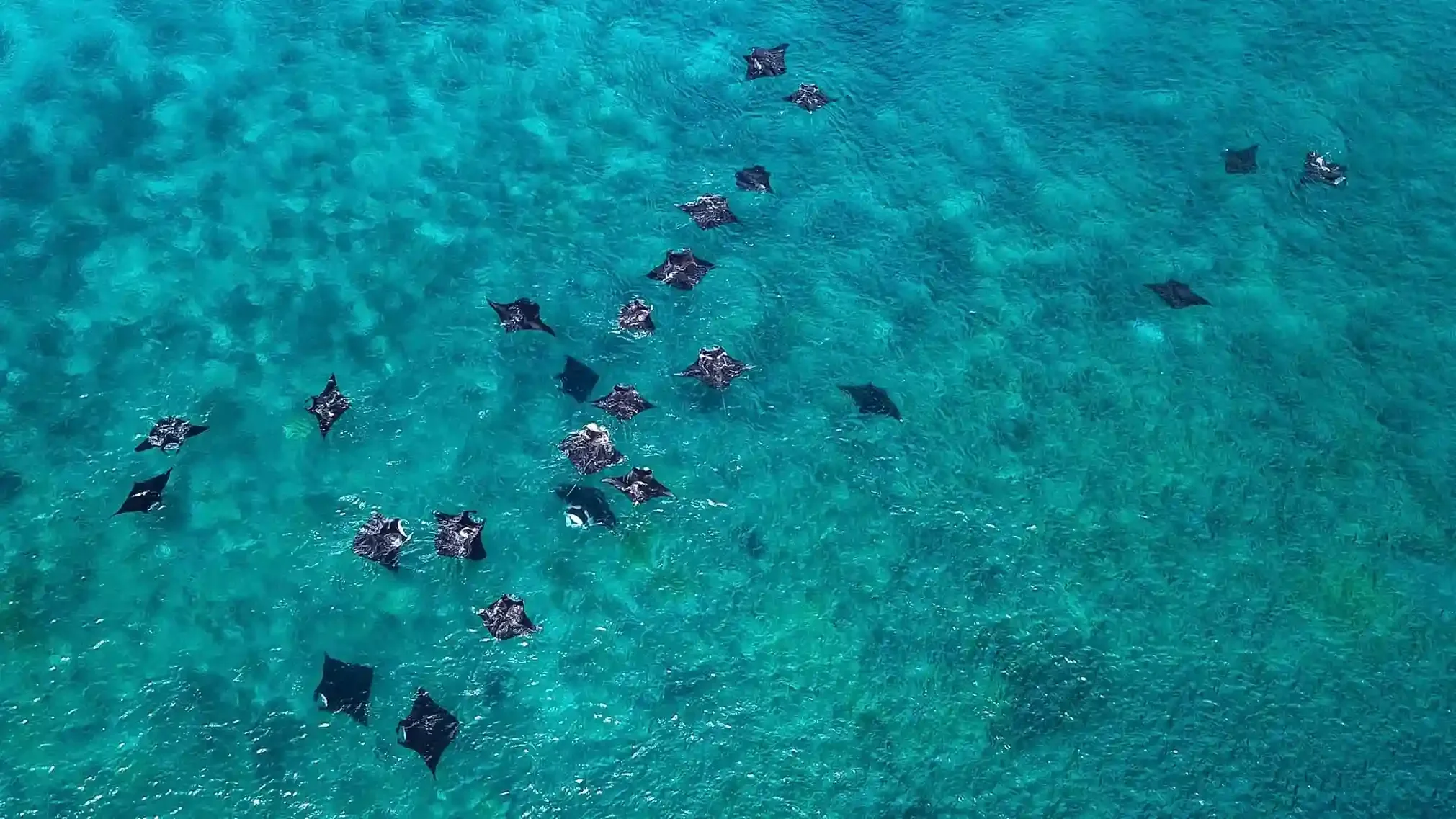
Komodo National Park’s diving is concentrated in 18 signature sites spread across three zones: the current-swept pinnacles of the north, the manta cleaning stations and coral drifts of the centre, and the cold, macro-rich walls of the south. Most of them ask for Advanced Open Water and honest drift experience; only a handful are genuinely beginner-friendly, and the table below shows exactly which is which.
Last updated: August 16, 2026
- Zones: north (Gili Lawa area), central (Karang Makassar to Tatawa), south (Nusa Kode and Padar south).
- Typical depth range: 5–30 m across the list; only Three Sisters runs deeper, to around 40 m on the right day.
- Water temperature: roughly 27–29 °C in the north and centre, dropping to 20–24 °C on southern sites.
- Certification reality: five of the eighteen suit fresh Open Water divers; the rest are Advanced-level drift diving.
- Access: all eighteen are boat-only, which is why liveaboards cover far more of this list than day trips do.
Which are the best dive sites in Komodo, and how do they compare?
Read the current column first — in Komodo it decides more than depth does. Site names link to our detailed write-ups where we have them, and the full index sits on the Komodo dive sites hub.
| Dive site | Area | Type | Depth | Current (1–5) | Minimum level | Signature species | Best months |
|---|---|---|---|---|---|---|---|
| Castle Rock | North | Submerged pinnacle | 5–30 m | 5 | Advanced + drift experience | Grey reef sharks, whitetips, dogtooth tuna, giant trevally | Apr–Nov |
| Crystal Rock | North | Pinnacle | 5–30 m | 4 | Advanced | Reef sharks, napoleon wrasse, schooling fusiliers, soft coral | Apr–Nov |
| Batu Bolong | Central | Pinnacle / rock wall | 5–30 m | 5 | Advanced + slack-water briefing | Dense hard coral, reef sharks, napoleon, trevally | Apr–Oct |
| The Cauldron (Shotgun) | North | Channel drift | 8–28 m | 5 | Advanced + drift experience | Reef mantas, eagle rays, whitetips, big schools | Apr–Nov |
| Manta Point (Karang Makassar) | Central | Manta cleaning station on rubble | 5–15 m | 3 | Open Water with drift briefing | Reef mantas, blue-spotted rays, turtles | Year-round, peak Dec–Feb |
| Siaba Besar | Central | Sheltered sloping reef | 5–20 m | 1–2 | Open Water / check dive | Green turtles, garden eels, cuttlefish | Year-round |
| Siaba Kecil | Central | Drift along reef slope | 5–25 m | 3–4 | Advanced recommended | Sweetlips, turtles, schooling snapper | Apr–Nov |
| Tatawa Besar | Central | Easy reef drift | 5–25 m | 2–3 | Open Water | Orange soft coral gardens, turtles, passing mantas | Apr–Nov |
| Tatawa Kecil | Central | Boulder pinnacle | 5–30 m | 4–5 | Advanced + drift experience | Whitetips, trevally, nudibranchs, coral bommies | Apr–Nov |
| Golden Passage | North | Channel drift | 5–30 m | 4–5 | Advanced | Reef sharks, trevally, passing mantas, big schools | Apr–Nov |
| The Passage | North | Narrow channel drift | 5–25 m | 5 | Advanced + drift experience | Sharks, cuttlefish, soft coral, high biodiversity | Apr–Nov |
| Gili Lawa Laut | North | Island reef and slopes | 5–30 m | 3–4 | Advanced | Schooling fusiliers, turtles, reef sharks | Apr–Nov |
| Mawan | Central | Reef slope + sandy cleaning station | 5–20 m | 2 | Open Water | Reef mantas, turtles, garden eels | Year-round |
| Wainilu | Central (Rinca) | Muck / critter dive | 5–18 m | 1–2 | Open Water | Mandarinfish, frogfish, nudibranchs, ghost pipefish | Year-round, dusk best |
| Yellow Wall | South (Nusa Kode) | Wall | 5–30 m | 2–3 | Advanced | Yellow soft coral, frogfish, pygmy seahorses | Oct–Apr |
| Three Sisters (Tiga Dara) | South | Three submerged pinnacles | 12–40 m | 4–5 | Advanced + deep experience | Dogtooth tuna, trevally, sharks, dense soft coral | Oct–Apr |
| Pillarsteen | South | Rock formations, swim-throughs | 5–25 m | 3–4 | Advanced | Pygmy seahorses, scorpionfish, canyons and caverns | Oct–Apr |
| Crinoid Canyon | South (Horseshoe Bay) | Slope and canyon | 5–25 m | 3 | Advanced | Crinoids, frogfish, rare nudibranchs | Oct–Apr |
One naming note: some operators use “The Passage” and “Golden Passage” for the same stretch of water between Komodo Island and Gili Lawa Darat. We brief them separately because the entry points and safe exits differ — worth asking your guide which version you are actually diving.
How should you read the current scale in this table?
Current is the single variable that separates a good day in Komodo from a stressful one. Our 1–5 scale is operational, not academic:
- 1 — negligible. Fine for a check dive or a rusty diver’s first immersion.
- 2 — mild. You can swim against it without effort.
- 3 — moderate drift. You go with the water; no hook needed.
- 4 — strong drift. Negative entry, tight group, reef hook useful.
- 5 — very strong, with up- and downcurrents. The dive only happens on the right tide window, with a reef hook and a guide who knows the site.
The same site can feel completely different four hours apart, because Komodo’s currents are tidal. Good boats plan the day around slack water rather than around breakfast, which is why an itinerary listing Castle Rock is not a promise you will dive it. Anyone diving 4s and 5s needs negative entries, SMB deployment and tight formation as reflexes; our notes on crew and safety standards cover guide ratios and briefings. No dive is risk-free, and the honest response to a marginal window is a softer site.
What is the difference between north, central and south Komodo diving?
The north — Castle Rock, Crystal Rock, The Cauldron, Golden Passage, Gili Lawa Laut — is the adrenaline half of the park: cool, clear, shark-heavy water pushed through channels between islands. The centre, from Karang Makassar past Siaba, Mawan and the Tatawas, is where mantas cruise cleaning stations and the reef diving stays gentle enough for newer divers and snorkellers. The south, around Nusa Kode and Padar, is a different ocean: Indian Ocean upwelling drops the temperature into the low twenties and delivers some of Indonesia’s best macro life in exchange.
We compare the two halves in north vs south Komodo diving, and critter divers should read the Komodo muck diving notes before giving Wainilu and the southern slopes a whole day.
Which Komodo dive sites match your certification level?
Open Water divers with modest experience are comfortable at Siaba Besar, Wainilu, Mawan, Tatawa Besar and — with a proper drift briefing — Manta Point. That is a genuinely good week of diving, and it is the backbone of what we plan for guests coming through our Komodo liveaboard for beginners route.
Advanced Open Water plus roughly twenty logged dives opens Crystal Rock, Siaba Kecil, Tatawa Kecil, Gili Lawa Laut and the southern walls. The three sites we will not put an inexperienced diver on, regardless of card, are Castle Rock, Batu Bolong and The Cauldron: all three punish poor buoyancy and loose group discipline. Most boats run a day-one check dive at Siaba Besar precisely so the guide can grade the group before committing to the big-current schedule. Non-divers are not stranded either — Manta Point, Mawan and Siaba Besar all work from the surface, which is what our Komodo liveaboard snorkelling page is built around.
When is the best month to dive each area?
North and central Komodo dive well from April to November, with the clearest water usually landing between June and September. Southern sites are the mirror image: October to April brings calmer seas around Nusa Kode, while the south-east monsoon can make that coast rough and inaccessible in mid-year. Mantas are resident year-round at Karang Makassar and Mawan, but plankton density between December and February concentrates them in the biggest numbers. Full month-by-month detail sits in our Komodo diving season guide and in the best time for a Komodo liveaboard.
Which of these sites will a liveaboard actually reach?
Trip length is the honest constraint. A three-day, two-night route out of Labuan Bajo covers the central belt plus one or two northern sites; six days adds the full northern circuit and a proper run into the south; eight days makes the south comfortable rather than rushed. Compare the 3D2N open trip, six-day and eight-day itineraries, or start from Komodo liveaboard packages and departures from Labuan Bajo. Cost tracks boat class and season rather than site list, so that comparison stays on the Komodo liveaboard price page.
Booking side, the operator behind these itineraries is Komodo Luxury – a registered Indonesian PT (PT Komodo Bahari Nusantara, KBLI 79120) under Juara Holding Group Limited. Their Komodo liveaboard fleet covers the range from shared open trips to luxury phinisi and full private yacht charter, and dive-focused charters can be routed around the sites in the table above rather than around a fixed sightseeing loop.
What do permits and current conditions look like in the park?
Every diver entering Komodo National Park pays entrance, ranger and diving-activity components, with rates differing between weekdays, weekends and public holidays; the breakdown lives on our park fees and permits page. Boats also need valid sailing clearance from the Labuan Bajo harbourmaster for each departure.
On conditions: a magnitude 7.7 earthquake struck roughly 200 km north-east of Labuan Bajo on 15 August 2026. Sailing permissions reopened the same day under Maklumat 05/MP-VIII/2026, the park was not closed, and dive sites have shown no reported structural change so far. Guides are still checking mooring points and southern walls dive by dive, which is normal practice after seismic activity.
Frequently asked questions
How many dive sites are there in Komodo National Park?
Local operators work from a list of roughly fifty named sites, but a realistic liveaboard week covers twelve to twenty dives across the eighteen above — the ones with consistent conditions, established mooring and a reason to be on the schedule.
Which Komodo dive site is best for seeing manta rays?
Karang Makassar, usually called Manta Point, is the highest-probability cleaning station and works for divers and snorkellers alike. Mawan is the quieter alternative with less current, and mantas also pass through The Cauldron and Golden Passage on the drift.
Can an Open Water diver dive Komodo?
Yes, on the right sites. Siaba Besar, Wainilu, Mawan, Tatawa Besar and Manta Point are all within Open Water limits. Castle Rock, Batu Bolong and The Cauldron are not, and a responsible guide will say so rather than take the booking.
Which Komodo dive site has the strongest current?
Batu Bolong, Castle Rock and The Passage produce the fiercest water, including downcurrents that can pull a diver off the reef. All three are dived on a tide window, and all three are cancelled without argument when that window closes.
Do I need nitrox for Komodo diving?
It is not required, but on three- and four-dive days it noticeably extends bottom time and shortens surface intervals. Most liveaboards carry it as an optional extra; confirm availability at booking rather than on board.
Is southern Komodo worth the extra travel time?
If you dive macro, photograph small subjects or already know the northern sites, yes — Yellow Wall, Crinoid Canyon and Pillarsteen are a different park entirely. If it is your first visit and you want sharks, mantas and coral, the north and centre deliver more per day.
How cold is the water in south Komodo?
Expect 20–24 °C on southern sites against 27–29 °C in the north, with sharp thermoclines. A 5 mm wetsuit, hood and gloves are sensible if your itinerary includes Nusa Kode; a 3 mm is enough for the north and centre.