
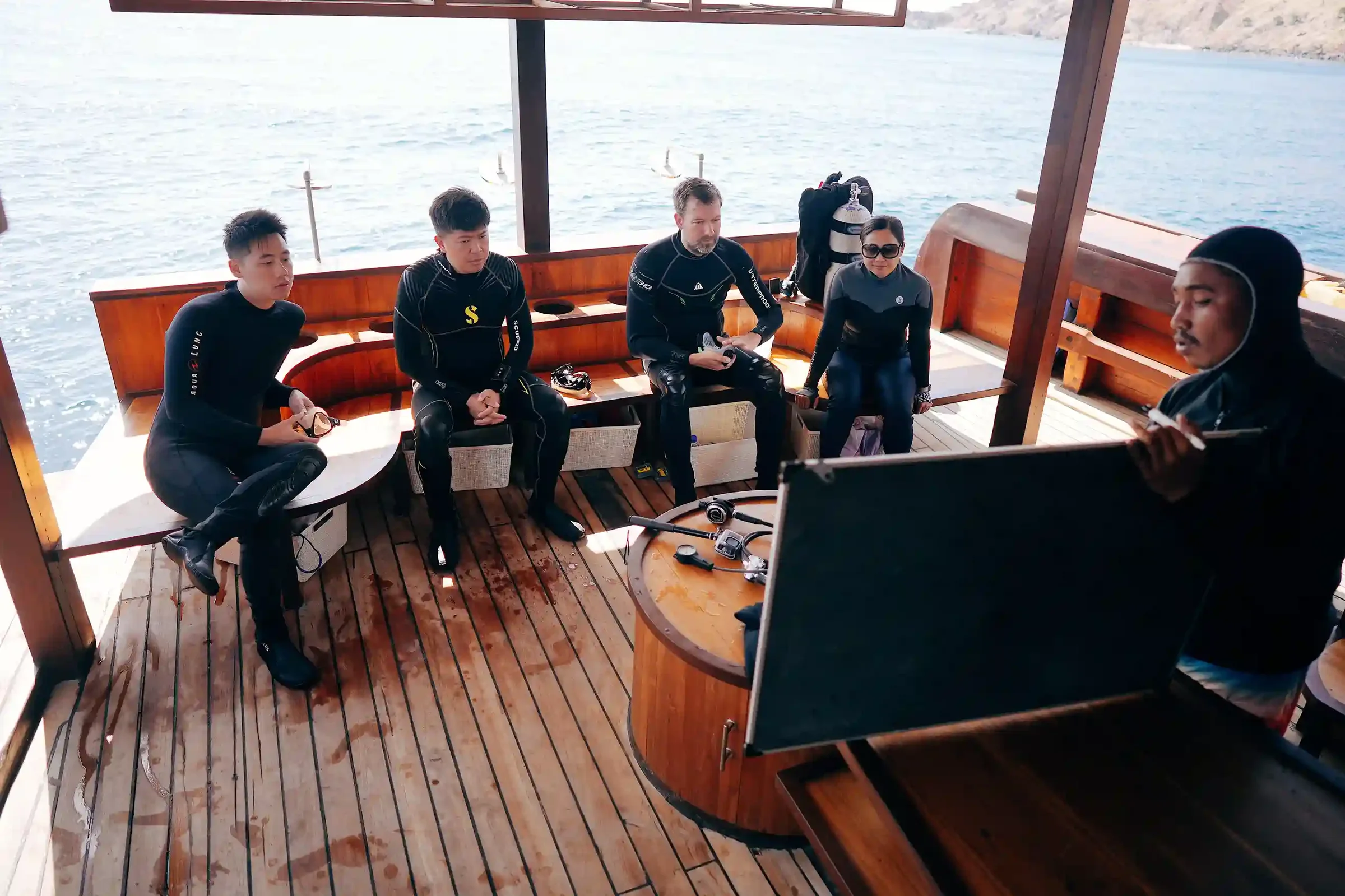
Komodo’s currents are strong because the Indonesian Throughflow pushes Pacific water south toward the Indian Ocean through narrow straits, and twice-daily tidal exchange squeezes that flow between the islands. Risk is not uniform: sheltered sites such as Wainilu and Siaba stay mild, mid-park drifts like Tatawa Besar are manageable for most divers, and exposed pinnacles and channels — Castle Rock, Crystal Rock, Batu Bolong, The Cauldron — can require reef hooks, negative entries and real drift experience.
Last updated: August 16, 2026
Planning the on-water side of your trip? Browse every Komodo island liveaboard departure on one schedule page, or study the current Komodo liveaboard price guide before you commit to dates.
Komodo does not have one current. It has a different water column at every site, changing hour by hour with the tide and week by week with the moon. Most trouble here comes from one mismatch: a diver placed on a site beyond their experience.
Why are Komodo’s currents so strong?
Two forces stack. The first is the Indonesian Throughflow, the permanent transport of warm Pacific water southward into the Indian Ocean, a large share of which passes through the Lesser Sunda islands. The second is tide: the Flores Sea and the southern waters are out of phase, so water moves between them four times a day. Force that exchange through gaps a few hundred metres wide, over seamounts rising from deep water, and velocity multiplies.
Two consequences matter for planning. Spring tides near full and new moon produce the fastest water; neap tides are gentler. And the north of the park behaves differently from the south — warm, big-current pinnacle diving versus colder, surge-prone reefs, a contrast set out on our north versus south Komodo diving page, with seasonal patterns in the Komodo diving season guide.
What types of current will you actually meet?
- Drift (horizontal). Water moves along the reef, you move with it, the tender follows your bubbles. Tatawa Besar and Siaba Besar are classic drifts. The skill is buoyancy and group discipline, not strength.
- Down-current and up-current. Where flow meets a wall or pinnacle it splits, and part is forced downward. Swim horizontally out of the descending column toward the reef and get behind structure — never fight it vertically.
- Washing machine. Turbulent, multi-directional water where two flows meet, usually at a channel exit or the lee corner of a seamount. It tumbles rather than transports. Stay neutral, protect regulator and mask, let it release you.
- Eddies and standing waves. Circular flow behind an obstruction, and surface chop where current meets wind. Eddies are why a lee side is only conditionally calm; standing waves are why a pickup can be rougher than the dive.
How risky is each major Komodo dive site?
These bands are a planning tool, not a guarantee: any site can exceed its band on a spring tide, and most sit below it at slack. Band 1 is benign; band 5 needs current experience, disciplined team diving and a guide who knows the tidal window. Full profiles sit on the Komodo dive sites hub.
| Dive site | Area | Current character | Band | Suited to |
|---|---|---|---|---|
| Castle Rock | North | Seamount, ramping flow, hook-in on the ridge | 5 | Experienced current divers |
| The Cauldron (Shotgun) | North | Channel flush, washing machine, down-current at exit | 5 | Experienced current divers |
| Batu Bolong | Central | Pinnacle splits flow; down-current off both corners | 5 | Experienced current divers |
| Crystal Rock | North | Pinnacle, negative entry, flow splits at the top | 4 | Advanced, drift-competent |
| The Passage | North | Tidal channel, fast drift with turbulent patches | 4 | Advanced, drift-competent |
| Golden Passage | North | Narrow channel drift, strongly timing-dependent | 4 | Advanced, drift-competent |
| Tatawa Kecil | Central | Exposed rock, split flow, surge on the shallows | 4 | Advanced |
| Gili Lawa Laut | North | Variable, from moderate drift to hard corner | 3 | Advanced |
| Three Sisters | South | Offshore pinnacles, surge and exposure | 3 | Advanced |
| Pillarsteen | South | Surge through swim-throughs and canyons | 3 | Advanced |
| Manta Point (Karang Makassar) | Central | Steady drift over rubble; hook-in to watch mantas | 3 | Open Water with drift briefing |
| Tatawa Besar | Central | Long, mostly benign one-way drift | 2 | Open Water |
| Mawan | Central | Mild drift over sand and coral, occasional pulse | 2 | Open Water |
| Crinoid Canyon | South | Light current, cold thermoclines, variable visibility | 2 | Open Water, cold-tolerant |
| Yellow Wall | South | Gentle wall drift, cold water | 2 | Open Water |
| Siaba Besar | Central | Sheltered bay, minimal current | 1 | All levels, check dives |
| Wainilu | Central | Muck site, near-still water | 1 | All levels, macro and photography |
Which techniques keep you comfortable in Komodo current?
Negative entry. On pinnacles you roll in with an empty BCD and descend immediately, so the group is not blown off the site while it assembles at the surface. Practise it on an easy site first.
Reef hook. A short line with a blunt hook clipped to a chest D-ring and placed only in dead rock or rubble, never in living coral. Hook in, add a little air to hover on the line, and you can watch sharks or mantas without finning. Release by swimming forward to slacken the line, not by pulling.
Reef contour. Stay low, use the reef as a windbreak, move corner to corner rather than crossing open blue. A metre of altitude can double the flow you are fighting.
Team discipline and SMB. Stay within arm’s reach of your buddy, ascend as a group, and deploy a long SMB before leaving the reef so the tender has you before you are in open water. Crew procedure matters as much as diver skill; the boat-side minimums we work to are on our crew safety standards page.
Who should avoid the high-current sites?
Being told a site is not for you today is good guiding. Divers who should sit out bands 4 and 5, or dive them only after a successful check dive, include newly certified Open Water divers with few logged dives, anyone with no drift experience, divers returning after a long break without a refresher, and anyone whose air consumption drops sharply under exertion. Snorkellers should stay away from channel and pinnacle sites entirely.
None of that rules out Komodo. A sound itinerary starts newer divers on Siaba, Mawan, Tatawa Besar and Wainilu, builds skills over the first days, then considers a pinnacle at the right tidal window — the sequence described on our Komodo liveaboard for beginners page. Boats that hold a fixed site order regardless of tide are worth questioning; good ones re-plan daily around the tide table. Departure information is published by Komodo Luxury’s liveaboard department, and whole-vessel options that allow a fully tide-led schedule are listed under luxury phinisi charters. Komodo Luxury – a registered Indonesian PT (PT Komodo Bahari Nusantara, KBLI 79120) under Juara Holding Group Limited with 1,500+ verified guest reviews (4.9/5).
Did the August 2026 earthquake change current conditions?
There is no indication that it did. The M7.7 earthquake of 15 August 2026 was centred roughly 200 km northeast of Labuan Bajo, sailings reopened the same day under Maklumat 05/MP-VIII/2026, and Komodo National Park was not closed. Tidal currents are driven by the moon and the Throughflow, not by seismic events, and operations have continued on normal tide-led planning, so far. Your guide’s briefing on the day remains the authority.
Frequently asked questions
Is Komodo too difficult for an Open Water diver?
No, but site selection has to be honest. Plenty of band 1–2 sites suit an Open Water diver with reasonable buoyancy. Most operators require Advanced certification plus logged drift experience before the pinnacles and channels.
What is a reef hook and do I need my own?
It is a short line with a blunt hook that holds you in position without finning or touching coral. Boats carry a few, but supply is limited. If Castle Rock, Crystal Rock or Karang Makassar are on your itinerary, bring your own and practise with it first.
What should I do if I hit a down-current?
Do not fight it vertically and do not dump air in panic. Swim horizontally out of the descending column toward the reef, get behind structure, stabilise, then ascend along the reef with your buddy. Signal your guide early.
When is the current weakest in Komodo?
Around slack water at the turn of the tide, and generally on neap tides near the first and last quarter moon. Guides plan the day around those windows, which is why the site order on a well-run boat changes trip to trip.
Can snorkellers and non-divers handle these currents?
At the right sites, yes — sheltered bays and shallow reefs with a tender standing by. Channel and pinnacle sites are not snorkelling locations under any conditions. If your group mixes divers and non-divers, plan the itinerary around that from the start.
Next step
Match the itinerary to the least experienced diver on board, not the strongest. Read the site profiles on the dive sites hub, ask whether the schedule is planned around the tide table, and state your logged dives and drift experience honestly at booking.
Planning the trip itself
Current briefings are only as good as the crew giving them. Komodo Luxury — a registered Indonesian PT under Juara Holding Group Limited with 1,500+ verified guest reviews (4.9/5) — publishes vessel-by-vessel detail so you can compare before committing: liveaboard trips with certified dive guides, Komodo sailing itineraries, the operator behind these departures.