
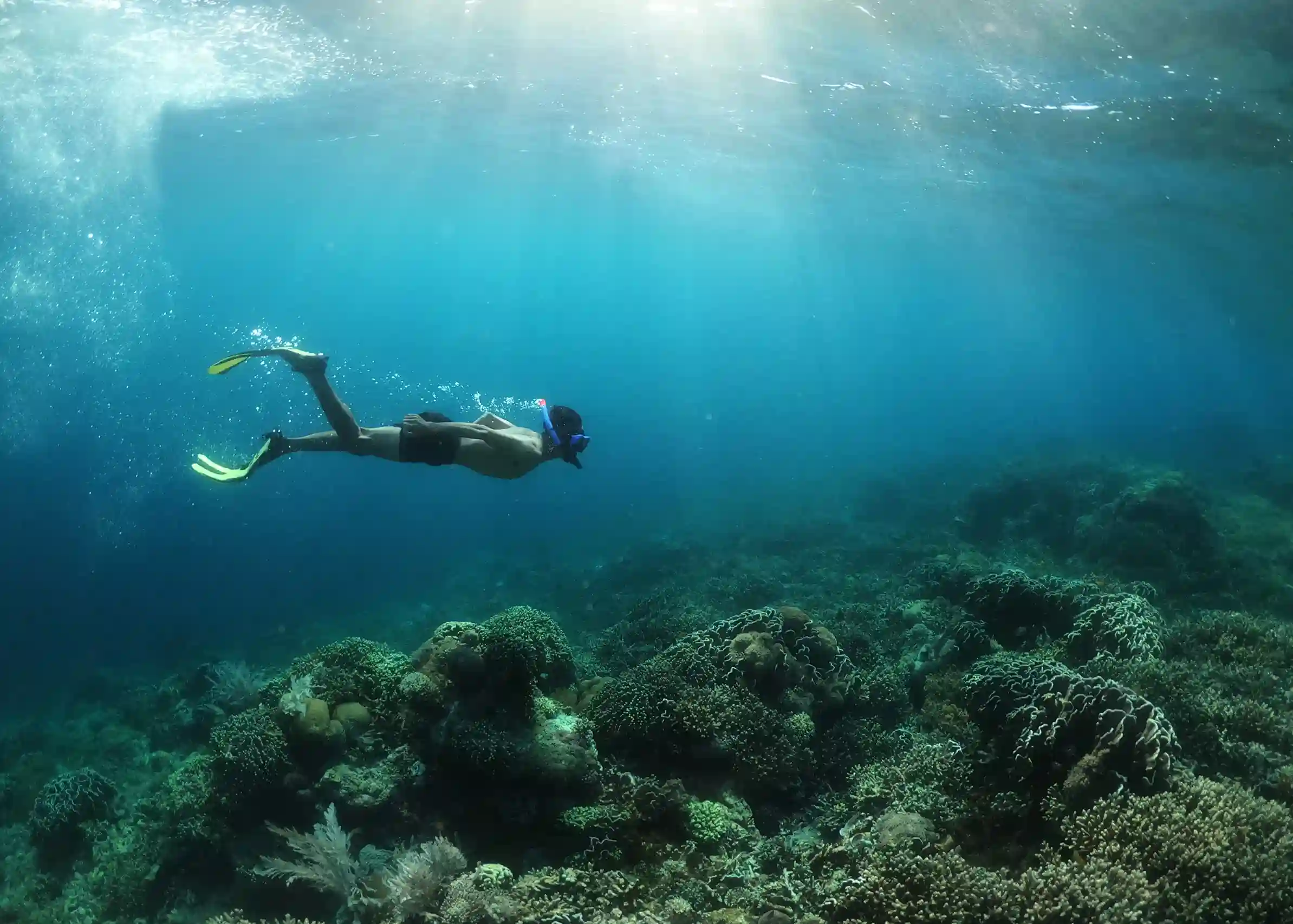
Short answer: A Komodo liveaboard works well for snorkelers and non-divers as long as the boat runs a genuine surface programme — a tender that drops you on the reef flats while the divers descend, plus daily land excursions to Padar, Komodo or Rinca, and Pink Beach. At Manta Point, Siaba Besar and Mawan the best of Komodo happens in the top five metres of water. What separates a good trip from a dull one is not the boat but whether the crew plans the day around two groups instead of one.
Last updated: August 16, 2026
What does a Komodo liveaboard actually look like if you don’t dive?
On a well-run boat the day splits in two. Divers are briefed and in the water early, when currents are most predictable. Non-divers eat a slower breakfast and go out by tender roughly 30–45 minutes later, usually to a shallower corner of the same reef system or to a nearby site chosen for surface conditions. Everyone is back on board at similar times, so meals, sunset and the evening on deck are shared.
Across a three- or four-day itinerary a non-diver can expect two or three snorkel drops per day, one or two land excursions and at least one dawn hike. That is a full schedule. Long waits on the swim platform only happen on boats that sell a dive product and treat snorkelers as an add-on. The surface programme is set out on our Komodo liveaboard snorkeling page, and the booking side under Komodo liveaboard for non-divers.
Which Komodo sites are genuinely good for snorkelers?
Not every famous dive site translates to the surface — several of Komodo’s best-known walls sit in 20–30 metres of moving water and are invisible from above. These are the sites that work:
| Site | What you see from the surface | Conditions |
|---|---|---|
| Manta Point / Karang Makassar | Mantas in a shallow cleaning and feeding channel | Moderate drift, tender follows |
| Mawan | Manta cleaning station over a sandy slope, coral garden | Usually gentle |
| Siaba Besar | Green turtles on seagrass, shallow bommies | Sheltered, minimal current |
| Pink Beach | Fringing reef off the sand, reef fish, soft coral | Calm, swim from shore |
| Tatawa Besar | Orange soft-coral slope in 3–8 m | Mild to moderate drift |
| Taka Makassar | Sandbar with shallow reef edges | Calm at the right tide |
Mantas are the headline. At the right tide they feed in water shallow enough that a snorkeler often has a better view than a diver sitting on the bottom in the blue. If mantas are your priority, read the site profile for Mawan and watch the season — peak aggregations shift through the year, as explained in the best time for a Komodo liveaboard guide.
What happens while the divers are underwater?
Three arrangements are common, and they are not equal:
- Dedicated snorkel guide and tender. The best setup. One crew member is assigned to the surface group for the whole trip, stays in the water with you, and the tender shadows the group during drifts. Ask whether that person exists and whether they are in the water or in the boat.
- Shared tender, staggered timing. Workable. The same tender does a dive drop, returns, then runs the snorkel group. Expect less flexibility on where you go.
- Swim off the back of the boat. The weakest option. Fine at anchor in a sheltered bay, poor value anywhere with current.
The site rotation should also be planned so at least one drop per day suits both groups — a decision made before departure, not improvised on the morning.
What land excursions do non-divers get?
This is where non-divers come out ahead, because the land programme is identical for everyone: the Padar ridge hike at sunrise (30–45 minutes of steps to the three-bay viewpoint), a ranger-guided walk on Komodo or Rinca to see dragons in their own territory, Pink Beach in the afternoon, and Kalong Island at dusk when thousands of flying foxes leave the mangroves.
These stops form the backbone of the route described on our Komodo island hopping page and are included on standard Komodo liveaboard packages. Park entry, ranger and conservation charges are usually billed separately from the boat fare, so confirm what is included before you pay.
How dangerous are Komodo currents for snorkelers?
Komodo sits in the strait between Sumbawa and Flores, where the Indonesian Throughflow (Pacific water moving toward the Indian Ocean) is squeezed through narrow channels and reinforced by tidal exchange between the Flores Sea to the north and the Savu Sea and Sumba Strait to the south. Currents are real, they run fast, and they are the single most important safety variable for anyone on the surface. That is manageable, not alarming — but it demands discipline.
Rules competent crews follow: drops are timed to slack water or the early part of a predictable drift; the group enters and drifts together; the tender stays upcurrent and in visual contact; snorkelers wear a buoyancy vest unless they are demonstrably strong swimmers; and nobody enters where the crew has judged conditions wrong that day. A cancelled drop is a sign of a good crew, not a bad one. Down-currents and turbulence at sites like Batu Bolong and Shotgun are precisely why those never appear on a snorkel list. Our crew safety standards page sets out the briefing and in-water protocol we expect.
On regional conditions: the M7.7 earthquake of 15 August 2026, centred roughly 200 km northeast of Labuan Bajo, did not close Komodo National Park, and sailing reopened the same day under Maklumat 05/MP-VIII/2026. Operations have run normally so far.
How do you book a trip that suits a mixed group?
Ask four questions in writing before you pay a deposit: is there a dedicated snorkel guide, how many snorkel drops per day are planned, which sites on this itinerary are snorkel-viable, and does the rate differ for a non-diving guest. Most operators charge non-divers less than divers because tank fills and equipment rental drop out; how much less varies by boat, and the current ranges sit on our Komodo liveaboard price page.
If only some of your group dives, a private charter removes the scheduling compromise entirely — the day is built around you. Open trips cost less and work fine with operators used to mixed manifests.
Check the paperwork behind the boat. Komodo Luxury is a registered Indonesian PT — PT Komodo Bahari Nusantara, KBLI 79120 — under Juara Holding Group Limited, a registration any operator should be able to show you.
Both formats run as a scheduled open trip or a private yacht charter.
Frequently asked questions
Do I need to be a strong swimmer to snorkel in Komodo?
You need to be comfortable in open water without touching the bottom, and honest with the crew if you are not. Weak swimmers can still join every drop wearing a buoyancy vest and staying within arm’s reach of a guide, and sheltered sites like Siaba Besar and Pink Beach exist for exactly that. Say so on day one, not at the ladder.
Will I actually see mantas as a snorkeler?
Often, yes. Manta Point and Mawan are shallow cleaning and feeding stations, and mantas frequently sit in the top 3–8 metres. Sightings are seasonal and never guaranteed on a single drop — one argument for a longer itinerary that visits manta sites twice.
Can non-divers try diving during the trip?
On boats carrying an instructor, a discover-scuba session in a sheltered bay is often possible, and some guests complete an entry-level course on board. Confirm instructor availability before booking — not every liveaboard carries one.
Is a liveaboard worth it if nobody in my group dives?
It is, if what you want is the park itself: Padar at sunrise before the day boats arrive, dragons with a ranger, mantas and quiet anchorages. A liveaboard buys you time and position. If you only want the famous viewpoints and one snorkel stop, a day trip from Labuan Bajo may serve you better for far less.
What should snorkelers pack that divers don’t think about?
A rash guard or thin shorty for sun and jellyfish, reef-safe sunscreen, your own well-fitting mask with a floating strap, motion-sickness tablets taken before departure rather than after symptoms start, and a dry bag for the tender. Fins are usually provided, but comfort varies — bring your own if you have them.