
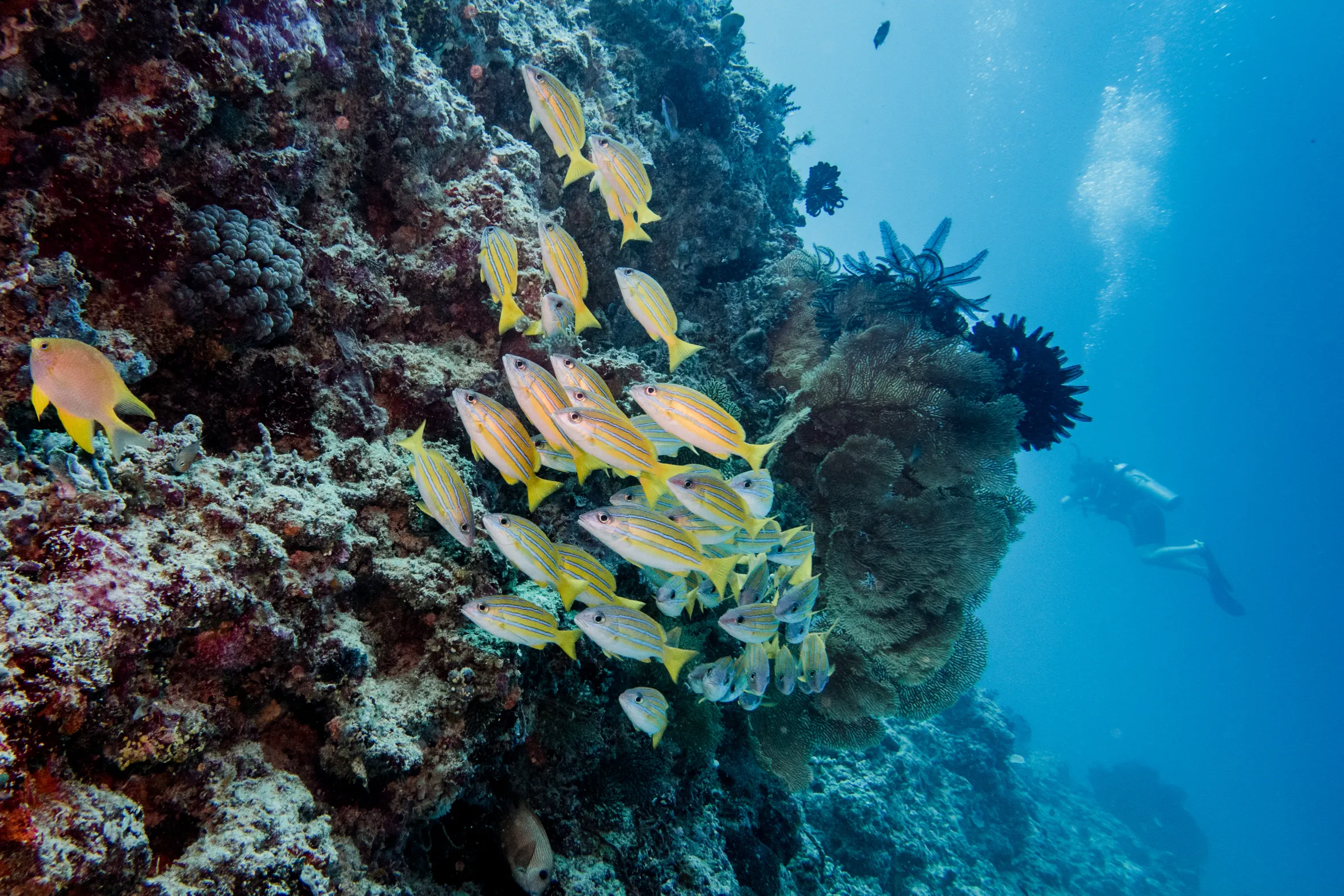
Castle Rock’s currents typically run 1.5–3 knots, spiking past 4 knots around spring tides and peak water exchange. The dive uses a negative entry straight to depth, requires Advanced Open Water certification or equivalent drift experience, and rewards divers with grey reef sharks, whitetip reef sharks, and dense schools of trevally and dogtooth tuna holding in the flow.
Why Castle Rock’s Current Behaves Differently
Castle Rock is a submerged seamount off Gili Lawa in North Komodo, and its shape is the reason the current here feels different from almost anywhere else you’ll dive on a komodo island liveaboard. The pinnacle rises steeply from well over 60 meters to within a few meters of the surface, and that abrupt vertical relief squeezes tidal flow through the strait between Flores and the open water beyond. Instead of a steady, predictable drift like you’ll find at gentler dive sites around the archipelago, the water accelerates as it’s forced up and around the rock — the same hydrodynamic effect that concentrates plankton, baitfish, and the predators that follow them.
That’s the trade-off every diver signs up for at Castle Rock: the same current that makes the dive technical is what makes it one of Komodo’s best shark and pelagic encounters. Guides brief this site differently from a standard reef dive, and the current is the first thing covered, not an afterthought.
How Strong Are Castle Rock’s Currents, Really?
Current strength at Castle Rock isn’t a single number — it shifts by tide state, depth zone, and time of month. Spring tides (around new and full moon) push noticeably harder water than neap tides, and the current at 25 meters often behaves differently from the current at the top of the pinnacle. Here’s the realistic range guides work with:
| Condition | Typical Current Speed | Depth Zone | What It Feels Like |
|---|---|---|---|
| Neap tide / slack window | 1–1.5 knots | Top of pinnacle (5–10m) | Manageable drift, easy to hold position with a light kick |
| Standard tidal exchange | 1.5–3 knots | Main wall (20–30m) | Continuous current requiring active fin work or a reef hook to hold still |
| Spring tide / peak exchange | 3–4+ knots | Full depth range (10–35m) | Strong, sustained current — reef hook or drift-only technique, no fighting it |
| Eddy / lee-side pockets | Variable, can reverse | Behind the pinnacle’s mass | Short, disorienting reversals as you round the rock’s contours |
The number that matters most for trip planning isn’t the average — it’s the maximum you might encounter on any given dive. Guides check tide tables and lunar phase before every Castle Rock dive and adjust the entry point, depth plan, and group size accordingly.
Reading the Current: Eddies, Upwellings & Directional Shifts
What catches inexperienced current divers off guard at Castle Rock isn’t raw speed — it’s unpredictability. The seamount’s steep topography creates eddy formations and upwelling columns that can reverse direction within seconds as you move from one face of the rock to another. A diver holding steady on the current-facing side can round a ledge and suddenly find the flow pushing the opposite way. This is why solo improvisation is discouraged here: your guide reads the water in real time and repositions the group based on what they’re seeing, not just what the tide table predicted.
Upwelling is the other factor worth understanding before you jump in. Cooler, nutrient-rich water pushed up from depth is what stacks baitfish and predators against the rock face — it’s also what can cause a sudden buoyancy shift if you’re not actively managing your BCD through the change. Guides brief this specifically because an unexpected upwelling at 25 meters is a common reason divers balloon toward the surface if they’re not paying attention.
Best Entry Technique for Castle Rock
Almost every operator uses a negative entry at Castle Rock — you enter already deflated and descend immediately, rather than floating on the surface and equalizing on the way down. Surface time at this site is minimized on purpose, since surface current and boat traffic make lingering topside the riskiest part of the dive. A typical entry sequence looks like this:
- Full gear check on the skiff — reef hook clipped and accessible, computer on, air confirmed, before you’re anywhere near the water.
- Giant stride with a negative entry — no air in the BCD, hands on mask and regulator, straight down on the guide’s signal.
- Group descent to the agreed depth — usually 15–20 meters, staying tight as a group rather than spreading out in the current.
- Position on the lee or current-facing side as briefed, using a reef hook on bare rock (never on coral) if you need to hold still and watch the action.
- Drift with the current for the return leg, letting the flow carry you toward the pickup point rather than fighting back to the entry line.
Reef hooks are standard equipment here, not optional gear — they let you anchor to bare rock and watch shark and pelagic activity without burning air fighting the flow. Your guide will show you exactly where hooking is permitted before the dive.
Is Castle Rock Beginner-Friendly?
No — and any operator telling you otherwise is underselling the conditions. Castle Rock is consistently rated one of Komodo’s more demanding dives, closer in intensity to the south loop sites like Manta Alley than to the calmer reefs most first-time visitors start on. Advanced Open Water certification (or equivalent logged experience with drift diving) is the realistic minimum, and guides want to see genuine comfort with negative entries, reef hooks, and current before booking you onto this site specifically.
If you’re newer to diving, that doesn’t mean Komodo is off the table — a shorter 3D2N itinerary can be structured around gentler north and central sites first, building current confidence before a site like Castle Rock enters the plan. Talk to your operator about sequencing if this is your first Komodo trip.
Want the current briefed properly before you commit? Our team can build a private charter itinerary around Castle Rock’s tidal window and your certification level, or add it to the 3D2N Komodo Liveaboard share-cabin open trip — live schedules and cabin availability through Komodo Luxury Open Trip. WhatsApp +62 811 3823 875 or email [email protected].
Marine Life You’ll See in the Current
The current is the whole point of Castle Rock, because it’s what concentrates the marine life. Expect grey reef sharks patrolling the current-facing wall, whitetip reef sharks resting in the lee pockets, and dense schools of trevally, jacks, and dogtooth tuna holding position and feeding in the flow. Napoleon wrasse and the occasional passing eagle ray round out a typical dive, and on stronger current days the baitfish balls can be dense enough to blot out the blue water behind them. Compare that to the manta-focused encounters at Manta Point further south — Castle Rock’s signature is shark density and schooling pelagics rather than ray activity, which is why serious shark divers often name it their favorite single site in the park.
Best Time of Day to Dive Castle Rock
There’s no universal “best hour” at Castle Rock — the right time is whatever the tide table says is closest to slack water or a manageable exchange on the day you’re diving, and your guide sets it accordingly. In practice, this often means an early morning dive, since liveaboards typically anchor near Gili Lawa overnight and launch the first dive of the day once the crew has checked the current prediction against the group’s experience level. Afternoon dives happen too when the tide window favors it. The takeaway: don’t fixate on a specific hour when planning your trip — trust that your operator is reading the tide table, not a generic schedule, and ask at the morning briefing what window is planned and why.
Season plays a supporting role here as well. North Komodo sites including Castle Rock are generally diveable April through October, when conditions across the Komodo destinations in this zone are most stable. Outside that window, itineraries typically shift focus toward other parts of the park depending on conditions that season.
Frequently Asked Questions
How strong are Castle Rock currents?
Typically 1.5–3 knots during standard tidal exchange, occasionally exceeding 4 knots around spring tides and peak water movement. Strength also varies by depth zone — the top of the pinnacle often feels calmer than the main wall at 20–30 meters. Guides check tide tables and lunar phase before every dive to set realistic expectations for the group that day.
Is it beginner-friendly?
No. Castle Rock is one of Komodo’s more demanding dives and is better suited to Advanced Open Water divers or those with solid logged drift-diving experience. Guides want to see comfort with negative entries, reef hooks, and current management before including you on this specific site. Newer divers can build confidence on gentler sites first.
Best entry technique?
A negative entry is standard — descend immediately without air in your BCD rather than floating on the surface. This minimizes time exposed to surface current and boat traffic, the riskiest part of the dive. Groups descend together to an agreed depth, typically 15–20 meters, before positioning along the current-facing or lee side of the pinnacle.
What marine life to expect?
Grey reef sharks and whitetip reef sharks are the headline species, alongside dense schools of trevally, jacks, and dogtooth tuna holding in the current. Napoleon wrasse and occasional eagle rays round out most dives. The current itself is what concentrates this activity, making Castle Rock one of Komodo’s top shark-diving sites.
Best time of day to dive?
There’s no fixed hour — your guide sets the dive time around the tide table’s closest slack or manageable exchange window for that day, which is often early morning since liveaboards typically anchor near Gili Lawa overnight. Ask at the morning briefing what window is planned and why, rather than expecting a universal best time.
Ready to feel that current for yourself? The 3D2N Komodo Liveaboard share-cabin open trip is bookable directly through Komodo Luxury Open Trip — live schedules and cabin availability. WhatsApp +62 811 3823 875 or email [email protected].