
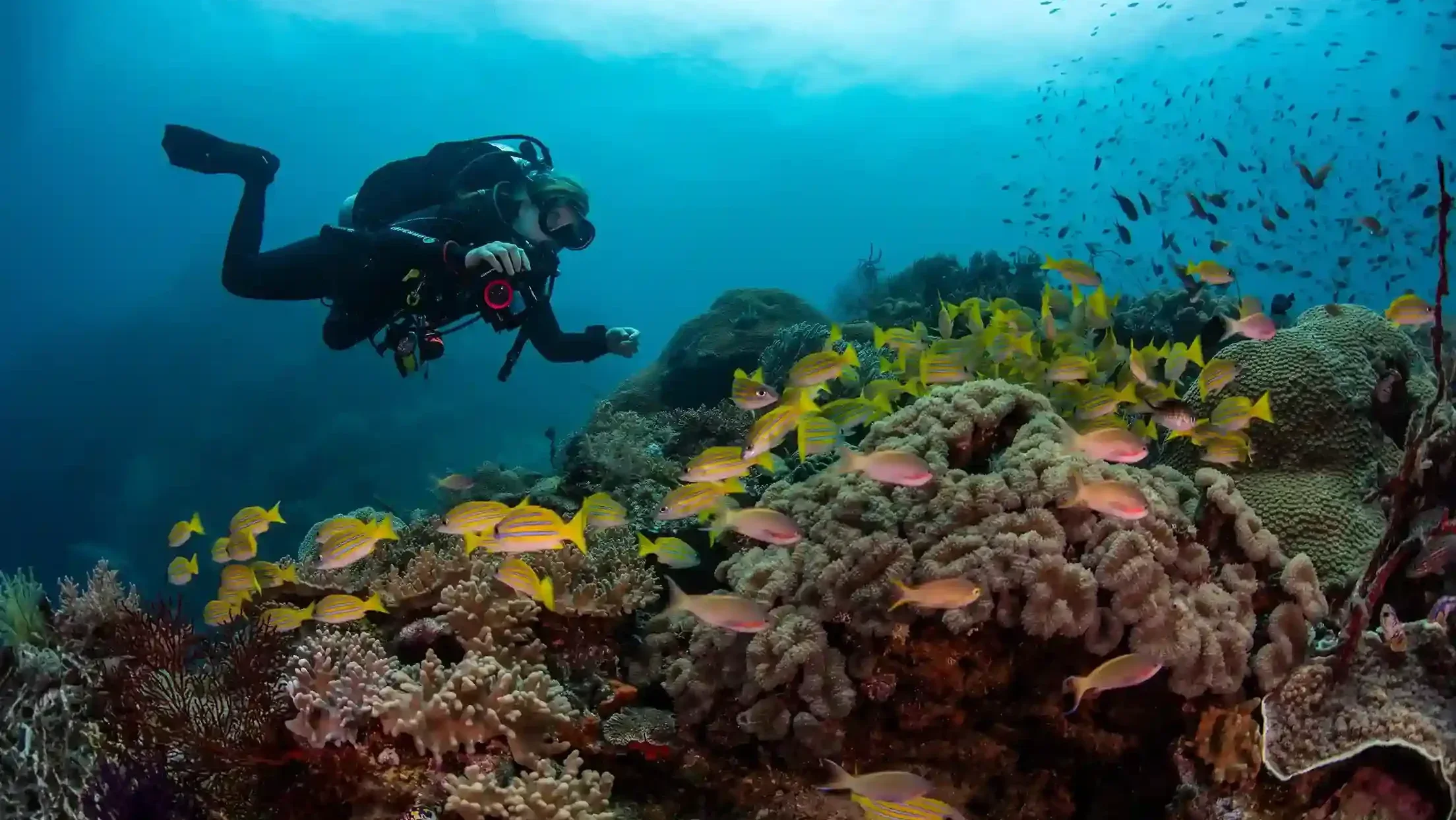
Komodo’s dive sites don’t share one “correct” camera setting. Castle Rock rewards fast fisheye wide-angle work at ISO 400–800 and f/8–f/11, while Cannibal Rock’s muck slopes favor a 60mm macro lens at f/16–f/22 and low strobe power. This guide breaks down mode, ISO, shutter, and strobe for all 12 named sites along the komodo island liveaboard route, updated for the 2027 season.
Why One Camera Setting Never Works Across Komodo
Komodo National Park sits at the collision point of two current systems, and that single fact drives almost every photography decision you’ll make onboard. The north and central sites — Castle Rock, Crystal Rock, Cauldron/Shotgun, Golden Passage — run their best visibility and most stable currents from April through October, which is when fast-drift wide-angle photography rewards preparation the most. The southern sites — Cannibal Rock, Torpedo Alley, Manta Alley — peak from October through December, when cooler, nutrient-rich water slows the current but crowds the reef with the critters that make macro photography worthwhile.
That north-south split means your camera bag should change depending on which loop is on the day’s itinerary, not just which season you’re traveling in. Check the day’s dive-sites briefing every morning — guides on a komodo liveaboard will tell you current strength before the first splash, and that number should decide your lens more than any packing list ever could.
Camera Settings by Named Dive Site (2027 Reference Table)
Use this table as a starting point, not a fixed rule — always confirm current strength with your dive guide at the morning briefing, since Komodo’s currents can shift within the same day.
| Dive Site | Typical Current | Best Shot Type | ISO | Shutter Speed | Aperture / Strobe |
|---|---|---|---|---|---|
| Castle Rock | Strong, unpredictable | Wide-angle, fisheye | ISO 400–800 | 1/125–1/250s | f/8–f/11, strobes 3/4 power, wide angle |
| Crystal Rock | Moderate-strong | Wide-angle reef scenes | ISO 200–400 | 1/125s | f/9–f/13, strobes angled outward to avoid backscatter |
| Cauldron / Shotgun | Very strong drift | Wide-angle, action shots | ISO 400–1000 | 1/200–1/320s | f/7–f/10, strobes pulled in tight, freeze-frame priority |
| Golden Passage | Moderate drift | Wide-angle channel scenes | ISO 200–500 | 1/125–1/160s | f/8–f/11, strobes half power |
| Torpedo Alley | Mild, current picks up at night | Macro, night-critter | ISO 400–800 | 1/125s | f/16–f/22, snoot or narrow-beam strobe |
| Cannibal Rock | Mild to moderate | Macro, muck subjects | ISO 200–400 | 1/125–1/160s | f/16–f/22, strobes low power, close positioning |
| Manta Alley | Variable, surge near cleaning stations | Wide-angle, big animal | ISO 200–500 | 1/160–1/250s | f/8–f/11, strobes wide, be ready to drop strobes for backlit shots |
| Batu Bolong | Strong, wall-hugging | Wide-angle wall, macro on ledges | ISO 400–800 | 1/160–1/250s | f/9–f/13, strobes tight to reduce particulate backscatter |
| Sebayur Reef | Mild | Macro and reef-scape | ISO 200–400 | 1/125s | f/13–f/18, moderate strobe power |
| Siaba Besar | Mild to moderate | Macro, turtle portraits | ISO 200–400 | 1/125–1/160s | f/14–f/18, strobes low to mid power |
| Tatawa Besar | Mild | Wide-angle coral garden | ISO 200–400 | 1/125s | f/9–f/13, strobes wide, spread evenly |
| Makassar Reef | Mild, sandy bottom | Wide-angle manta encounters | ISO 200–500 | 1/160–1/250s | f/8–f/11, strobes lowered when mantas pass close |
Four Sites Worth a Closer Look
Castle Rock — Fast Water, Fast Fisheye
Castle Rock’s currents can shift from a gentle push to a washing-machine drift inside a single dive, so pre-setting your camera on the surface matters more here than anywhere else on the itinerary. Lock a fisheye or wide zoom, set exposure a stop brighter than you think you need (the deep blue water eats light fast), and keep your strobe arms tucked in tight — a strobe arm caught by current is how gear gets damaged. Save the fine-tuning for after the dive; on Castle Rock, hesitation costs you the shot of the resident grey reef sharks cruising the pinnacle.
Cannibal Rock — Slow Down for Macro
Cannibal Rock is Komodo’s answer to Lembeh Strait, and it punishes anyone who shows up with a wide-angle rig and no macro backup. Frogfish, pygmy seahorses, and nudibranchs sit tucked into soft coral and sponge at depths from 5 to 20 meters, which means slow fin kicks and near-perfect buoyancy matter as much as your f-stop. Drop strobe power to avoid blowing out translucent subjects, and shoot at f/16 or narrower to keep the whole critter in focus. This is one of the few dive sites in the park where a 60mm or 100mm macro lens outperforms anything wide.
Manta Alley — Wide-Angle Patience
Manta Alley rewards patience over aggressive strobe use. Reef mantas here glide past cleaning stations at variable depth and speed, so pre-focus on the substrate near the station and wait rather than chase — chasing scatters them before you get the shot. Ambient-light silhouettes against the surface often outperform strobe-lit shots when mantas pass overhead, so be ready to kill your strobes entirely for a few frames. Current can surge without warning, so secure loose gear before you settle in to wait.
Batu Bolong — The Wall That Punishes Bad Buoyancy
Batu Bolong is a small pinnacle wall with strong current and a mixed cast of subjects — reef sharks and schooling fusiliers in open water, pygmy seahorses tucked into gorgonian fans on the ledges. That combination means you’re switching mentally between wide-angle and macro mid-dive, which is exactly why a compact travel setup with a wet-mountable macro lens (rather than a fixed port swap) works best here. Keep strobe arms close to the housing; the current at Batu Bolong will yank an extended arm and ruin your framing before you notice.
A Pre-Dive Camera Checklist (Every Site, Every Dive)
- Confirm the site and expected current strength at the morning briefing before you touch your camera settings.
- Set white balance and exposure compensation on the surface — Komodo’s blue-water depth eats warm tones fast.
- Choose your lens based on the table above, not habit — swapping mid-dive rarely works in current.
- Check O-rings and housing seals every single dive, not just once a trip; salt residue builds fast on a multi-day itinerary.
- Secure strobe arms in a tucked position for entry, especially at drift sites like Castle Rock or Cauldron/Shotgun.
- Pack a spare battery and memory card in your BCD pocket — surface intervals on a liveaboard are short.
- Brief your buddy or guide on your shot priority (macro subject vs. wide-angle scene) before descending.
- Rinse gear in the dedicated camera rinse tank immediately after each dive, never in the general gear tank.
Day-by-Day Lens Strategy on a 7D6N Komodo Liveaboard
Longer durations give photographers the biggest advantage: enough days to cover both current systems without rushing. Here’s how a typical 7D6N itinerary maps to gear choice.
- Day 1 — North loop, Golden Passage / Crystal Rock: Wide-angle rig, moderate ISO, expect current briefings on arrival.
- Day 2 — Castle Rock / Cauldron-Shotgun: Fisheye locked, strobes tucked tight, fast shutter for action shots.
- Day 3 — Central reefs, Tatawa Besar / Sebayur Reef: Mixed day — bring both lenses, current is generally forgiving.
- Day 4 — South loop transition, Manta Alley: Wide-angle only, patience over strobe power, silhouette shots at midday.
- Day 5 — Cannibal Rock / Torpedo Alley: Full macro day, narrow aperture, low strobe power, slow fins.
- Day 6 — Batu Bolong / Siaba Besar: Compact wet-lens setup for the wall-to-macro switch, plus topside light at Padar Island for landscape shots.
- Day 7 — Pink Beach and return: Camera day off underwater, topside macro of the pink sand at Pink Beach before disembarkation.
Shorter trips compress this same logic. A 3D2N itinerary usually covers one loop only, so decide in advance whether the trip is a macro trip or a wide-angle trip — trying to do both in three days spreads your gear too thin. Full pricing by duration is on the Komodo liveaboard price page.
Want a photography-focused itinerary built around this guide? Our team can arrange a private diving charter that sequences the sites above to match your lens plan, or point you to the 3D2N share-cabin Komodo Luxury Open Trip if scheduled departures suit you better. WhatsApp +62 811 3823 875 or email [email protected] to plan your diving itinerary.
Housing, Strobes & Beginner Setup
Current is the variable that separates Komodo from calmer photography destinations, and your housing choice should reflect that before your lens choice does. A compact housing with a single wet-mountable macro lens travels lighter and swaps faster between subjects than carrying two dedicated ports, which matters when a dive briefing changes your plan five minutes before the splash. Dual strobes give more even lighting on wide-angle reef scenes, but a single strobe is easier to control one-handed in current and is usually enough for the macro-heavy south loop sites like Cannibal Rock and Torpedo Alley.
If you’re new to housing your camera, practice buoyancy without it first — a camera rig adds drag and changes your trim, and Komodo’s current is an unforgiving place to learn that lesson. Ask your guide which dive sites on your itinerary are current-light enough for a first attempt with the full rig.
Video vs Photo: Making the Call Before You Jump
Video rewards Komodo’s big-animal encounters — manta cleaning stations, shark passes at Castle Rock, the sheer scale of a Cauldron/Shotgun drift — because motion and current are part of the story. Photo rewards the macro sites, where a single sharp frame of a pygmy seahorse says more than thirty seconds of unstable handheld footage. Most photographers on a multi-day komodo liveaboard trip settle into a rhythm: video on north-loop drift days, photo on south-loop macro days, and a hybrid setup (camera with video capability, no dedicated rig) on transition days like Batu Bolong where the subject switches mid-dive.
Frequently Asked Questions
Best settings for Castle Rock currents?
Set ISO 400–800, shutter 1/125–1/250s, and aperture f/8–f/11 with strobes at three-quarter power before you enter the water — current at Castle Rock can pick up fast, and mid-dive adjustments are difficult. Use a fisheye or wide zoom, keep strobe arms tucked close to reduce drag, and prioritize framing over fine exposure tweaks once you’re in the drift.
Macro vs wide-angle at Cannibal Rock?
Macro wins at Cannibal Rock. The site’s muck slopes hold frogfish, pygmy seahorses, and nudibranchs tucked into soft coral rather than open-water big animals, so a 60mm or 100mm macro lens outperforms wide-angle almost every dive. Shoot narrow apertures (f/16–f/22) to keep small subjects fully in focus, and keep strobe power low to avoid overexposing translucent critters.
Manta Alley photography tips?
Position near a cleaning station and wait rather than chase — mantas scatter when divers swim toward them. Use wide-angle only, pre-focus on the reef substrate below the station, and be ready to switch off your strobes for backlit silhouette shots when a manta passes between you and the surface. Current can surge suddenly, so secure loose gear before settling in.
Best housing for beginners?
A compact housing with a single wet-mountable macro lens is the easiest starting point for Komodo. It travels light, swaps quickly between wide and macro without a full port change, and is more forgiving to control one-handed in current than a large dual-strobe rig. Practice buoyancy without the housing first, since added drag changes your trim underwater.
Video vs photo priority?
Prioritize video on north-loop drift and big-animal sites — Castle Rock sharks, manta cleaning stations, Cauldron/Shotgun current — where motion tells the story better than a still frame. Prioritize photo on south-loop macro sites like Cannibal Rock and Torpedo Alley, where a single sharp image of a small critter outperforms unstable handheld footage in low-flow water.
Ready to put these settings to the test? Whether you want a private diving charter sequenced around the sites in this guide or the flexibility of the 3D2N share-cabin Komodo Luxury Open Trip, our team can match the right boat to your photography plan. WhatsApp +62 811 3823 875 or email [email protected] — check current park regulations and site access at booking, since conditions can change between seasons.