
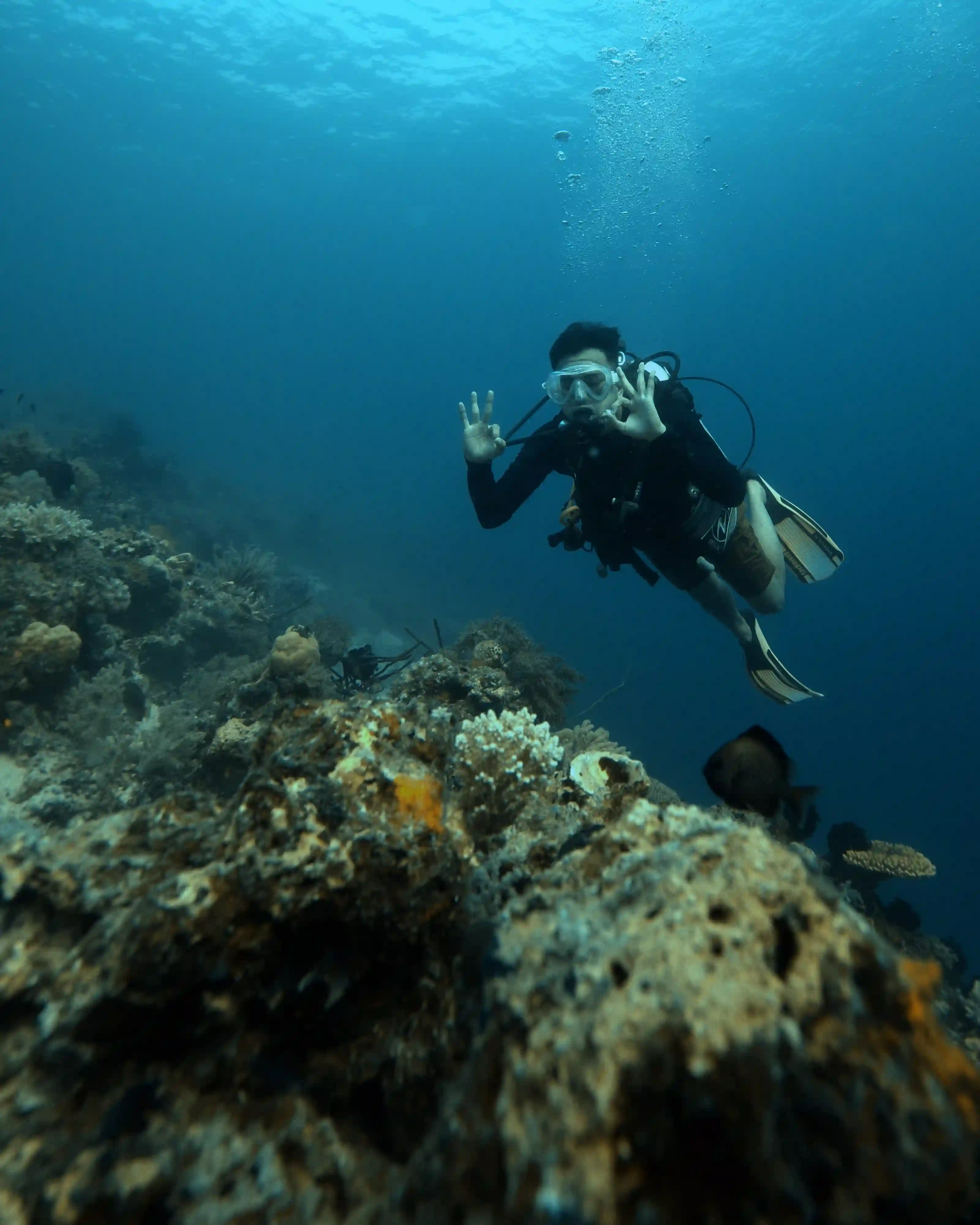
The 5D4N Komodo liveaboard is usually the strongest cost-per-dive-site value: roughly 8–10 named sites across one embarkation cycle, spreading fixed logistics costs over more dives than a 3D2N trip while avoiding the repeat-site fatigue that starts eroding value past 7D6N. Shorter trips cost less upfront but cost more per dive site logged.
Why “Cost Per Night” Is the Wrong Question
Most travelers comparing a komodo liveaboard trip default to a simple sum: total price divided by nights aboard. That math is misleading, because a night at anchor in Komodo National Park isn’t the product you’re buying — the dive sites are. A 3D2N trip and a 4D3N trip both include one full transit day out of Labuan Bajo and one transit day back; the extra night in the 4D3N itinerary is almost entirely additional diving time, not additional overhead. Comparing komodo liveaboard cost per day figures site-by-site, rather than night-by-night, is the only way to see which itinerary actually pays for more park.
That’s the gap this page fills. The price page gives you the fixed rate cards; this page shows you how those rates translate into value once you divide by the number of sites, dive count, and transit-day ratio each duration actually delivers.
Cost-Per-Dive-Site Across Four Standard Durations
The table below models the four most-booked durations against typical dive-site counts drawn from standard North–Central–South loop planning. Treat the index column as a relative comparison, not a quoted price — always confirm exact current rates at /komodo-liveaboard-price/ or via WhatsApp before booking, since fuel surcharges and cabin category shift the absolute number.
| Duration | Nights Aboard | Transit Days | Typical Dive Sites Covered | Avg. Dives/Day | Relative Cost-Per-Dive-Site Index* |
|---|---|---|---|---|---|
| 3D2N | 2 | 2 of 3 | 4–6 | 2–3 | 100 (baseline) |
| 4D3N | 3 | 2 of 4 | 6–8 | 2–3 | ~88 |
| 5D4N | 4 | 2 of 5 | 8–10 | 2–3 | ~78 |
| 7D6N | 6 | 2 of 7 | 12–16 | 2–3 | ~64 |
*Index illustrates how fixed transit-day overhead is amortized as trip length grows — lower number means more sites per dollar spent, not a lower total price. It is not a pricing quote.
What Each Duration Actually Buys You
3D2N — Fastest Entry, Highest Per-Site Cost
A 3D2N open trip covers the North–Central loop only: think Manta Point, Siaba, Sebayur, and a Komodo dragon trek plus Pink Beach. Because two of your three days are partial transit days, you’re paying full trip overhead — port fees, boat positioning, crew logistics — for the smallest dive-site count of the four durations. It’s still the right call for a first Komodo trip on a tight schedule, but it is mathematically the most expensive way to log a single dive site.
4D3N — The Balanced Middle
Add one night and the itinerary usually extends into a few more Central-loop sites, sometimes reaching Castle Rock depending on route and season. The per-site index drops noticeably here because that third night is almost pure diving time — no extra transit day is added.
5D4N — The Value Sweet Spot
This is where the South loop typically opens up: Manta Alley, Cannibal Rock, and other current-driven sites become reachable alongside the North–Central staples. You’re now spanning nearly the full geographic range of the park in one trip, and the cost-per-dive-site index reflects it — the extra day buys real geographic diversity, not just repeat dives on sites you already covered.
7D6N — Best Absolute Coverage, Diminishing Marginal Value
A full 7D6N itinerary can string together 12 or more named sites end to end — the lowest cost-per-dive-site index of the four, and the closest thing to seeing everything Komodo National Park offers in a single trip. The tradeoff is fatigue and repetition: by day 5 or 6, some itineraries start reusing similar reef profiles because the total inventory of world-class sites within a comfortable sailing radius is finite. It’s the best value on paper, but only if you have the vacation days and the diving stamina to use it.
How to Calculate Your Own Cost-Per-Dive-Site Score
- Get the quoted total price for your target duration from /komodo-liveaboard-price/ or a direct WhatsApp quote.
- Ask the operator for the exact planned itinerary — not a marketing list, the actual site-by-site day plan for your dates, since routes shift with season and permits.
- Count unique named dive sites, not total dives — two dives at the same site on the same day count once for this purpose.
- Divide total price by unique site count to get your personal cost-per-dive-site figure.
- Compare that figure against your priorities — a lower number only matters if the extra sites are ones you actually want to dive (South-loop current sites aren’t ideal for brand-new divers, for example).
Want the exact number for your dates? The fastest way to see a real itinerary and quote — not an average — is to talk to the team directly. WhatsApp +62 811 3823 875 or email [email protected], or book the flagship Komodo Liveaboard 3D2N Open Trip directly for live schedules and cabin availability.
Where Diminishing Returns Set In
The index keeps improving through 7D6N on paper, but three real-world factors cap how far “longer is cheaper per site” actually holds:
- Finite site inventory. Komodo National Park has around a dozen widely-dived named sites within comfortable sailing range of a single loop. Past roughly 8–9 nights, itineraries start repeating sites rather than adding new ones — the cost-per-dive-site index stops improving in practice even if the formula still shows a lower number.
- Diver fatigue. Two to three dives a day for six or seven straight days is demanding, even for experienced divers. Guests who book 7D6N purely to chase a lower per-site cost sometimes skip dives by day 5, which quietly erases the value advantage.
- Weather and swell windows. Longer trips carry more exposure to a single rough-weather day disrupting the schedule, which can shrink the realized site count below the planned one — see current conditions and planning guidance at /faq/ before committing to the longest itinerary.
In practice, value peaks around 5D4N to 6D5N for most travelers — enough duration to reach the South loop and add real geographic diversity, without stacking so many transit-adjacent days that the marginal sites stop being worth the marginal fatigue.
Frequently Asked Questions
Which duration gives best value?
For most divers, 5D4N offers the best balance: it reaches both the North–Central and South loops, delivering roughly 8–10 named dive sites while adding only one extra transit-adjacent day over a 4D3N trip. It has a meaningfully lower cost-per-dive-site index than 3D2N without the fatigue and site-repetition risk that starts appearing on 7D6N itineraries.
How many dive sites per day?
Standard Komodo liveaboard itineraries schedule two to three dives per day, typically morning, midday, and an optional afternoon or night dive. Each dive is usually at a distinct named site rather than repeating the same spot, so a 5D4N trip with three diving days can realistically log 8–10 unique sites depending on route and weather.
Is longer always better value?
No. The cost-per-dive-site index keeps falling on paper through 7D6N, but real value plateaus once itineraries start repeating sites — typically past 8–9 nights within a single sailing loop. Beyond that point you’re paying for more nights aboard without a proportional increase in unique diving, so “longer” stops being automatically “better value.”
Diminishing returns after how many nights?
Diminishing returns typically start appearing after night 6 or 7. Up to that point, most itineraries can still string together new named sites across the North, Central, and South loops. Past it, route planners usually have to revisit sites already dived earlier in the trip, since the finite inventory of world-class Komodo dive sites within a comfortable sailing radius has been largely covered.
Best duration for first-timers?
3D2N or 4D3N is the recommended entry point for first-time Komodo divers. Both stay within the North–Central loop, which has calmer conditions and fewer strong-current sites than the South loop reached on 5D4N and longer trips. It’s a shorter commitment to test whether liveaboard diving suits you before booking a longer, more current-heavy itinerary next time.
Ready to see it firsthand? Whichever duration fits your dive count and schedule, the 3D2N Komodo Liveaboard share-cabin open trip is the easiest way to start — bookable directly through Komodo Luxury Open Trip for live schedules and cabin availability. WhatsApp +62 811 3823 875 or email [email protected] for a dive-site-by-dive-site quote on any duration.