
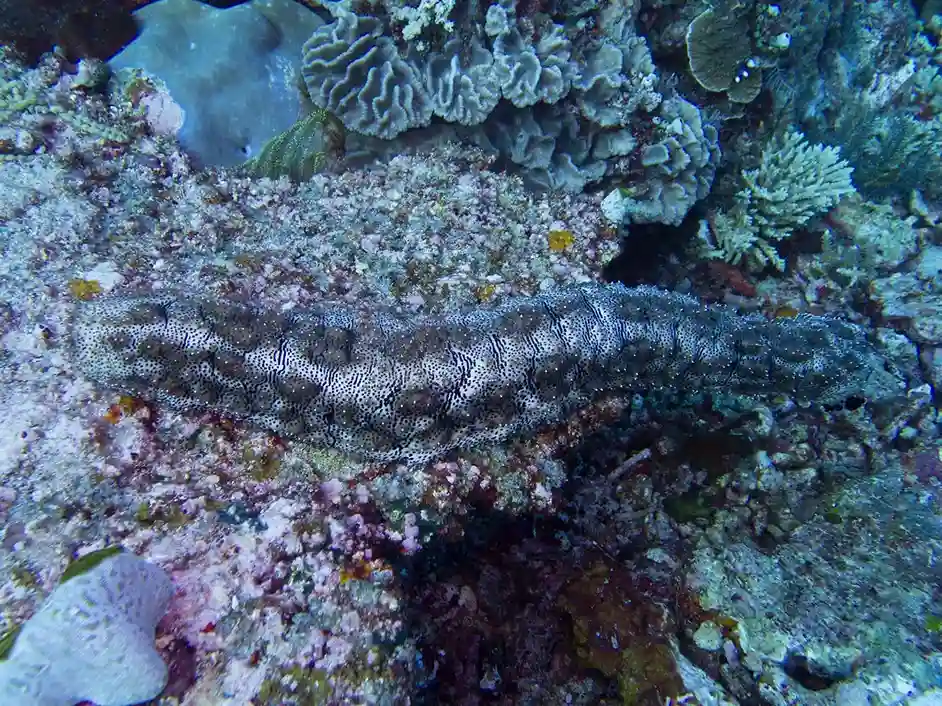
Cannibal Rock at Nusa Kode, in Komodo’s South Loop, is the macro capital of a national park better known for sharks and mantas — a shallow 5–25m plateau where nutrient-rich upwelling fuels dense colonies of nudibranchs, frogfish, sea apples, and crustaceans on nearly every square meter of substrate. Currents are moderate, and October–December is the prime window.
Most first-time visitors book a komodo island liveaboard chasing big-animal encounters — reef sharks at pinnacles, manta cleaning stations, the occasional passing mola mola — and Cannibal Rock rarely makes the highlight reel until they’ve actually descended on it. Then the camera comes out and doesn’t go back in the housing. This guide covers what actually lives there, how hard the dive is, when to go, and how to shoot it properly.
Where Cannibal Rock Sits and Why It’s Different
Cannibal Rock is part of the Nusa Kode cluster in south Komodo, grouped on most liveaboard itineraries alongside Manta Alley and Torpedo Alley. Geographically this is a different Komodo from the north loop’s Gili Lawa pinnacles: cooler, greener, nutrient-rich water pushed up from the Indian Ocean side of the strait, rather than the warm, high-visibility conditions that define sites like Castle Rock. That upwelling is the whole reason the site works. Cold, plankton-loaded water suppresses visibility a little — expect 8–15m rather than the 25–30m you’d get up north — but it feeds an invertebrate density that few other Indonesian sites can match.
The dive profile itself is a gently sloping plateau rather than a wall or pinnacle, which is what makes it a genuine muck-diving site instead of a drift dive with critters as a bonus. Divers hover a meter or two off soft sediment, sponge fields, and current-swept rubble, working slowly across a small area rather than covering distance. If your idea of a good dive is racking up meters, Cannibal Rock will feel strange at first. If your idea of a good dive is finding twelve species of nudibranch on one coral head, this is the site you’ve been asking your dive guide about.
The Critter Checklist: What You’ll Actually See
No dive is guaranteed, and critter sightings shift week to week with conditions — but these are the residents guides at Cannibal Rock report consistently, season after season.
| Critter | Where to Look | Lens Choice | Notes |
|---|---|---|---|
| Nudibranchs (multiple species) | Sponge fields, rubble, coral rubble edges | 100mm macro or equivalent | The site’s signature find — colors and species turnover are dense enough that repeat dives rarely repeat the same list |
| Frogfish | Sponges and encrusted rock, often motionless | 60–100mm macro | Easy to swim past — ask your guide to point, don’t expect to spot them solo on your first pass |
| Sea apples | Current-facing rubble and rock faces | Wide-macro or standard macro | One of Cannibal Rock’s most photographed residents — vivid purple-and-orange sea cucumbers filter-feeding in current |
| Crustaceans (shrimp, crabs, squat lobsters) | Anemones, feather stars, sponge crevices | 100mm macro with snoot if available | Includes commensal shrimp on crinoids and anemones — slow, methodical scanning finds far more than fast fin kicks |
| Reef fish schools | Mid-water above the plateau | Wide-angle or leave it in the housing | Not the main draw here, but useful for a change of composition between macro sequences |
| Occasional reef sharks | Deeper edge of the plateau | Wide-angle | Not a reliable sighting — a bonus if it happens, not something to plan the dive around |
What sets Cannibal Rock apart from a typical macro site elsewhere in Indonesia is density rather than rarity: you don’t need to search for twenty minutes to find one interesting subject. The south’s nutrient-rich water means healthy specimens are stacked close together, which is exactly what makes it forgiving for photographers who are still learning to compose macro shots under time pressure.
Macro Photography at Cannibal Rock
This is one of the few Komodo dive sites where you should plan the whole dive around your camera rather than treating photography as secondary. A few practical notes from guides who run this site regularly:
- Lens choice matters more here than anywhere else in Komodo. A 100mm (or equivalent) macro lens is the standard choice — wide-angle housing setups will leave you frustrated watching subjects you can’t frame properly.
- Buoyancy control is the real skill being tested. Sediment kicked up by a careless fin stroke ruins the shot for everyone behind you and can take minutes to settle in low current.
- Use your guide as a spotter, not a photo subject. Experienced Cannibal Rock guides know where the resident frogfish and sea apples have been sitting for days — ask before the dive, not during.
- Bring a focus light or small torch. Visibility here is naturally lower than the north loop, and a focus light dramatically speeds up autofocus lock on small, low-contrast subjects like nudibranchs.
- Shoot slower than you think you should. A 45-minute muck dive here rewards patience — five minutes on one subject, trying different angles, generally beats fifteen quick snapshots.
Difficulty, Currents & Who Should Dive It
Cannibal Rock has a reputation problem — divers hear “south Komodo” and assume Castle Rock-level current, then are pleasantly surprised. Currents at Cannibal Rock can build, but they’re generally more manageable than the outer pinnacles like Castle Rock or Crystal Rock. The site suits Advanced Open Water divers comfortably and experienced Open Water divers when conditions are cooperative — your dive guide will make the final call on the day based on tide and visibility.
Where it does demand a real skill is buoyancy and body position, not current-fighting. You’ll spend most of the dive hovering close to the substrate without touching it, which is a different discipline from drift diving a pinnacle. Divers coming straight from wall dives sometimes struggle here more than genuine beginners, simply because the instinct to kick and cover ground works against you.
A thicker wetsuit is worth packing. South Komodo’s cooler, nutrient-rich water runs noticeably colder than the north loop, and long, slow macro dives mean more time exposed to thermoclines — a 5mm suit or a hooded vest layered over a 3mm is a common choice for the South Loop.
A Typical Cannibal Rock Dive, Step by Step
- Briefing on the sundeck. Your guide covers current direction, entry point, and the critter list spotted on the most recent dive — this is when to flag specific species you’re hoping to photograph.
- Negative or standard entry. Depending on current at the time, you’ll either drop straight to the plateau or descend along the mooring line.
- Slow traverse across the plateau, 5–15m. The guide leads at a deliberately slow pace, stopping at known critter locations rather than covering distance.
- Deeper detour, up to 20–25m, if conditions allow. Some groups drop slightly deeper mid-dive to check known frogfish and nudibranch spots before working back shallow.
- Safety stop and ascent. A standard 3–5 minute safety stop in the shallows, often over a final patch of sea apples worth one last frame.
- Surface debrief. Guides typically compare critter sightings across the group back on the boat — a good moment to log species you’re unsure of for later identification.
Want Cannibal Rock on your itinerary? Our team can build a private charter around the South Loop’s macro and current diving, or you can join the 3D2N Komodo Liveaboard share-cabin open trip — both are bookable directly through Komodo Luxury Open Trip — live schedules and cabin availability. WhatsApp +62 811 3823 875 or email [email protected].
Best Season, Trip Length & How This Fits Your Itinerary
Like the rest of the South Loop, Cannibal Rock is at its best October–December, when the nutrient-rich upwelling that feeds its critter population is most active and conditions in the south are generally more settled for liveaboards to reach Nusa Kode comfortably. It’s diveable outside that window too — muck sites are less weather-dependent than exposed pinnacles — but guides consistently point to the final quarter of the year as prime time, alongside the same window that brings Manta Alley‘s mantas into the south.
Because Cannibal Rock sits in the South Loop rather than the more commonly visited north loop near Labuan Bajo, it’s more often included on longer itineraries. A quick 3D2N open trip typically stays closer to the north and central sites; if Cannibal Rock, Manta Alley, and Torpedo Alley are must-dives for you, look at a 7D6N itinerary or a private charter built around the South Loop specifically, and check current per-trip inclusions on our Komodo liveaboard price breakdown before booking.
Frequently Asked Questions
What critters live at Cannibal Rock?
Cannibal Rock is best known for dense macro life: multiple nudibranch species, resident frogfish, sea apples (vivid purple-and-orange filter-feeding sea cucumbers), and crustaceans including commensal shrimp on anemones and feather stars. Reef fish schools pass over the plateau and reef sharks are an occasional bonus, but the site’s reputation is built on invertebrate density rather than big animals.
Is it good for macro photography?
Yes — it’s one of the best macro sites in Komodo National Park. The shallow, current-fed plateau concentrates enough nudibranchs, frogfish, and sea apples that photographers rarely need to search far between subjects. Bring a macro lens (100mm or equivalent), a focus light for the lower-visibility water, and plan for a slow, deliberate dive rather than covering distance.
Difficulty level?
Moderate. Currents can build but are generally more manageable than outer pinnacles like Castle Rock, so the site suits Advanced Open Water divers comfortably and experienced Open Water divers when conditions allow — your guide confirms this on the day. The real skill tested is buoyancy control and body position for slow, close-to-substrate muck diving, not current-fighting.
Best season to dive it?
October–December is consistently cited as prime time, matching the wider South Komodo season alongside Manta Alley and Torpedo Alley, when nutrient-rich upwelling is most active. It’s diveable outside that window since muck sites are less weather-dependent than exposed pinnacles, but always confirm current conditions with your operator at booking.
How long is a typical dive?
Most Cannibal Rock dives run 45–60 minutes, following the standard depth range of roughly 5–25m across the plateau. Because it’s a slow, macro-focused dive rather than a drift, air consumption tends to be lower than at current-heavy pinnacle sites, which often lets photographers extend bottom time within normal no-decompression limits.
Ready to shoot Cannibal Rock’s critters yourself? The 3D2N Komodo Liveaboard share-cabin open trip is bookable directly through Komodo Luxury Open Trip — live schedules and cabin availability. Prefer a private charter built around a South Loop macro itinerary? WhatsApp +62 811 3823 875 or email [email protected], or check our full FAQ for more trip-planning details.