
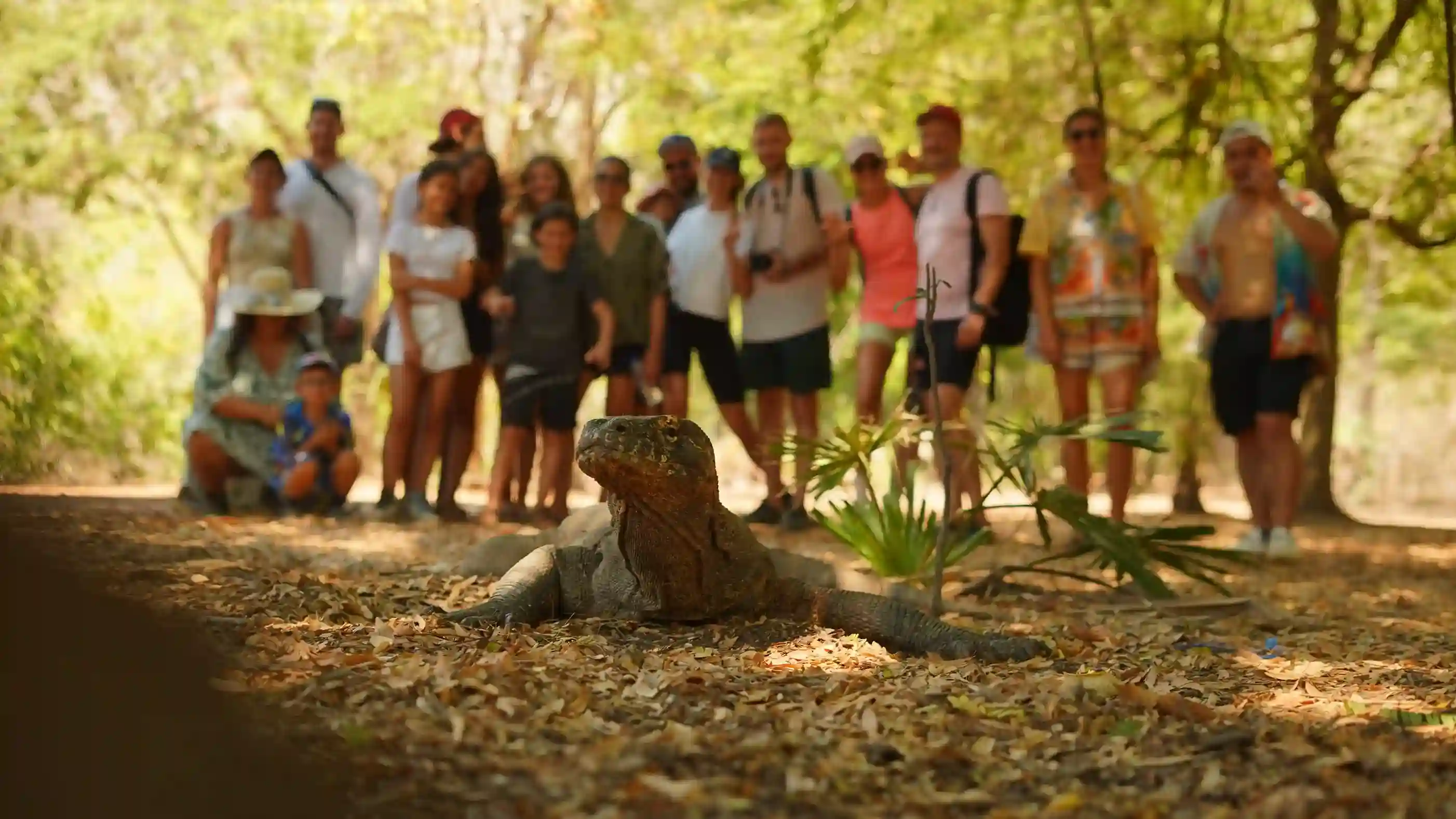
Quick Answer: Komodo dragons are the world’s largest lizards, reaching 3 meters and weighing 100+ kilograms, inhabiting only Indonesia’s Lesser Sunda Islands. These apex predators hunt large prey through ambush predation, possess venomous saliva and bacteria-laden bites, reproduce through parthenogenesis in isolated populations, and are classified as Endangered with approximately 4,000 remaining wild individuals. Viewing them requires visiting Komodo National Park through guided tours ensuring visitor and dragon safety.
Komodo Dragon Facts: Complete Guide to the World’s Largest Lizard
Few creatures capture human imagination and inspire primal awe like Komodo dragons. These prehistoric-seeming reptiles, existing virtually unchanged for millions of years, represent one of the planet’s most remarkable living fossils. Weighing over 100 kilograms, stretching nearly 3 meters in length, and possessing hunting prowess that earned them “dragon” comparisons among terrified medieval sailors, Komodo dragons embody power, evolution, and nature’s capacity for spectacular adaptation. Understanding these magnificent creatures—their biology, behavior, habitat, and conservation status—provides context for their significance in global biodiversity and justifies the extraordinary efforts required to preserve them.
Physical Characteristics and Size
Impressive Dimensions
Komodo dragons hold the distinction of being the world’s largest living lizards. Adult males typically measure 2.5 to 3 meters in length, though exceptionally large specimens reach 3.5 meters. Females remain considerably smaller, averaging 2 to 2.5 meters. Weight distributions vary dramatically based on recent feeding success, but mature males weigh 80 to 150+ kilograms, with some exceptionally large individuals exceeding 200 kilograms.
To contextualize these dimensions: a 3-meter Komodo dragon matches the length of an average car from bumper to bumper. A 150-kilogram dragon weighs as much as three average adult humans combined. This sheer mass places Komodo dragons in an exclusive category of apex predators, rivaled only by the largest Saltwater crocodiles and great white sharks among reptiles.
Sexual dimorphism (size differences between males and females) reflects typical reptilian patterns where males attain significantly larger sizes. This size advantage enables dominance in inter-male competitions for territory and mating access. Females, smaller and more energy-efficient, dedicate resources to reproductive investment rather than competitive bulk.
Distinctive Physical Features
Beyond raw size, Komodo dragons possess distinctive morphological features shaped by millions of years of specialized predatory evolution. Their bodies feature muscular builds with robust limbs, powerful claws, and long, whip-like tails comprising nearly half their body length. Tails function both for balance during terrestrial movement and as weapons in inter-dragon combat, capable of inflicting serious injuries.
Komodo dragon heads appear oversized relative to body proportions, dominated by powerful jaw muscles capable of exerting devastating bite force. Their eyes, though positioned on skull sides, provide reasonable forward vision enabling predatory focus despite limited binocular overlap. Nictitating membranes (transparent eyelids) protect eyes in harsh terrestrial conditions.
Skin appears rough and heavily scaled, colored in shades of black, gray, or brownish-tan depending on age and individual variation. These colors provide excellent camouflage in Komodo’s rocky, vegetated terrain. Older dragons often display yellowish coloration resulting from mineral deposition in shed skin, creating distinctive aged appearance. The rough texture aids surface contact during climbing and digging activities.
Evolutionary Biology and Paleontological History
Ancient Origins
Komodo dragons represent a living connection to Earth’s prehistoric reptilian past. Fossil evidence indicates that ancient monitor lizards—the family (Varanidae) to which Komodo dragons belong—originated in Australia approximately 40 million years ago during the Eocene epoch. Through continental drift and island dispersal, these monitor lizards spread throughout Southeast Asia and the Indonesian archipelago.
Komodo dragons specifically diverged from their monitor lizard relatives approximately 4 million years ago, becoming isolated on the Lesser Sunda Islands through geographic separation. This isolation enabled extraordinary evolutionary specialization—selection pressures favored increasingly large size, enhanced predatory capabilities, and specialized hunting strategies. Isolated populations experience genetic bottlenecking that intensifies selective pressures and accelerates evolutionary change.
Interestingly, Komodo dragons share evolutionary lineage with Australian Saltwater crocodiles—both descend from ancient Asian monitor lizards before their divergent speciation. This connection explains behavioral similarities between these apex predators despite vastly different evolutionary trajectories.
Giant Island Syndrome
Komodo dragons exemplify “island gigantism”—a well-documented phenomenon where isolated island populations evolve larger body sizes than related mainland populations. This paradoxical pattern occurs through multiple mechanisms: absence of large competitors and predators on islands enables large herbivores to flourish, providing abundant prey for predators; isolation limits genetic admixture with smaller mainland populations; and reduced predation pressure on juveniles enables survival of larger offspring.
The Lesser Sunda Islands, including Komodo, hosted unique fauna including giant Komodo rats, large water buffalo, and smaller elephant species—all larger than mainland counterparts. This abundance of megafauna prey enabled Komodo dragons to evolve extraordinary size. When prey availability decreased through human hunting and habitat change, Komodo dragon populations declined proportionally.
Dietary Specialization and Hunting Behavior
Apex Predator Diet
Komodo dragons function as apex predators occupying the top of their ecosystem’s food chain. Adult dragons consume an impressively diverse diet reflecting their size and predatory prowess:
- Large ungulates: wild boar (Sus scrofa), water buffalo (Bubalus arnee)
- Cervids: sambar deer (Rusa unicolor), small Timor deer
- Other reptiles: smaller Komodo dragons (cannibalism), monitors, skinks
- Carrion: decomposing mammalian carcasses, particularly valuable during dry seasons
- Occasional avian prey: large ground-nesting birds
Juvenile dragons occupy lower trophic positions, feeding on smaller prey—insects, small lizards, small mammals—until growth enables access to larger prey. This ontogenetic niche shift (changing food preferences as organisms grow) reduces juvenile-adult competition and enables population coexistence at different life stages.
The largest prey items—adult water buffalo weighing 500+ kilograms—represent remarkable predatory achievements. A 150-kilogram dragon successfully hunting a 600-kilogram buffalo demonstrates the exceptional hunting prowess Komodo dragons evolved.
Ambush Predation Strategy
Komodo dragons hunt through ambush predation—a specialized strategy involving extended periods of patient concealment followed by explosive predatory strikes. Dragons position themselves along animal trails, partially hidden within vegetation or rocky terrain, remaining motionless for hours until prey approaches within striking distance.
When prey approaches sufficiently close, dragons accelerate explosively, covering 4-5 meters in seconds through powerful hindlimb propulsion. The bite itself—targeting legs to disrupt mobility or throat to restrict breathing—initiates the predatory sequence. Unlike constrictors, Komodo dragons don’t subdue prey through prolonged restraint; instead, the initial bite triggers prey incapacitation through venomous effects or traumatic shock, enabling the dragon to consume the now-manageable prey.
Ambush predation requires extensive habitat—dragons need multiple resting locations with strategic positioning relative to prey trails. This explains their relatively low population densities and expansive home ranges (several square kilometers per dragon). Liveaboard trips and island visits encounter these dragons through skilled guides who understand their behavioral patterns and preferred resting locations.
Venomous Saliva and Bite Mechanics
Komodo dragons possess venomous saliva produced by modified salivary glands—a discovery relatively recent in scientific understanding (confirmed in 2009). This venom, while less potent than snake venom, contains compounds that induce hemorrhagic effects, shock, and paralysis in prey animals. The venom essentially incapacitates large prey, preventing escape and enabling the predator to consume the victim.
The bite itself delivers extraordinary force through powerful jaw muscles and specialized tooth structure. Komodo teeth, serrated and curved slightly backward, maximize tissue damage and penetration. The combination of mechanical trauma (bite force exceeding 1,000 pounds per square inch) and chemical assault (venom toxins) creates a highly effective hunting tool.
Interestingly, the bacteria-laden saliva—containing numerous pathogenic bacteria from constant contact with decomposing carcasses—also contributes to prey incapacitation through sepsis. Whether dragons intentionally employ bacterial sepsis or this results as accidental byproduct remains debated among researchers.
Reproductive Biology and Population Dynamics
Sexual Reproduction and Mating
Komodo dragons exhibit seasonal breeding tied to environmental cycles. Mating occurs during the dry season (approximately May to August), with females entering reproductive receptivity during this period. Males compete aggressively for mating access, engaging in dramatic combat displays involving ritualized wrestling matches. These combats, while rarely resulting in lethal injury, establish dominance hierarchies that determine mating access.
Females demonstrate preference for larger males—evolutionary selection favors giant males capable of defeating competitors and presumably transmitting “large size” genes to offspring. This preference explains sexual size dimorphism; females preferentially mate with the largest males, concentrating large-size genetic traits in subsequent generations.
Copulation occurs after extended courtship displays and female receptivity signaling. Unlike mammals, female dragons don’t lactate—they invest reproductive energy into developing eggs rather than milk production. This egg-laying (oviparity) strategy parallels most reptiles.
Egg-Laying and Incubation
Female Komodo dragons lay clutches of 4 to 30 eggs (average approximately 15-20) in protected locations—typically ground nests, burrows, or abandoned mammalian dens. Females don’t guard eggs (unlike some crocodilians); eggs develop unattended through environmental heat. Incubation periods range from 8 to 10 months, with temperature-dependent development. Warmer nest sites produce shorter incubation periods; cooler sites extend development timelines.
Newly hatched dragons measure approximately 40 centimeters in length—diminutive relative to adults. Hatchlings immediately face predation pressure from larger animals, cannibalistic adults, and environmental hazards. Mortality rates are extremely high; perhaps only 10-20% of hatchlings survive to maturity through predation, starvation, or disease.
Asexual Reproduction in Isolated Populations
A remarkable and scientifically significant discovery involves parthenogenesis (asexual reproduction) in isolated Komodo dragon populations. In zoos and isolated populations separated from males, female dragons have produced viable offspring through unfertilized egg development. This capacity for asexual reproduction represents an evolutionary adaptation enabling population persistence even when sexual reproduction becomes impossible.
Parthenogenetically produced offspring are clones of their mothers, producing daughters exclusively. This represents an evolutionary strategy of last resort—when mate availability disappears, asexual reproduction enables genetic continuity. However, asexual reproduction reduces genetic diversity, potentially decreasing long-term population viability.
Growth Rates and Lifespan
Komodo dragons exhibit indeterminate growth—they never stop growing throughout their lives. However, growth rates decline dramatically with age. Juveniles grow rapidly, reaching 1-2 meters within their first 3-4 years of life. Growth continues more slowly through adulthood, with mature dragons gaining perhaps 10-20 centimeters per decade.
Wild Komodo dragons live approximately 30-40 years based on observational records and comparative analysis with related species. Captive dragons sometimes exceed these lifespans, reaching 50+ years in zoo conditions with consistent food availability and medical care. Natural lifespan appears constrained by injury accumulation, disease, and competitive mortality rather than intrinsic physiological limits.
Habitat and Geographic Distribution
Endemic Island Distribution
Komodo dragons exist nowhere on Earth except the Lesser Sunda Islands of Indonesia. This extraordinarily restricted range encompasses primarily four islands: Komodo, Rinca, Flores (southwestern region), and Gili Motang. Population estimates suggest approximately 3,000-4,000 individuals remain in the wild, concentrated on Komodo and Rinca islands within Komodo National Park.
This extremely limited distribution makes Komodo dragons extraordinarily vulnerable to catastrophic population collapse. A single significant environmental perturbation—disease outbreak, extreme weather event, or habitat destruction—could threaten the entire global population. This vulnerability justifies intensive conservation efforts and explains why Komodo dragons remain flagship species for Indonesian conservation initiatives.
Habitat Preferences and Range Requirements
Komodo dragons inhabit diverse terrain across their island ranges: savanna grasslands, dry deciduous forests, coastal areas, and rocky highlands. They demonstrate remarkable habitat flexibility, adapting to varied environmental conditions. However, they universally require abundant prey—habitat suitability depends directly on ungulate populations (wild boar and water buffalo) that constitute primary prey.
Home range sizes vary based on prey availability and individual body size. Larger dragons require larger ranges; well-fed dragons in prey-abundant areas maintain smaller ranges than underfed dragons in prey-scarce regions. Typical home ranges span 3-10+ square kilometers per individual, requiring substantial protected habitat to support viable populations.
Coastal areas hold particular importance for Komodo dragons. Dragons frequently visit beaches for swimming, carrion scavenging, and thermoregulation. Marine influences including sea turtle eggs provide seasonal food supplements. The integration of marine and terrestrial habitats makes island ecosystems essential for long-term dragon survival.
Conservation Status and Threats
Endangered Classification
Komodo dragons are officially classified as Endangered by the International Union for the Conservation of Nature (IUCN). This classification reflects genuine extinction risk—wild populations are small, geographically restricted, and vulnerable to multiple anthropogenic and natural threats. Without active conservation intervention, Komodo dragons face realistic probability of extinction within 100-200 years.
The Endangered status drives intensive conservation efforts across Indonesian government agencies, international conservation organizations, and research institutions. Liveaboard tourism partially funds conservation through park entrance fees and operator contributions.
Primary Threats to Survival
Multiple interconnected threats challenge Komodo dragon conservation:
Prey depletion represents the most critical threat. Illegal hunting of wild boar and water buffalo—Komodo dragons’ primary food sources—has reduced prey populations by 50-80% over recent decades. Without adequate prey, dragons starve; population declines directly correlate with ungulate population declines. Managing prey populations through hunting regulations requires effective enforcement in remote island regions with limited governmental presence.
Habitat degradation follows from human settlement expansion, agricultural development, and invasive species introduction. Invasive plants alter vegetation communities, favoring dense scrubland unsuitable for dragon movement and prey habitat. Feral goats and pigs compete with native ungulates and alter vegetation structure.
Climate change poses emerging threats including increased drought frequency, altered precipitation patterns, and temperature extremes. Extended droughts stress prey populations and dragon metabolism. Increased sea level variability could inundate critical nesting areas on low-lying islands.
Genetic bottlenecking from small population size limits evolutionary adaptability and increases disease vulnerability. Limited genetic diversity predisposes populations to inbreeding depression—reduced fitness from limited genetic material.
Conservation Efforts and Successes
Indonesia designated Komodo National Park in 1980, creating legal protection for critical dragon habitat. Park designation enabled hunting regulations protecting prey species and habitat preservation. The park has expanded since establishment, now encompassing nearly 2,000 square kilometers of protected terrestrial and marine habitat.
Active population management includes monitoring, research, and intervention when necessary. Radio-tagging enables tracking of individual dragons, providing behavioral and movement data informing conservation strategies. Captive breeding programs in zoos maintain genetic diversity and provide insurance populations against wild extinction.
International cooperation—particularly between Indonesian government agencies and global conservation organizations—enhances conservation effectiveness. Funding from ecotourism, including liveaboard operations, directly supports conservation infrastructure and staff compensation.
Danger to Humans and Viewing Safety
Attacks on Humans: Actual Risk Assessment
Despite their fearsome appearance and apex predator status, Komodo dragons rarely attack humans. Comprehensive records from Komodo National Park document fewer than 10 confirmed fatal attacks over the past 50+ years—approximately one fatality per decade. This represents a genuinely low risk for park visitors following safety protocols.
Attacks occur primarily when humans fail to maintain required distances or ignore guide instructions. Visiting guidelines mandate maintaining at least 7 meters from dragons at all times—this distance provides sufficient time for guides to intervene if unexpected dragon approach occurs. Following these guidelines essentially eliminates attack risk.
Dragons perceive humans as too large to be prey—adult humans exceed typical prey size preferences. Dragons attacking humans typically misidentify humans as smaller prey or act defensively when surprised. Children and smaller adults theoretically face greater risk; parents should exercise extra caution and ensure closer guide proximity.
Viewing Recommendations and Safety Protocols
Safe dragon viewing requires following established guidelines strictly:
- Maintain minimum 7-meter distance from all dragons
- Never approach dragons attempting to move away or showing agitation
- Follow guide instructions without deviation
- Avoid sudden movements or loud noises that might startle dragons
- Never position yourself between a dragon and escape routes
- Walk in groups; never approach dragons individually
- Hire licensed guides through authorized operators—their expertise ensures safe viewing
Licensed guides, trained extensively in dragon behavior and safety, understand dragon communication signals and recognizing dangerous situations. Guides position visitors optimally for viewing while maintaining safety. They interpret dragon body language—ears pinned back or jaws gaping indicate agitation requiring immediate increase in distance.
Are Komodo dragons really dangerous, or is this exaggerated?
Komodo dragons are genuinely dangerous apex predators capable of inflicting fatal injuries. However, actual danger to properly supervised visitors is minimal—documented attacks affecting tour groups are extremely rare. The danger is real but managed effectively through professional guide supervision and safety protocols. Respecting dragons’ space and following guidelines reduces danger to negligible levels while enabling extraordinary wildlife viewing experiences.
Can Komodo dragons swim, and are they found in water?
Yes, Komodo dragons are capable swimmers despite their terrestrial specialization. They regularly visit beaches, swim between islands, and hunt in shallow water environments. Genetic analysis suggests occasional inter-island swimming maintains some genetic connection between isolated populations. However, dragons prefer terrestrial hunting; marine environments represent secondary habitat rather than primary ecosystem.
How many Komodo dragons remain in the wild?
Current estimates suggest 3,000-4,000 wild Komodo dragons remain globally, with approximately 1,700 on Komodo Island and 1,300 on Rinca Island. Smaller populations inhabit Flores and Gili Motang islands. These numbers represent significant declines from historical populations—estimates suggest 5,000+ dragons existed in the early 20th century before habitat loss and prey depletion.
What’s the difference between Komodo dragons and Saltwater crocodiles regarding size?
Saltwater crocodiles are longer and heavier than Komodo dragons on average. Saltwater crocodiles reach 4-5 meters and weigh 400+ kilograms, exceeding typical Komodo dragons (3 meters, 100-150 kg). However, exceptional Komodo dragons approach saltwater crocodile dimensions. Historically, both species coexisted on some Indonesian islands, but habitat changes eliminated this overlap.
How do Komodo dragons differ from other monitor lizards?
Komodo dragons represent the largest and most specialized monitor lizards. Other monitors (Indonesian monitors, Asian water monitors) measure 1-2 meters and inhabit more diverse ecological niches. Komodo dragons evolved extreme size specialization for apex predation on large prey, while other monitors remain generalist hunters consuming smaller prey. This specialization enables Komodo dominance in their ecosystem but creates vulnerability when specialized prey populations decline.
Why are Komodo dragons found only in Indonesia?
Komodo dragons represent an ancient evolutionary lineage isolated on the Lesser Sunda Islands for millions of years. This geographic isolation enabled specialized evolution toward extraordinary size and predatory prowess. Unlike more generalist species capable of surviving varied conditions, Komodo dragons adapted specifically to island ecology. Their restricted range reflects evolutionary specialization and geographic isolation rather than lack of capacity for broader distribution.
Do zoos breed Komodo dragons successfully?
Yes, international zoo programs breed Komodo dragons successfully. Zoos maintain genetically managed populations through coordinated breeding programs (Species Survival Plans). This captive population serves dual purposes: insurance against wild extinction and public education increasing appreciation for these remarkable creatures. However, zoo populations cannot indefinitely replace wild populations—long-term survival depends on wild ecosystem conservation.
Conclusion: The Living Prehistoric
Komodo dragons represent more than impressive predators—they embody evolutionary history, biological adaptation, and the extraordinary diversity life achieves when given sufficient time and environmental opportunity. Their existence challenges our understanding of size limits for reptiles, demonstrates predatory specialization possibilities, and showcases nature’s capacity for producing awe-inspiring creatures.
Yet their future remains uncertain. Population decline from prey depletion and habitat loss demands continued conservation investment. Each Komodo dragon viewing experience—whether through liveaboard expeditions to Komodo Island or Rinca Island—contributes directly to dragon conservation through tourism revenues funding protection efforts.
By visiting Komodo dragons through authorized channels within Komodo National Park, travelers participate in their conservation while experiencing one of Earth’s greatest wildlife encounters. Witnessing these prehistoric-seeming creatures in their natural habitat reminds us of nature’s grandeur and justifies the urgent commitment to their long-term survival. Plan your Komodo dragon encounter today, and become part of the global effort ensuring these magnificent dragons inspire future generations as profoundly as they inspire us today.