
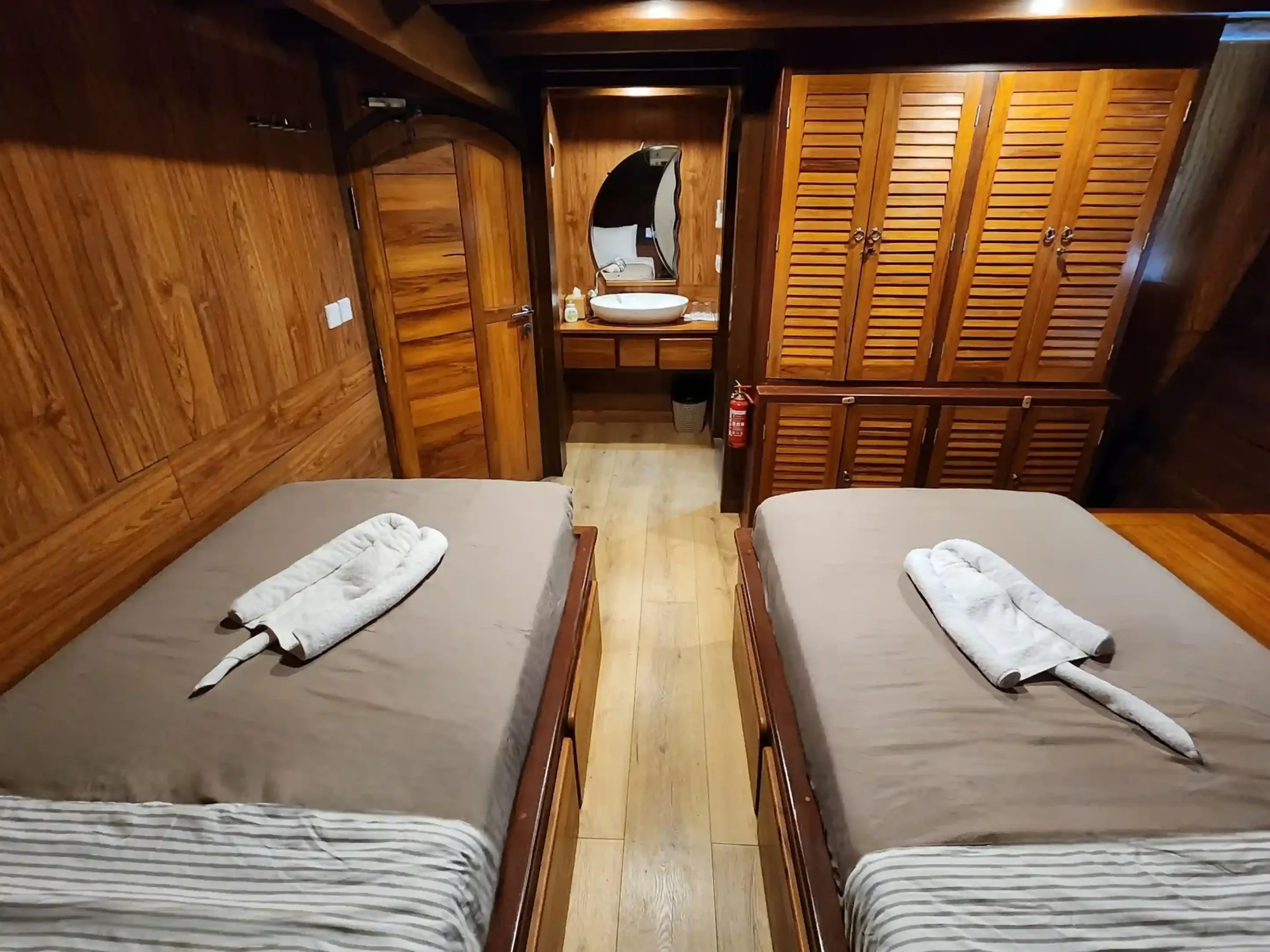
Yes — you can join a Komodo liveaboard on your own, and most boats are built for it. Cabins are usually sold by the berth rather than by the room, so a solo traveller books one bed in a twin or triple share, or pays a single supplement to keep the cabin private. Guides pair solo divers with a buddy, and reputable boats run lockable cabins, mixed-gender crew and a clear briefing culture that makes travelling alone straightforward.
Last updated: August 16, 2026
Can you actually join a Komodo liveaboard alone?
Solo guests are one of the largest groups on Komodo boats, alongside couples and small friend groups. Open-trip (shared departure) boats exist precisely because most people arriving in Labuan Bajo are not a full charter group of twelve. A typical open trip mixes solo divers, one or two couples and a pair of friends — sociable, without becoming a group tour where you are the odd one out.
What changes when you travel alone is not access, it is the booking mechanics. You are buying a berth in a shared cabin, so the operator either matches you with another guest of the same gender or charges you to hold the empty bed. Our 3D2N open trip page explains the shared-departure format, and the packages overview shows which itineraries commonly run as open trips.
How do shared cabins and single supplements work?
There are three normal arrangements, and a good operator will tell you which one applies before you pay anything:
- Same-gender share. One bed in a twin or triple cabin, with the operator filling the other bed with a same-gender solo guest. Standard rate, cheapest option.
- Single supplement. An additional percentage of the berth rate to keep the cabin to yourself — typically a moderate uplift rather than a full double charge, and often waived on quiet-season departures.
- Guaranteed share. Some operators promise no supplement even if no roommate materialises. Ask for this in writing; it is the most valuable thing a solo traveller can confirm.
Supplement policies vary by boat and by season, so treat any figure quoted elsewhere as indicative only. Our Komodo liveaboard price guide sets out how rates are structured across boat categories. If keeping costs down matters more than cabin privacy, the budget liveaboard options almost always run share-based cabins with the lowest supplements.
Is a Komodo liveaboard safe for solo female travellers?
Komodo has a strong track record with solo female guests, and the practical safeguards are worth checking boat by boat rather than assuming. The questions that actually matter:
Does the cabin lock from the inside, and is there a lockable valuables box? Newer phinisi and steel-hulled boats have proper cabin locks and in-cabin or purser-held safes. Older wooden boats sometimes have neither, which is a fair reason to choose one vessel over another.
Are there women on the crew? Indonesian liveaboard crews have historically been male-dominated, but better operators now carry female hospitality staff, dive guides or a cruise director. Having at least one woman on the team gives you someone obvious to raise anything with.
How are cabins allocated? Same-gender matching should be the default, not something you have to request. Vagueness on this point tells you how the rest of the trip is run.
What is the crew’s safety and conduct standard? Look for documented briefings, a named safety officer, and crew on contract rather than hired casually per trip. Our crew and safety standards page covers what a properly run boat looks like. No sea operation is risk-free, but a boat with real procedures behaves very differently from one without.
On the wider picture: the M7.7 earthquake of 15 August 2026 struck roughly 200 km northeast of Labuan Bajo, sailing was reopened the same day under Maklumat 05/MP-VIII/2026, and Komodo National Park was not closed — so far. Solo travellers should do what everyone else does: keep the operator’s WhatsApp on your phone and leave your itinerary with someone at home.
What are the social dynamics like on board?
A liveaboard is a small, fixed community for three to eight days, and that intensity works in a solo traveller’s favour. Meals are served family-style at a shared table, surface intervals are spent on the same sun deck, and everyone dives the same sites in the same order — you do not have to manufacture conversation, it arrives with the schedule.
Group size shapes the experience more than boat luxury does. Eight to twelve guests is the sweet spot: large enough to find people you click with, small enough that nobody gets lost. Boats carrying eighteen or more split into cliques faster. If you want quiet, the sun deck at dawn is reliably empty.
Solo travellers who are not diving integrate fine — snorkellers and land-only guests share every meal, island trek and sunset, separating only for the dives themselves. The non-divers guide sets out how those parallel schedules run.
How does buddy pairing work for solo divers?
You will not be left to find your own buddy. The dive guide assigns pairs at the first briefing, usually after a check dive at a benign site such as Siaba Besar, then adjusts across the trip based on air consumption, buoyancy and comfort in current. Guide-to-guest ratios of roughly 1:4 are common on well-run boats, and a solo guest is often placed directly with a guide — effectively a private-guide experience at share rates.
Komodo’s currents make pairing a safety function, not a formality. Negative entries, drift exits and up-currents at sites like Batu Bolong and Castle Rock reward a buddy who matches your pace. Be honest about your logged dive count and last dive date at the briefing — guides pair conservatively on accurate information and badly without it. If you are new to drift diving, our beginners guide covers what the first few dives will ask of you.
How do you check an operator is legitimate when nobody is booking with you?
Travelling with friends, someone else usually notices if the paperwork looks thin. Alone, that check is yours, and it takes about ten minutes over WhatsApp. Ask for the company’s registered legal entity, not just its brand name. Ask whether the vessel carries passenger insurance and who underwrites it. Ask which agency certified the dive guides. An operator that answers all three in plain language is telling you how the rest of the boat is run.
Komodo Luxury is a registered Indonesian PT — PT Komodo Bahari Nusantara, licensed under KBLI 79120 and operating under Juara Holding Group Limited — and that is the level of detail any operator should be willing to put in writing before you transfer a deposit. Its liveaboard fleet lists cabin configurations and guide ratios per vessel, with open trip departures the usual entry point for solo bookings and private charter the option if a group later forms around you.
Frequently asked questions
Will I be charged double if no roommate is found?
Not on boats with a guaranteed-share policy — they absorb the empty berth. Others apply the supplement automatically. Confirm which applies in writing before paying a deposit, and ask how late the cut-off is: a matching guest can appear weeks after you book.
Are Komodo liveaboards mixed-gender in shared cabins?
Standard practice is same-gender allocation. Mixed-gender sharing only happens when guests request it, such as friends travelling together. If an operator will not confirm same-gender matching, book elsewhere.
Do I need a certain certification level to dive Komodo solo?
Advanced Open Water with recent drift experience is the practical baseline for the northern sites; Open Water divers enjoy the calmer central and southern sites. Certification governs site access, not whether you travel alone.
Is a solo traveller better off on a short or long itinerary?
Three or four nights suits a first solo trip — enough time to bond with the group without committing a full week to people you have not met. Six nights and above reach the southern and far-northern sites and attract more experienced divers, which many solo travellers prefer on a repeat visit.
Can I book a whole cabin without paying for a charter?
Yes — the single supplement is exactly that: a private cabin on a shared boat, for far less than chartering a vessel, while keeping the social side of an open trip. See the booking guide for how cabin holds and payment stages work.