
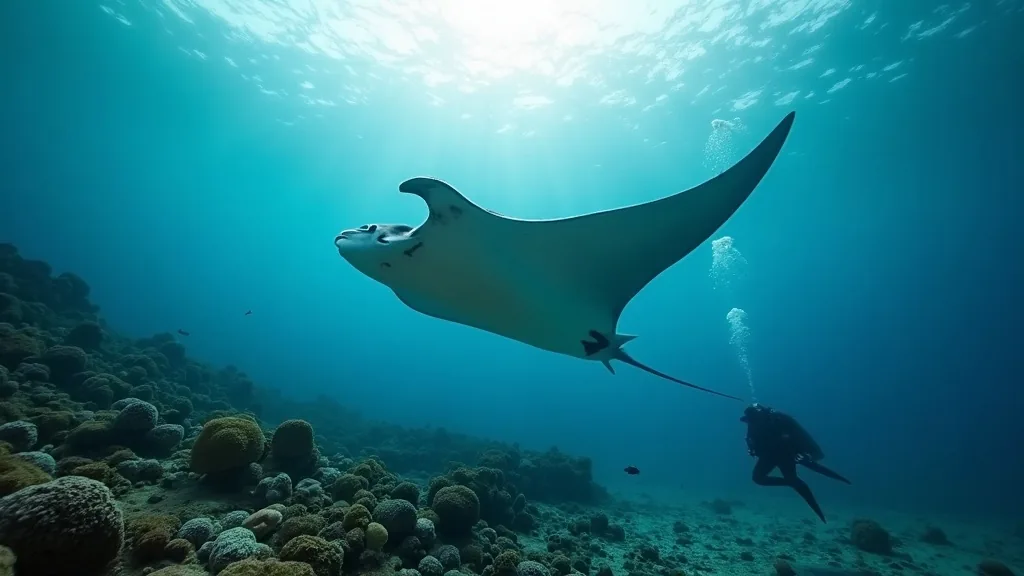
Reef mantas (Mobula alfredi) live in Komodo National Park all year, so there is no month without them. Encounter density peaks twice: December to February, when monsoon plankton blooms pull large aggregations onto Karang Makassar in the central park, and July to September, when cold upwelling feeds the southern sites around Manta Alley.
Last updated: August 16, 2026
When is manta season in Komodo National Park?
Komodo does not have a manta season the way some destinations have a migration window. The park sits on the Indonesian Throughflow, the current draining Pacific water into the Indian Ocean, and that flow keeps plankton in the system year-round. What changes is where the food concentrates, and the mantas follow it.
December to February is the wet season. Rain and northwest winds trigger plankton blooms through the central channel, and Karang Makassar can hold feeding trains of a dozen or more animals at once. The trade-off is visibility: a heavy bloom drops the water to five or ten metres of green soup — the price of the food that brought the mantas there.
July to September flips the pattern. Southeast winds push cold, nutrient-dense water up the southern coast of Komodo and Rinca, and the action moves to Manta Alley and the southern bays. Water temperature there sits well below the north, which thins out the crowds — pack a 5 mm suit and a hood rather than the 3 mm that serves the central park.
The March to June and October to November shoulders are quietly excellent: fewer boats, better visibility, mantas still working the cleaning stations in ones and twos. Our Komodo diving season guide breaks the year down month by month, and the best time for a Komodo liveaboard page covers sea state alongside marine life.
Where do you actually see mantas in Komodo?
Four sites account for the overwhelming majority of encounters, and all sit on standard liveaboard routes.
| Site | Area | Best window | What happens there |
|---|---|---|---|
| Karang Makassar (Manta Point) | Central | December–February | Long rubble drift, feeding trains and cleaning stations, easy depth |
| Manta Alley (Toro Liang) | South Komodo | July–September | Rocky channel, cold water, multiple cleaning stations, surge |
| Mawan | Central | Year-round | Shallow sandy cleaning station, gentle, good for snorkellers |
| Makassar north end / German Flag | Central and south | Variable | Passing animals, not reliable stations |
Karang Makassar is a drift: you descend, settle on the rubble, and let the current carry you down a corridor where mantas hover at cleaning stations or barrel past in feeding formation. Mawan is the opposite — shallow, sandy, the site most crews pick when there are nervous divers or snorkellers aboard. Manta Alley demands more, but delivers the highest counts in the dry-season months. See north versus south Komodo diving and our dive sites index.
Do you need to be a diver to see mantas?
No. Mantas at Karang Makassar and Mawan feed and get cleaned in the top ten metres, so a competent snorkeller often has a better view than a diver pinned to the bottom in current. The limitation is fitness, not certification: these are open-water sites with moving water, and you need to be able to swim back to a tender without drama.
Divers get the trade-off in reverse: less surface chop, more bottom time, and the chance to sit still at a cleaning station and let the animals come to you. Mixed groups work fine aboard — see Komodo liveaboard snorkelling and our non-divers guide.
How close can you get to a manta ray?
Close enough that you will remember it, and no closer than the animal chooses. The etiquette Komodo crews brief exists because harassed mantas abandon cleaning stations:
- Keep at least three metres of clear water between you and the animal. Let it close the gap if it wants to.
- Never swim above a manta. A shadow overhead reads as a predator, and it will leave.
- Do not block the corridor. Move to the side of the cleaning station or drift line, not into it.
- Stay low and stay still. Divers settle on rubble or sand, hands to themselves. Snorkellers float flat and stop splashing — surface thrashing is the most common reason a manta breaks off an approach at Mawan.
- No touching, no chasing. Contact strips the mucus layer that protects the animal from infection.
- Do not exhale directly under a passing manta. A column of bubbles from below will turn it away every time.
How do you photograph mantas without spoiling the encounter?
Wide angle, close, and patient. A fisheye or wide zoom behind a dome port is the right tool — manta portraits are shot from a metre or two, not from across the reef.
Position yourself in front of and slightly below the animal’s flight path, then wait. Shoot upward for the belly pattern against surface light, which also captures the identification markings researchers use. Raise shutter speed for drift work at Karang Makassar; a slow shutter turns a barrel roll into a smear.
On strobes: keep them wide and pulled back, and skip them at a busy cleaning station. Repeated flash at close range pushes mantas off a site, and in January bloom conditions strobes mostly light up backscatter anyway. Turn them off and shoot silhouettes.
Does a liveaboard improve your odds?
Yes, for two reasons that have nothing to do with luxury. First, timing: a liveaboard sits on the site overnight and can dive Karang Makassar on the tide that suits the mantas, while a day boat from Labuan Bajo arrives when the transit allows. Second, geography: Manta Alley is far enough south that reaching it from town and back inside a day is not realistic, so the dry-season manta window is effectively liveaboard-only.
Trip length matters more than boat category. Three days gives you one or two shots at a manta site; six days gives you central and southern options and the flexibility to return when conditions improve. Cost ranges sit on our Komodo liveaboard price page, since they move with season and fuel.
For boats and departures, Komodo Luxury’s liveaboard fleet runs both the central and southern routes, with traditional phinisi options for the longer southern itinerary. Because park permits and manta-site access are issued only to licensed operators, it is worth knowing who you are actually sailing with: Komodo Luxury is a registered Indonesian PT (PT Komodo Bahari Nusantara, KBLI 79120) under Juara Holding Group Limited, and its crews run these sites through both monsoon seasons every year.
Is Komodo National Park operating after the August 2026 earthquake?
Yes. The M7.7 earthquake on 15 August 2026 was centred roughly 200 km northeast of Labuan Bajo. The park was not closed, and sailing reopened the same day under Maklumat 05/MP-VIII/2026. Manta sites in the central and southern park have been operating normally so far. Confirm current conditions with your operator when you book.
What else do people ask about mantas in Komodo?
Are Komodo mantas the same species as Maldives mantas?
Both are reef mantas, Mobula alfredi. Komodo’s population appears largely resident rather than migratory, which is why encounters are possible in every month.
What is the single best month for mantas in Komodo?
January for volume in the central park, August for the southern sites. For a balance of encounters and clear water, aim for the April to June or October to November shoulders.
Can children snorkel with mantas at Mawan?
Often, yes — Mawan is shallow and sheltered enough for confident young swimmers under direct adult supervision. It depends on swimming ability and the day’s current, so the crew makes the call on site.
Do I need Advanced certification to dive Karang Makassar?
Open Water with reasonable buoyancy and some drift experience is usually enough. Manta Alley in the south is more demanding because of surge and cold, and crews will assess you on a check dive first.
Does poor visibility mean no mantas?
Usually the opposite. Poor visibility from December to February is caused by plankton, and plankton is what brings the mantas in. Plan for green water and close-range wide-angle photography in those months.
Planning the trip itself
Manta timing shapes the whole itinerary. Komodo Luxury — a registered Indonesian PT under Juara Holding Group Limited with 1,500+ verified guest reviews (4.9/5) — publishes vessel-by-vessel detail so you can compare before committing: liveaboard departures by month, sailing trips that reach Manta Point, the operator running these routes.