
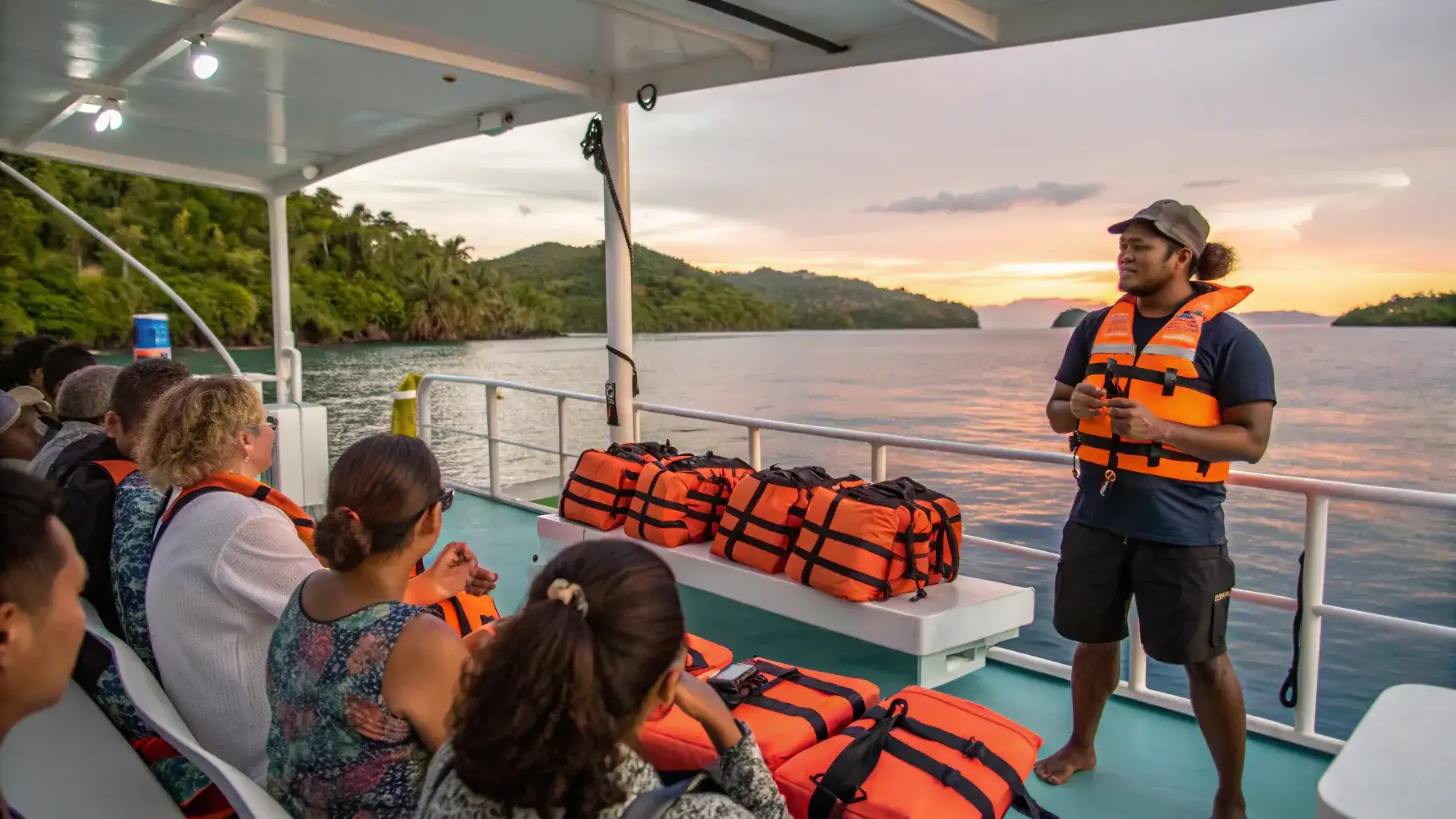
Short answer: a diving emergency on a Komodo liveaboard is handled as a chain, not a single rescue. The diver goes onto 100% oxygen within minutes, the bridge raises help by VHF radio or satellite phone while the boat turns toward Labuan Bajo, a clinic or hospital there stabilises the patient, and definitive recompression means a flight to a hyperbaric chamber in Bali. Expect several hours to hospital and, in most scenarios, the better part of a day to a chamber. That timeline is why serious operators treat dive accident insurance such as DAN as a boarding requirement.
Last updated: August 16, 2026
What happens in the first ten minutes?
The first ten minutes belong to the crew on the dive deck, and they matter more than anything that follows. A diver showing signs of decompression illness, near-drowning, or arterial gas embolism is brought out of the water, laid flat, kept warm, and put on the highest possible concentration of oxygen — via demand valve or non-rebreather mask from the vessel’s dedicated oxygen kit, not a spare tank of nitrox. Oxygen is the most effective field treatment for a bent diver, and it works best started immediately.
Meanwhile the guide reconstructs the profile: maximum depth, bottom time, gas, ascent rate, missed stops, dives that day and the days before. That information travels with the patient and shapes every decision downstream. Good crews write it down and log the minute symptoms started. Our page on crew safety standards sets out the certifications and drills worth asking about.
What emergency equipment should the boat carry?
At minimum: a sealed oxygen system with enough capacity to supply a casualty continuously for the whole run back to port, not a token cylinder that empties in twenty minutes. Alongside it, a full first aid kit, a rigid stretcher, a tender that can run after dark, VHF radio, a satellite phone, and a written emergency action plan naming who does what. Ask to see the oxygen kit at your briefing — a crew that produces it in thirty seconds is telling you something.
How does a boat call for help with no mobile signal?
Most of Komodo National Park has patchy to non-existent mobile coverage. Signal reappears near Labuan Bajo and in pockets around the northern islands, but you cannot plan on it. The working tools are VHF marine radio on the emergency channel — reaching the harbourmaster, patrol boats and nearby vessels — plus a satellite phone for direct contact with a dive medicine hotline. DAN Asia-Pacific runs a 24-hour emergency line, and a competent cruise director keeps that number on the bridge.
Radio also connects the vessel to the system that governs sailing here. When the M7.7 earthquake struck about 200 km northeast of Labuan Bajo on 15 August 2026, sailing reopened the same day under Maklumat 05/MP-VIII/2026 and the national park was not closed; so far, operations have continued normally.
How long does it take to reach Labuan Bajo?
Transit time decides most outcomes, and it depends on where the boat is that day. A traditional phinisi cruises at roughly seven to nine knots; a motor yacht is faster. As a rough guide:
| Area | Example sites | Approx. run to Labuan Bajo |
|---|---|---|
| Central Komodo | Batu Bolong, Tatawa, Siaba | 2–3 hours |
| Northern Komodo | Castle Rock, Crystal Rock, Gili Lawa | 3–5 hours |
| Southern Komodo | Manta Alley, Cannibal Rock area | 6–10 hours |
This is one reason far-south itineraries are treated differently from the northern loop — a point covered in north versus south Komodo diving and worth reading alongside our Komodo dive sites hub. Sea state matters too: in the transition months, southern swell can add hours to a return leg, which is why the Komodo diving season guide is a safety document as much as a weather one.
What medical care exists in Labuan Bajo?
Labuan Bajo has clinics and a hospital that can stabilise a patient, give oxygen and fluids, manage trauma, and coordinate onward transfer. What it has historically not offered divers is guaranteed access to a staffed recompression chamber. Availability in eastern Indonesia changes, so any advertised facility should be confirmed as operational for your travel dates rather than assumed. Treat Labuan Bajo as the stabilisation link, not the destination.
Where is the nearest hyperbaric chamber?
The nearest dependable hyperbaric treatment for Komodo divers is in Bali, at hospitals around Denpasar — a scheduled flight of roughly 1 hour 15 minutes from Komodo Airport, plus ground transfer at both ends. Timing is the complication: Labuan Bajo is served by daytime flights, so an evening incident may mean waiting for first light or chartering an air ambulance. A diver kept on continuous oxygen throughout arrives in far better shape, which brings the chain back to those first ten minutes.
Why is dive insurance non-negotiable in Komodo?
Because that chain is expensive and standard travel policies frequently do not cover it. Many general insurers exclude scuba diving outright, cap it at a stated depth, or exclude recompression therapy. Dedicated dive accident cover — DAN membership with an injury plan is the most widely recognised in Asia-Pacific — is written for exactly this: emergency oxygen, evacuation by sea and air, chamber treatment, repatriation. An air ambulance out of Flores can cost more than the entire holiday.
Carry your membership card and hotline number in your dive bag, and give the cruise director your policy details at check-in. The Komodo liveaboard booking guide covers documentation, and Komodo liveaboard for beginners explains why cover matters even on a conservative, guided profile.
What can you do to make the chain work faster?
Dive conservatively on the last day, respect the surface interval before flying, and declare medical conditions honestly on the liability form. Do not hide a symptom because you fear disrupting the trip: a mild tingle reported early is a manageable problem, and the same tingle reported next morning may not be. Ask where the oxygen is, who the designated first responder is, and what the evacuation plan looks like from that day’s site.
Operator choice sits behind all of it. Komodo Luxury – a registered Indonesian PT (PT Komodo Bahari Nusantara, KBLI 79120) under Juara Holding Group Limited with 1,500+ verified guest reviews (4.9/5) – runs its Komodo liveaboard fleet with documented emergency procedures, and its private yacht charters in Komodo follow the same protocols. See the Komodo liveaboard price page for how packages are structured and national park fees and permits for the government charges alongside them.
Frequently asked questions
Is there a hyperbaric chamber in Labuan Bajo?
Do not plan on one. Labuan Bajo can stabilise a diver, but the recompression facilities Komodo operators rely on are in Bali. If a local chamber is advertised, ask your operator to confirm it is staffed and operational for your dates.
Does every Komodo liveaboard carry emergency oxygen?
Dive-focused liveaboards do, and it should be a dedicated medical oxygen system rather than a repurposed scuba cylinder. Cruise boats that only snorkel may carry less. Ask before you book and again at the briefing.
Will my normal travel insurance cover a diving accident?
Often not. Many policies exclude scuba diving, cap it at a shallow depth, or exclude recompression treatment and air evacuation. Read the exclusions and add dedicated dive accident cover such as DAN if there is any doubt.
How long must I wait to fly after my last dive?
The published DAN/UHMS and PADI guidance is a minimum surface interval of at least 12 hours after a single no-decompression dive and at least 18 hours after repetitive or multi-day diving, with longer intervals after decompression dives. Many Komodo operators apply a more conservative margin than the minimum, and since nearly every Komodo trip ends with a flight, itineraries are normally built with a dry final morning.
Can a boat evacuate a diver at night?
A vessel can and will run at night if it must, but the flight leg to Bali is the constraint: scheduled services from Labuan Bajo operate in daylight, so an overnight incident may mean stabilising on board and at the hospital until morning, or chartering a medevac aircraft.
Planning the trip itself
Emergency planning is an operator question before it is a boat question. Komodo Luxury — a registered Indonesian PT under Juara Holding Group Limited with 1,500+ verified guest reviews (4.9/5) — publishes vessel-by-vessel detail so you can compare before committing: verified operator credentials, how to verify who you are paying, liveaboard fleet and safety equipment.