
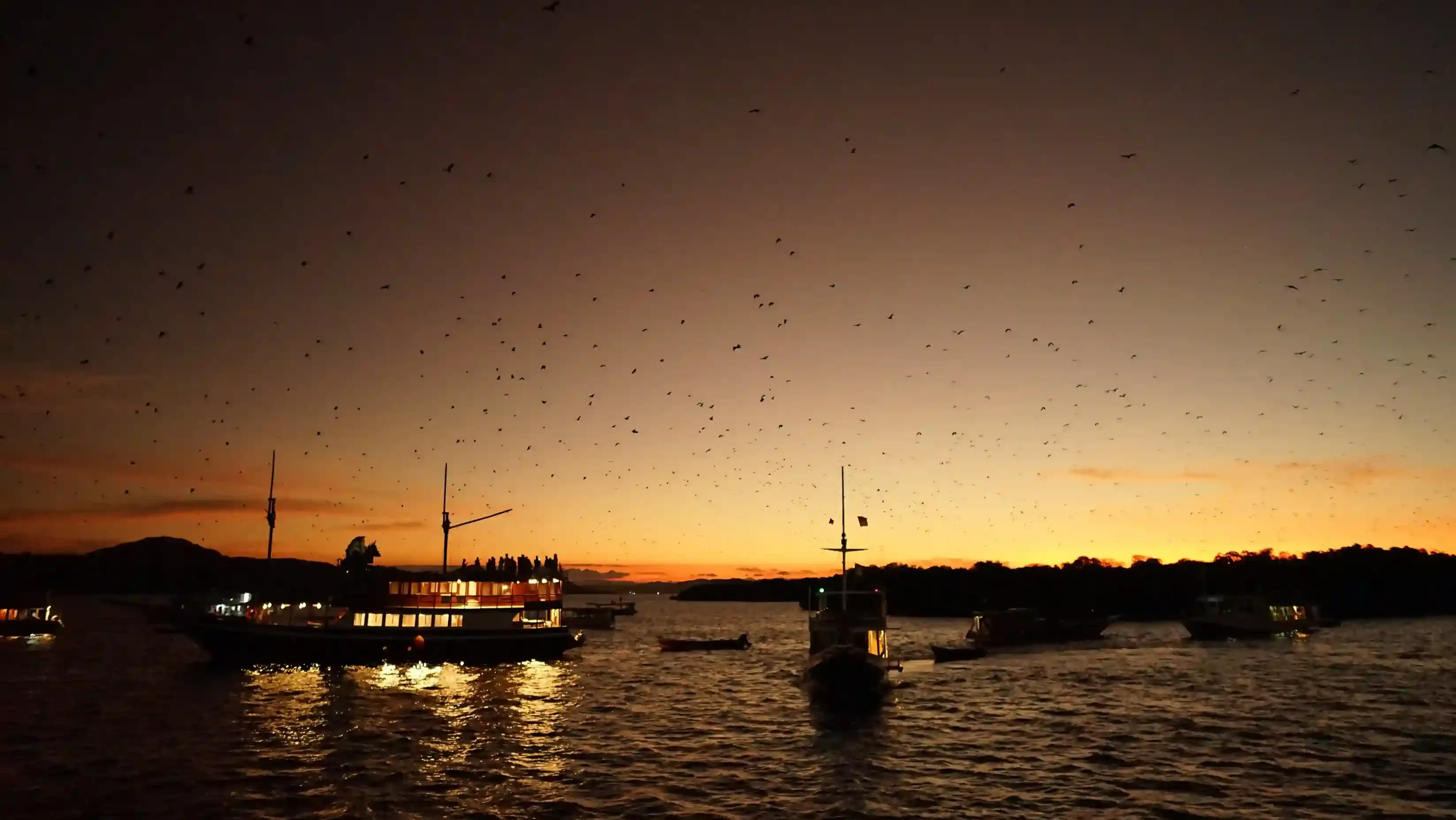
Kalong Island, a small mangrove islet near Rinca, hosts one of Komodo National Park’s largest flying fox colonies — tens of thousands of fruit bats stream out over the water every evening at sunset. Most komodo liveaboard itineraries anchor nearby at dusk for this no-landing, on-deck spectacle, timed to the last light and best watched from an open, unobstructed western view.
A Komodo Ritual You Watch, Not Walk
There’s no trek, no ranger briefing, and no entry fee for this one — which is part of what makes it stand out on a komodo island liveaboard itinerary full of hikes and dive briefings. Kalong Island sits just off Rinca Island, close enough that boats returning from a Rinca dragon trek or a day of diving in the south can reposition here without adding meaningful sailing time. As the sun drops toward the horizon, the mangrove canopy that blankets the island starts to stir, and within a matter of minutes the sky fills with dark, moving lines of bats heading out to feed on the mainland and nearby islands for the night.
It’s a passive experience by design. Guests stay aboard the main boat or in a tender a respectful distance offshore, drinks in hand, cameras up, while the colony does what it does every single evening regardless of who’s watching. There’s a stillness to it that contrasts with the rest of a typical liveaboard day — no briefing, no gear, no schedule pressure, just watching a genuinely wild spectacle unfold against a Komodo sunset.
What Actually Happens at Dusk (Minute by Minute)
The flight isn’t a single dramatic burst — it builds. Boats that time their arrival for the final hour of daylight get the full arc of the event, from first stirring to the tail end of the exodus.
| Time (relative to sunset) | What’s happening |
|---|---|
| 60–40 minutes before | Boat arrives and anchors or holds position offshore; mangrove canopy still quiet, bats roosting |
| 30–20 minutes before | First scattered bats lift off; light “test flights” around the canopy edge |
| 15–5 minutes before sunset | Numbers build fast — small groups become steady streams peeling off the island |
| Sunset to 15 minutes after | Peak flight; continuous dark lines of bats cross the sky, often silhouetted directly against the sun |
| 15–30 minutes after sunset | Flow tapers; stragglers continue departing as light fades to dusk colors |
| After dark | Colony largely emptied for the night; boat repositions or continues toward next anchorage |
Because the peak window is short and light-dependent, boats generally build in a buffer either side — arriving a little early beats arriving late, since a missed peak can’t be replayed.
Why So Many Bats Call One Small Island Home
Kalong is a mangrove islet, and mangroves make ideal daytime roosts for flying foxes: dense canopy cover, protection from most predators, and proximity to feeding grounds on Flores and the surrounding islands the bats reach by night. The colony here is large enough that the mass departure reads as a genuine natural event rather than a curated tourist moment — this is simply what the island does every evening, liveaboard schedule or not.
Landings on Kalong itself are generally not permitted, which protects both the mangrove root system and the roosting colony from disturbance during daylight hours when the bats are most vulnerable. That’s part of why this stop works so well on a liveaboard specifically — the entire experience happens from the water, with zero trekking or physical difficulty involved, making it accessible to every guest onboard regardless of fitness or mobility.
How It Fits Into a Komodo Liveaboard Itinerary
Kalong’s bat flight is typically slotted in as a late-afternoon or early-evening stop, most often on a day that’s already built around Rinca Island or the return leg toward Labuan Bajo. On a standard multi-day route, the sequence usually looks like this:
- Morning: Ranger-guided dragon trek or a dive/snorkel session, depending on the day’s route
- Midday: Lunch and boat repositioning toward the southern or central park route
- Late afternoon: Boat sails toward Kalong Island, timed to arrive with 45–60 minutes of daylight remaining
- Sunset: Anchor offshore, guests gather on deck or in tenders for the bat flight
- Evening: Boat continues toward the next anchorage or back to Labuan Bajo for dinner
Shorter 3D2N trips and longer expeditions alike can include it, since it adds almost no extra sailing distance when the route already passes near Rinca — but it’s weather- and route-dependent rather than a fixed stop on every single sailing.
Ready to sail? The 3D2N Komodo Liveaboard share-cabin open trip is bookable directly through Komodo Luxury Open Trip — live schedules and cabin availability. WhatsApp +62 811 3823 875 or email [email protected].
Photography Tips for the Bat Flight
This is one of the most photogenic moments on the entire trip, and it rewards a bit of preparation since the window is short and the light changes fast.
- Shoot into the sunset for silhouettes. Positioning the boat so bats cross directly in front of the sun produces the classic “river of bats” shot — dark shapes against orange and pink sky.
- Use a fast shutter speed. Bats move quickly and erratically; 1/1000s or faster helps freeze wing detail if you want sharp individual subjects rather than motion blur.
- Bring a mid-range zoom, not just wide-angle. A 70–200mm equivalent lets you isolate streams of bats against the sky, while a wider lens captures the full scene with the island and boat in frame.
- Stabilize against the boat’s motion. A monopod or simply bracing against a rail helps more than a full tripod on a moving deck.
- Arrive early and shoot the buildup too. Some of the best frames come from the scattered “test flight” phase 20–30 minutes before sunset, when individual bats are easier to isolate against a still-bright sky.
- Don’t use flash. It won’t reach the colony at distance, and it disturbs other guests watching the same event in low light.
What First-Time Visitors Get Wrong
The most common surprise is scale — photos and videos rarely convey just how many bats are involved, and guests often expect a smaller, quieter version of what they actually see. The second is timing: because the flight is genuinely tied to light levels rather than a clock, a boat running 20 minutes behind schedule can miss the most dramatic part of the event entirely, which is why experienced crews build in arrival buffers rather than cutting it close. Finally, first-timers sometimes expect a landing or close-up viewing option — but the entire point of watching from the water is that the colony carries on completely undisturbed, which is exactly what makes it feel authentic rather than staged.
Frequently Asked Questions
What time do bats fly out?
The flight builds in the final 30 minutes before sunset and peaks in the 15 minutes around sunset itself, tapering off over the following 15–30 minutes as light fades. Because it’s tied to daylight rather than a fixed clock time, the exact minute shifts slightly by season — crews time the boat’s arrival to the local sunset, not a set hour.
How many bats are there?
The colony is large — commonly described as tens of thousands of flying foxes roosting in Kalong’s mangroves — though no official, current census figure is published, so treat any precise headcount you see online as an estimate rather than a verified number. What’s consistent across visits is the scale: continuous streams of bats crossing the sky for a sustained period, not a brief handful.
Is it included in every itinerary?
It’s a common stop on itineraries that already pass near Rinca Island or route back toward Labuan Bajo in the late afternoon, but it’s not a universal fixed stop on every sailing — weather, timing, and the day’s route all factor in. If watching the bat flight matters to you, mention it when booking so it can be confirmed as part of your specific itinerary.
Best photography spot?
The deck or bow of the main boat generally gives the steadiest platform and best vantage, especially positioned so the colony crosses between you and the setting sun for silhouette shots. A tender can get you slightly closer and offers more flexibility to reposition as the flight direction shifts, at the cost of a less stable shooting platform.
Is it safe to watch up close?
Yes — guests remain on the boat or in a tender at a respectful offshore distance throughout, with no landing and no direct contact with the colony. The bats show no interest in the boats and simply fly their normal evening route overhead and past, making this one of the lowest-risk, zero-effort experiences on the entire liveaboard.
Want to see where Kalong fits alongside the rest of the park? Browse the full destinations guide, check current sailing options on our komodo liveaboard price page, or read more answers in the FAQ hub. Ready to catch the sunset flight yourself aboard a komodo liveaboard? WhatsApp +62 811 3823 875 or email [email protected] — the team will confirm which sailings include Kalong Island.