
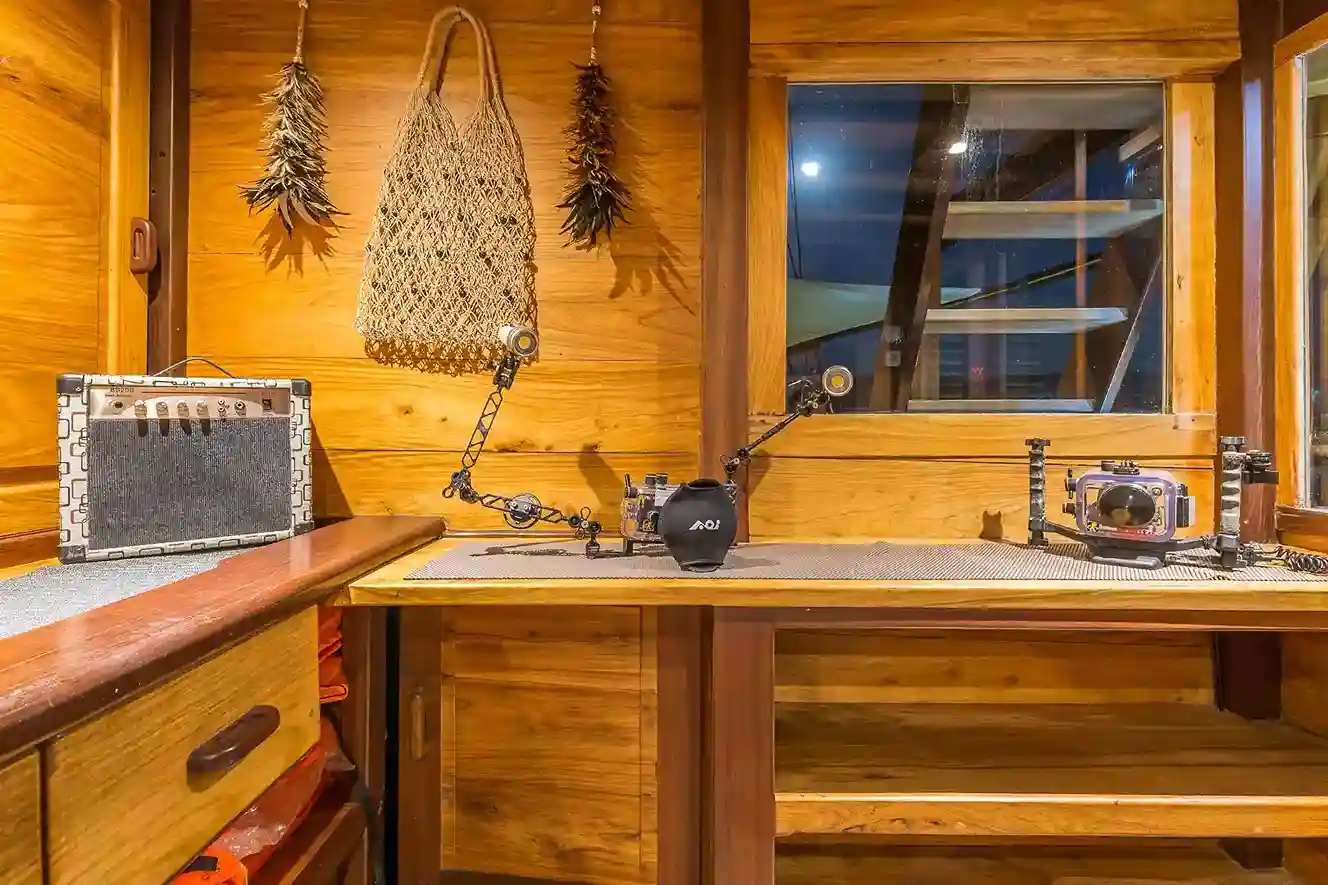
Short answer: The best Komodo liveaboard setup for underwater photographers is a boat with a dedicated camera table (padded, shaded, power sockets within reach), a rinse tank reserved for cameras only, tender crew trained to hand your rig down after you are in the water, and guides who understand light and subject behaviour — then an itinerary pairing wide-angle sites in the north with macro sites in the south.
Last updated: August 16, 2026
What actually makes a Komodo liveaboard photographer-friendly?
Almost every boat in Labuan Bajo says it welcomes photographers. Four details separate the ones that do:
- Camera table: a permanent, shaded bench on the dive deck with a rubber or foam mat, roughly 60–80 cm per photographer, plus a blower for drying o-ring grooves.
- Power at the table: Indonesian 220V type C/F sockets beside your seat, not only in the cabins. Ask how many outlets there are and whether the generator runs overnight; bring a multi-plug and surge protector, because boat power fluctuates.
- A camera-only rinse tank: fresh water, deep enough to submerge a housing with a dome port, used for nothing else.
- Tender handling: crew who take the rig at the surface and pass it down once you are in, and never let a housing sit loose in a moving tender.
A boat that cannot answer those four specifically has not thought about photographers.
Why does the rinse tank matter more than people expect?
The most common cause of a flooded housing is not depth — it is a shared rinse tank. Masks carry defogger, wetsuits carry sand and salt, regulators shed silicone grease, and any of it can end up on an o-ring seal. On a photographer-ready boat the camera tank sits apart from the gear tanks and the rule is enforced.
Carry spare o-rings, silicone grease, silica sachets and a moisture alarm. Labuan Bajo has no underwater camera shop, and Bali stocks housing-specific parts thinly.
Which Komodo dive sites are best for wide-angle?
Northern Komodo produces the big, blue frames. Manta Point (Karang Makassar) is a rubble and sand plateau in roughly 5–12 metres where reef mantas queue at cleaning stations; the shallow depth and pale bottom let you shoot ambient light, or pull strobes wide and back to kill backscatter. Castle Rock and Crystal Rock are current-swept pinnacles where fusilier schools, giant trevally and whitetip reef sharks work the up-current side — reef hook, wide lens, dawn dive if the crew offers one.
Batu Bolong is the densest hard-coral wall in the park, but it also generates the region’s strongest down-currents — a poor place to be absorbed in a viewfinder. Tatawa Besar is the gentler option: a long soft-coral drift suiting reefscapes and diver-in-frame compositions. Full profiles sit on our Komodo dive sites hub.
Which sites deliver the best macro?
The sheltered south is the macro half of the trip. Wainilu is a rubble and seagrass slope that behaves like a classic muck site — nudibranchs, frogfish, bobtail squid, ghost pipefish, and mandarinfish activity at dusk. Yellow Wall is dense enough in soft coral to shoot wide while still holding pygmy seahorses for a macro lens. Crinoid Canyon, Pillarsteen and Three Sisters round out the southern rotation.
The trade-off is water: the south runs cooler and more plankton-rich, with thermoclines in the low 20s Celsius, greener visibility, and a 5 mm wetsuit sensible where 3 mm is fine up north. Our guide to north versus south Komodo diving covers that before you build a shot list.
| Site | Best for | Typical current |
|---|---|---|
| Manta Point (Karang Makassar) | Wide-angle, mantas | Moderate drift |
| Castle Rock / Crystal Rock | Schooling fish, sharks | Strong, reef hook advised |
| Batu Bolong | Wide-angle reefscape | Strong, down-currents possible |
| Tatawa Besar | Soft-coral drift | Mild to moderate |
| Wainilu | Macro, critters, dusk | Mild |
| Yellow Wall | Macro and soft coral | Mild to moderate, cool water |
How do Komodo’s currents change the way you shoot?
- Fold strobe arms in tight for descents, negative entries and drift phases; extend them once you are settled behind structure.
- Long arms act like sails. On the pinnacles, strobes held close to the housing are far easier to control than a wide clamshell rig.
- Hook in on the up-current side and let the action come to you rather than swimming into blue water after it.
- At Manta Point, stay low over the sand, keep off the cleaning station, and let the animal set the distance — uncrowded mantas pass close enough for a dome port.
- Accept that a site can be dropped; a guide who moves a pinnacle to the next morning is protecting your images too.
Does the dive guide really change your results?
More than the boat does. A photography-aware guide positions their torch to backlight rather than blow out a subject, holds trim instead of silting a frogfish, points and then withdraws, and knows which cleaning station is active that week. Ask whether guides shoot themselves, what the guide-to-diver ratio is, and whether photographers can be split from a fast general group.
Group size is the practical lever. On a shared departure you work to the group’s pace; on a private Komodo liveaboard you set dive times, repeat a site and run dawn or dusk dives for the light you want. Four to six divers aboard is a sensible ceiling.
When should photographers travel, and how should you plan?
April to June and September to November are the practical windows: settled seas, active manta aggregations, fewer boats on the pinnacles than at the July–August peak. January and February bring the strongest west-monsoon weather and many operators pause. Our Komodo diving season guide breaks the months down further.
On current conditions: an M7.7 earthquake struck on 15 August 2026, epicentre roughly 200 km northeast of Labuan Bajo. Sailing reopened the same day under Maklumat 05/MP-VIII/2026, Komodo National Park was not closed, and operations have run normally so far. Confirm status with your operator when you fix dates.
For gear allowances, nitrox and camera-table capacity, see what is included on a Komodo liveaboard, and Komodo liveaboard pricing for how park fees, rental and nitrox are quoted. For an operator-side view of photographer-friendly vessels, Komodo Luxury’s liveaboard fleet lists deck layouts and schedules, and their private yacht charters suit small photo teams needing control over timing. Whichever boat you shortlist, check who actually stands behind the charter: Komodo Luxury, for example, trades as a registered Indonesian PT (PT Komodo Bahari Nusantara, KBLI 79120) under Juara Holding Group Limited, so terms, crew arrangements and park paperwork sit with one accountable entity rather than a broker chain.
What else do photographers ask about Komodo liveaboards?
Can I bring a camera as a relatively new diver?
You can, but Komodo rewards buoyancy control over ambition. Under roughly 30 logged dives, dive the first day without the camera, then add a compact or single-strobe rig rather than a full dual-strobe setup.
Wide-angle or macro for a Komodo liveaboard?
Both, if your rig allows a port change between dives; most itineraries run north for wide-angle and south for macro. If you can only carry one, wide-angle wins on a first trip — mantas, pinnacles and soft-coral walls define the region.
Is there enough power on board to charge strobes and laptops?
On most established boats yes, but capacity varies and smaller vessels may shut the generator overnight. Ask for the socket count at the camera table and carry enough spare batteries to survive a night without charging.
Can a non-diving partner join a photography-focused trip?
Yes. Komodo liveaboards routinely carry snorkellers, who can join manta snorkels, Padar and Pink Beach landings and the Rinca dragon walk while divers are down. Confirm the schedule suits both, since photo-led trips front-load dawn dives.
Do I need a permit to shoot photos in Komodo National Park?
Personal photography is covered by the standard park entry fees your operator arranges. Commercial shoots, drone flights over park land and broadcast filming need separate written permission from the park authority.
Planning the trip itself
Light, deck space and tender access decide the shot. Komodo Luxury — a registered Indonesian PT under Juara Holding Group Limited with 1,500+ verified guest reviews (4.9/5) — publishes vessel-by-vessel detail so you can compare before committing: luxury phinisi with open sun decks, private yacht charter for full schedule control, liveaboard departures.