
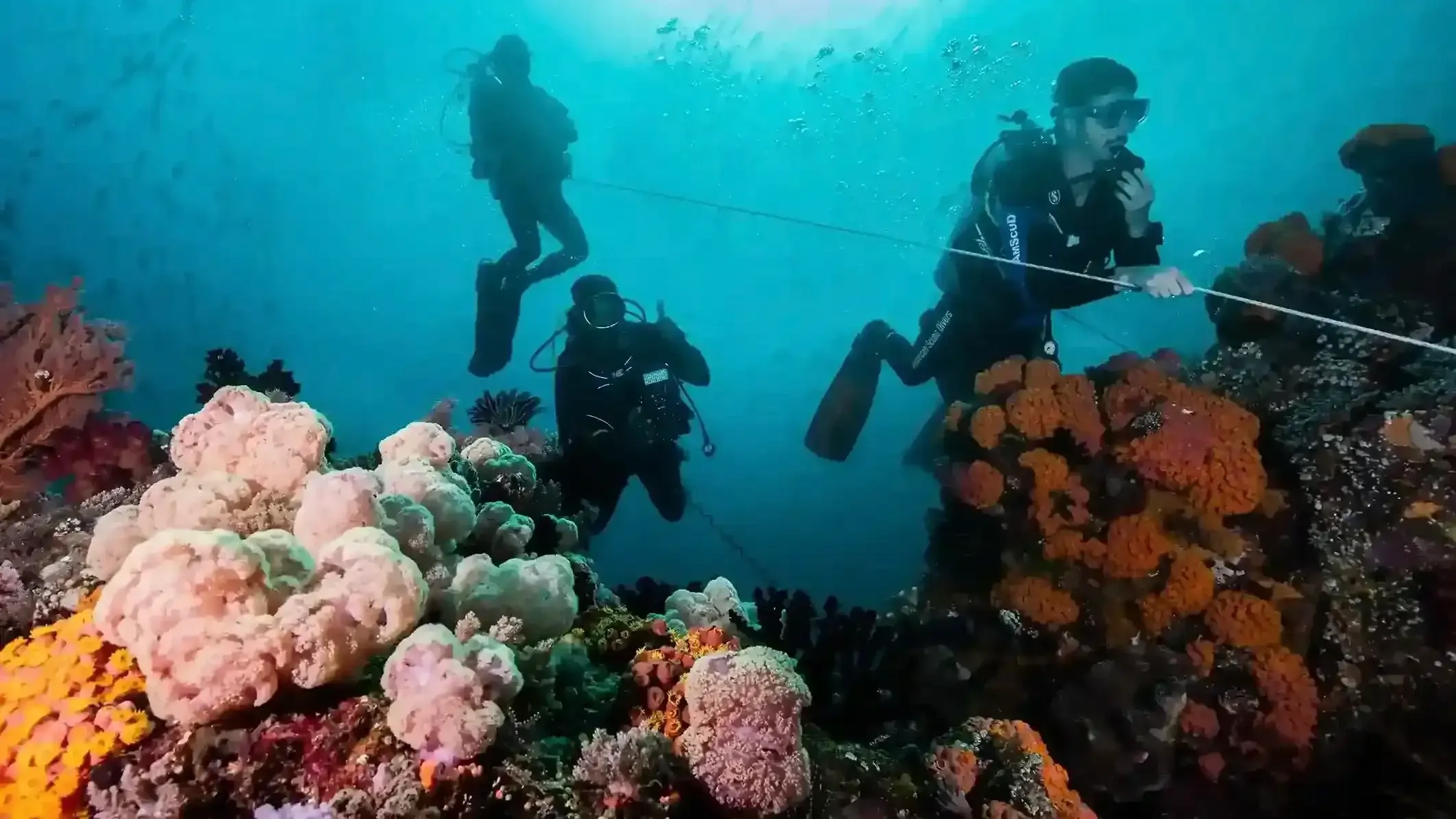
Liveaboard diving in Komodo means three guided dives on a normal full day, an optional night or dusk dive on most itineraries, and a diving style built around moving water rather than flat, easy reefs. The boat sleeps at the dive sites, so you dive tidal windows day boats cannot reach, on a schedule set by the tide table, not the clock.
Last updated: August 16, 2026
What should divers expect at a glance?
- Dives per day: 3 on full days, 2 on arrival and departure days, plus a night or dusk dive on longer trips.
- Style: drift diving, negative entries, reef hooks at the pinnacles, calmer reef and muck dives in between.
- Water: roughly 27-29 °C north, 20-24 °C south.
- Minimum level: Open Water centrally, Advanced Open Water for the northern pinnacles.
How many dives per day does a Komodo liveaboard run?
Three dives is the working standard for a full day: one before breakfast, one mid-morning, one in the afternoon, then a dusk or night dive if the anchorage suits it. Arrival and departure days are shorter because of transfers, park check-in and the surface interval before flying.
| Itinerary | Guided dives | Night / dusk dives |
|---|---|---|
| 3 days / 2 nights | 6-8 | 0-1 |
| 4 days / 3 nights | 10-11 | 1 |
| 6 days / 5 nights | 16-18 | 1-2 |
| 8 days / 7 nights | 22-26 | 2-3 |
The last day is cut short deliberately: at least 18 hours between your final dive and your flight out of Labuan Bajo is standard. “Unlimited diving” is not realistic here either — Komodo sites work only in specific tidal windows, so the number of dives follows the tide table.
Why are Komodo’s currents different from other destinations?
Komodo sits in a narrow gap between the Flores Sea and the Indian Ocean, and enormous volumes of water push through it twice a day. That feeds the reef and, on the wrong tide, moves you past it at walking pace. These currents are tide-driven and directional, so guides plan them off a tide table.
The practical split is north versus south. The north is warmer and clearer, with the classic pinnacles and the manta highway at Karang Makassar; the south sits in cold Indian Ocean upwelling, with lower visibility, plankton and a different species list. Compare them in our guide to north versus south Komodo diving, with full profiles in the dive sites hub.
| Area | Conditions | Suits |
|---|---|---|
| Northern pinnacles (Castle Rock, Crystal Rock, Shotgun) | Strong, reef hook usually needed | Experienced drift divers |
| Central channels and reef pinnacles (Batu Bolong, Tatawa, The Passage) | Moderate to strong, timed drifts, dense reef fish | Advanced and confident Open Water divers |
| Manta stations (Karang Makassar / Manta Point centrally, Manta Alley in the south) | Gentle to moderate drift over sand and rubble cleaning stations | Most levels on the right tide; Manta Alley is more exposed |
| Southern walls (Yellow Wall, Crinoid Canyon) | Cold, green, plankton-rich, surge | Soft coral and critter divers |
| Sheltered bays and black sand | Little current, shallow, silty | Muck diving, night dives, cameras |
What drift and reef hook technique do you need?
Komodo rewards divers who stay low, streamlined and close to the reef, where eddies behind bommies hold calm pockets while the current runs hard two metres away. Guides brief these on day one.
- Negative entry. Deflated BCD, regulator in, roll and descend as a group; hanging on the surface separates teams at a pinnacle.
- Reef hook. Short line and double-ender clipped to your BCD, set into dead rock or rubble only, never live coral. Unhook before ascending.
- Down currents. Do not fight them vertically. Move horizontally out of the zone, stay near the reef, add gas once you stop descending.
- SMB. In drift conditions you surface away from the boat, and the marker is what the tender follows.
- Team discipline. Tight groups, a set turn point, no chasing photographs out of formation.
What certification level and experience do you need?
Open Water divers are welcome on many Komodo liveaboards, but the itinerary is adjusted around them. Advanced Open Water with around 30 logged dives, some in current, opens up the whole site list. If your last dive was over a year ago, book a refresher before the trip.
The check dive is not a formality: the guide sets your weighting, watches your trim and gas use, then decides which sites you dive. Newly certified divers should start with our guide for beginners; briefings and in-water protocols sit under crew and safety standards.
Is nitrox worth it on a Komodo liveaboard?
For most divers doing three or four dives a day across several days, yes: enriched air at 32% extends no-decompression limits on the repetitive middle dives, and many feel less worn down by the end of a week. You need the certification, analyse your own tanks, and respect the shallower maximum operating depth. Availability varies: some run a membrane system, others bank a few tanks, a few carry none. It is usually a supplement rather than an inclusion, so confirm at booking. Supplements by vessel and season sit on the Komodo liveaboard price page.
What gear should you bring?
Boats supply tanks, weights and rental sets, but sizes vary and popular ones go early. Bring what fits you, or keeps you found:
- Dive computer — required, not optional, on a repetitive multi-day schedule.
- SMB with reel or finger spool — required by most operators for drift diving.
- Exposure protection — 3 mm north, a hooded vest or 5 mm south; cold divers make poor decisions in current.
- Your own mask, torch and spares — a leaking rental mask ruins a manta dive, and there is no dive shop at anchor.
When should you dive Komodo, and what are conditions now?
Diving runs year-round, with the most stable conditions from April to November; sea state, not rainfall, limits southern itineraries between January and March, as our Komodo diving season guide explains. On current conditions: a magnitude 7.7 earthquake struck roughly 200 km north-east of Labuan Bajo on 15 August 2026. Sailing resumed the same day under Maklumat 05/MP-VIII/2026 and Komodo National Park has not been closed so far, but confirm conditions with your operator before departure.
When comparing operators, ask how many divers per guide, whether groups are split by experience, and how nitrox is filled. We work alongside Komodo Luxury’s liveaboard fleet and its phinisi charters, with shared departures on their open trip schedule. Komodo Luxury – a registered Indonesian PT (PT Komodo Bahari Nusantara, KBLI 79120) under Juara Holding Group Limited. Next step: check which departures are open for your travel months, compare two or three itineraries against the site list above, and ask the operator to hold your dates.
What else do divers ask about Komodo liveaboards?
How many dives will I get on a 4-day Komodo liveaboard?
Usually 10 or 11 guided dives, including one night or dusk dive. First and last days are shorter because of transfers and the pre-flight interval.
Do I need Advanced Open Water to dive Komodo?
Not for the whole trip, but it is the level at which the northern pinnacles open up. Open Water divers are taken to gentler central sites first.
How strong are the currents in Komodo?
Strong enough that sites are dived only in specific tidal windows. Guides plan around slack and running tides and use reef hooks at the pinnacles.
Where do you dive with mantas in Komodo?
Karang Makassar, widely called Manta Point, is the main cleaning and feeding station in the central park; Manta Alley in the south is the second option. Both are drift dives timed to the tide.
Is nitrox available on every Komodo liveaboard?
No. Some vessels have membrane systems, others bank a few tanks, some carry none. It is usually a paid supplement.
How many divers are assigned to each guide?
Four is a common working maximum in current, and smaller groups are normal on mixed-experience trips. Ask before booking — the ratio decides how closely a guide can watch you.
Can non-divers join a Komodo liveaboard?
Yes. Most vessels carry snorkellers alongside divers, with island hikes, beach stops and snorkelling over the same reefs.
How cold is the water in southern Komodo?
Typically 20-24 °C, sometimes lower during strong upwelling, against 27-29 °C in the north. A 5 mm suit suits a south-heavy itinerary.