
Komodo Liveaboard vs Land-Based: Complete Comparison Guide
Travel Journal

Komodo Liveaboard vs Land-Based: Complete Comparison Guide

Ghifari April 4, 2026 15 min read

Quick Answer: Komodo liveaboards provide superior diving access to pristine sites, cost-effective multi-dive packages, and immersive underwater experiences—ideal for diving-focused travelers. Land-based stays offer greater comfort, cultural exploration, and flexibility—perfect for mixed-interest travelers or those prioritizing relaxation alongside diving. Your choice depends on diving frequency, budget, comfort preferences, and whether you value land-based activities alongside water experiences.

Komodo Liveaboard vs Land-Based: Complete Comparison Guide

Choosing between a liveaboard trip and a land-based resort experience represents one of the most important decisions when planning a Komodo adventure. Each approach offers distinct advantages and trade-offs that dramatically influence your experience, budget, comfort level, and overall satisfaction. This comprehensive comparison examines every relevant dimension—from diving frequency and cost to comfort, logistics, and environmental impact—empowering you to select the approach that best aligns with your priorities, diving experience level, and travel style.

Understanding the Two Approaches

A liveaboard experience involves staying aboard a dedicated diving vessel, typically ranging from 20 to 60 meters in length, equipped with comfortable cabins, dining facilities, and diving infrastructure. These vessels operate multi-day trips (usually 3-7 days) based from Labuan Bajo, navigating throughout Komodo National Park and adjacent waters. Guests sleep aboard, eat all meals aboard, and access dive sites directly from the boat—sometimes reaching locations in under 30 minutes.

Land-based experiences involve staying at shoreside accommodations ranging from budget guesthouses to luxury resorts, primarily located in Labuan Bajo or occasionally on the islands themselves. Divers travel daily to dive sites via dedicated dive boats departing from harbors each morning, returning each afternoon. Non-diving time is spent at accommodations, in town, or exploring land-based attractions.

These fundamentally different structures create entirely different vacation experiences, each with distinct advantages and considerations that deserve careful evaluation.

Diving Frequency and Underwater Exploration

Liveaboard trips dramatically maximize diving frequency. A typical 4-day liveaboard accommodates 8-10 dives, sometimes more. Boats conduct multiple dives daily, with flexibility to adjust dive timing based on weather, light conditions, and marine activity patterns. This frequency allows exploring multiple dive sites daily, experiencing different ecosystem conditions, and dramatically increasing wildlife encounter probabilities.

Land-based operations typically provide 1-2 dives daily. Guests descend once in the morning (after a boat journey of 30-60 minutes), return to shore for lunch and rest, then perhaps undertake a second afternoon dive. This schedule accommodates non-diving activities but limits total underwater time and site diversity experienced.

The mathematical difference is significant: a week of liveaboard diving provides 16-20+ dives, while land-based offers 7-10 dives. For serious divers, this difference translates to exponentially greater site exploration, species encounters, and underwater experience accumulation. Diving in Komodo becomes progressively more rewarding with additional dives as you recognize species, understand site layouts, and develop intuitive understanding of the environment.

Access to Remote Dive Sites

Liveaboards access remote, pristine dive sites inaccessible to land-based operations. Many spectacular sites require 2-4 hours boat travel from Labuan Bajo—distances impractical for daily return operations. Liveaboards position themselves strategically overnight, allowing morning dives at these remote locations without extensive travel time.

These remote sites typically offer superior conditions: less diver traffic (sometimes no other divers for an entire day), more abundant marine life due to reduced pressure, and pristine reef conditions. You experience Komodo’s underwater world as few others do. Many celebrated dive sites—dramatic seamounts, pristine garden reefs, nutrient-rich current passages—are effectively exclusive to liveaboard access.

Land-based operations concentrate on closer sites accessible via 30-90 minute boat runs. These sites are beautiful and excellent, but receive more diver pressure from multiple daily groups. Komodo National Park encompasses an enormous area—liveaboards explore perhaps 5-10% of potential dive locations, while land-based operations concentrate on a smaller accessible radius.

Cost Analysis: Total Value Assessment

Cost comparison requires careful analysis of what’s included in each option, as apparent price differences can be misleading.

Liveaboard Pricing

Typical komodo liveaboard pricing ranges from $2,500-$5,000+ for a 4-day trip, depending on vessel quality, season, and inclusions. This price typically includes:

  • Accommodation in shared or private cabins
  • All meals (breakfast, lunch, dinner, snacks)
  • Unlimited diving (typically 8-10 dives over 4 days)
  • Diving equipment rental (if needed)
  • Diving guides and boat captains
  • Transportation to/from Labuan Bajo
  • Park entrance fees

When broken down to per-dive cost, a $3,000 liveaboard with 8 dives costs approximately $375/dive, often including accommodation and meals. This represents exceptional value when compared to land-based operations where diving, accommodation, and meals are separately charged.

Land-Based Pricing

Land-based costs vary enormously based on accommodation choice:

  • Budget guesthouses: $20-50/night
  • Mid-range hotels: $50-150/night
  • Luxury resorts: $150-300+/night
  • Diving: $100-200 per dive (2 dives daily = $200-400/day)
  • Meals: $10-50/day depending on restaurant choices
  • Miscellaneous activities and transport: $20-100/day

A modest land-based experience—mid-range accommodation, conservative dining, and 7 dives across 4 days—costs approximately $100/night accommodation ($400 total) + $1,400 in diving ($200/dive × 7) + $300 meals + $200 misc = $2,300. This approaches liveaboard pricing while providing only 70% of the dives.

However, land-based offers flexibility to skip diving on some days, attend to personal matters, or explore Labuan Bajo—activities impossible on a liveaboard. These flexibility benefits carry real value for some travelers.

Value Analysis

Per-dive cost favors liveaboards significantly, especially for serious divers planning high dive frequency. For travelers seeking fewer dives (3-5 total), land-based becomes more economical. The break-even point varies individually—divers enjoying 5+ dives per week favor liveaboards; those preferring 2-3 dives weekly might save money with land-based operations.

Comfort, Amenities, and Accommodation Quality

Land-based experiences typically offer superior comfort for non-diving time. Shoreside accommodations provide spacious facilities, reliable utilities, air conditioning (usually), and separation between personal and shared spaces. Luxury resorts offer spa services, multiple dining venues, and resort amenities.

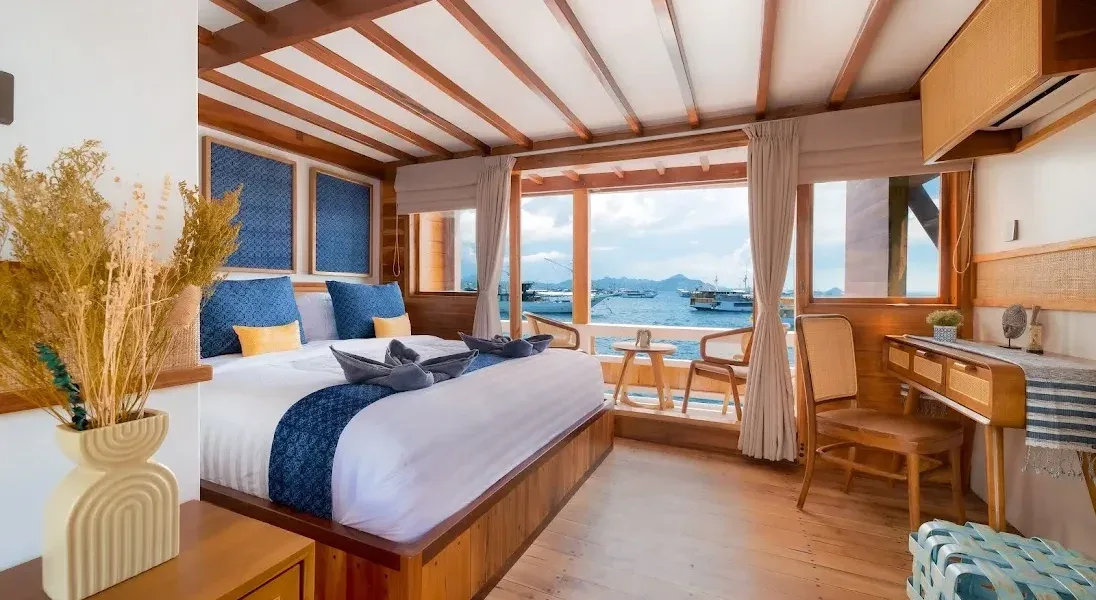
Liveaboard cabins are invariably compact—space constraints limit most cabins to 8-12 square meters with minimal privacy. Shared bathrooms are common on economy vessels; only upscale liveaboards offer private ensuite facilities. Ocean motion can create sleeping discomfort for sensitive individuals. The communal environment—shared dining, shared spaces, continuously living with the same people for days—suits extroverts but challenges introverts.

However, liveaboard vessels increasingly offer excellent comfort. Modern operators maintain high standards with quality bedding, reliable air conditioning, fresh food, and excellent hygiene. Fleet quality varies significantly—premium operators provide five-star comfort; budget operations require accepting more basic amenities. Comfort levels depend entirely on vessel selection and operator reputation.

Non-Diving Activities and Exploration

Land-based experiences naturally accommodate non-diving activities. Daily schedule includes time ashore to explore Labuan Bajo, visit local restaurants and shops, enjoy cultural experiences, attend local events, or simply relax. Many travelers combine diving with island exploration, photography, hiking, and cultural immersion.

Liveaboards restrict non-diving activities to daily surface intervals and evening/night hours. Some vessels offer non-diving activities—snorkeling, kayaking, photography workshops—but these are supplementary to diving. The schedule revolves entirely around dive timing. Travelers uninterested in diving multiple times daily will find liveaboard experiences tedious.

For families with non-diving members, land-based experiences facilitate inclusion. Non-divers explore independently while divers engage in water activities, with daily reunion time. Liveaboards, while technically accepting non-divers, create awkward situations where non-diving passengers have limited activities during dive operations.

Environmental Impact and Sustainability

Both approaches impact the marine environment, but differently.

Liveaboards concentrate diver numbers—40-50 divers on a single boat create significant impact at individual sites but concentrate that impact. Multiple groups of divers at the same site compound the environmental stress. However, superior dive site knowledge and professional dive guide expertise typically mean better environmental stewardship and reduced accidental reef damage.

Land-based operations disperse divers across multiple boats and sites, reducing concentration at any single location. However, the necessity for daily transportation from shore to distant sites creates environmental consequences. Multiple small boats making daily journeys consume fuel and create noise/pollution that liveaboards minimize through overnight positioning.

Progressive operators—both liveaboard and land-based—implement strong environmental practices: strict weight belt fitting to prevent accidental contact, current-following navigation to minimize effort, briefings on environmental respect. The operator’s commitment to sustainability matters more than the accommodation type. Destination partners emphasizing environmental stewardship ensure your visit contributes positively to conservation.

Logistics and Travel Convenience

Land-based experiences offer superior logistical simplicity. Arrive in Labuan Bajo, check into accommodation, and begin diving whenever ready. If flights are delayed, adjust the itinerary without consequence. Want to skip a day or extend a day? Simple—just adjust bookings. Need to leave early? No problem—your room awaits until departure.

Liveaboards demand precision timing. The boat departs at a specific time—missing departure forfeits your investment. Multi-day commitments cannot be shortened. Weather delays might require waiting days for departure. The rigid schedule suits organized travelers but frustrates those with uncertain timelines.

Flying into Komodo involves booking precise arrivals that align with liveaboard schedules. This complicates planning, particularly for travelers with limited vacation time or those adjusting for weather delays. Land-based accommodations accept arrivals/departures with great flexibility, ideal for travelers uncomfortable with rigid schedules.

Social Dynamics and Group Experience

Liveaboards create intensive social environments. You spend days living with 30-50 divers, sharing meals, diving, and evening entertainment. This creates strong friendships and shared experiences, often transforming diving trips into profound social experiences. Extroverts thrive in this environment; introverts might find it overwhelming.

Land-based provides social flexibility. You control how much social interaction occurs—dining alone or with others, exploring independently or joining group activities. Many divers genuinely enjoy solitude between dives or prefer small group interactions to large communal experiences.

Diving Experience Level Considerations

Liveaboards suit advanced and experienced divers most effectively. The intensity—multiple daily dives, challenging current dives, deep explorations—demands solid diving skills and comfort with marine conditions. Beginners or rusty divers frequently struggle with the pace.

Land-based operations better accommodate varied experience levels. The 1-2 daily dive pace allows skill development and confidence building. Guides easily customize site selection for group abilities. The less intense schedule suits all experience levels, from fresh certifications to seasoned technical divers.

A newly certified diver (50-100 dives) might feel overwhelmed on a challenging liveaboard with current dives and deep explorations. The same diver would thrive on a land-based trip where daily site selection accommodates their abilities.

Flexibility and Customization

Land-based operations provide greater flexibility. Want to sleep late and skip morning dive? No problem. Want to do three dives instead of two? Arrange it. Want to skip diving entirely for a day? Your accommodation remains unchanged. This flexibility appeals to travelers with variable energy levels, family obligations, or uncertain comfort zones.

Liveaboards operate on fixed schedules with limited flexibility. Dives occur at designated times; missing a dive means forfeiting the experience. The all-inclusive structure eliminates decision-making (which sometimes appeals to travelers who prefer predetermined experiences) but restricts personal autonomy.

Seasonal Considerations

Both approaches operate year-round, but season affects each differently.

Liveaboards maintain better operations during rough sea seasons through flexibility in positioning and route adjustment. A land-based operation might cancel dives due to rough conditions between shore and distant sites; a liveaboard simply repositions overnight and dives nearby sites the following morning.

However, extreme wet season conditions (January-February) might restrict liveaboard operations more severely than land-based, since the boat must remain in specific harbors for safety. Land-based operations might continue though with reduced site access.

Photography Opportunities

Liveaboards excel for underwater photography through multiple daily dives at varying times, allowing optimal light angles. The flexibility to repeat favored sites and adjust timing to peak animal activity periods benefits photographers substantially. The dive frequency allows skill development, test shots, and refinement impossible with limited daily dives.

Land-based operations provide fewer photography opportunities through reduced dive frequency and time pressure during dives (afternoon dives often occur in suboptimal light, and early return to shore limits bottom time).

For both approaches, photographer-specialized operators exist. Some liveaboards specifically accommodate underwater photographers with longer bottom times and positioning favoring photography. Land-based guides can customize dives for photographers. Confirm photography-friendly operations when booking if this matters.

Which option is better for first-time Komodo visitors?

The answer depends on diving experience and priorities. Newly certified divers with limited experience should consider land-based options, where daily site selection accommodates skill levels and the pace allows confidence building. Experienced divers seeking maximum immersion should favor liveaboards for exceptional diving access and frequency. Culture-interested travelers should absolutely choose land-based to explore Labuan Bajo and interact with local communities.

Can I afford liveaboard diving on a budget?

Yes—budget liveaboards operating economy vessels offer competitive pricing compared to land-based operations when total costs are calculated. However, budget vessels mean compact cabins, basic amenities, shared facilities, and less comfort. Mid-range liveaboards offer better value than budget options through improved comfort without premium pricing. Premium liveaboards offer exceptional experiences but require higher budgets. Compare total costs (accommodation + diving + meals) across options before assuming one is cheaper than the other.

Is liveaboard diving physically demanding?

Yes—8-10 dives over 4 days represents significant physical exertion. Divers experience nitrogen loading, repetitive gear setup/breakdown, early mornings, and minimal recovery time. The multiple daily dives create cumulative fatigue. Advanced and experienced divers typically manage easily; intermediate divers should assess comfort with the pace. Land-based 1-2 daily dives impose minimal physical demand by comparison.

What if I get seasick on a liveaboard?

Seasickness is a legitimate concern for liveaboard diving. Ocean motion affects most individuals to some degree; some remain unaffected, while others suffer significantly. Speak with your doctor about preventative medication before departure. Choose larger vessels (45-60m range) that move more smoothly than smaller boats. Check operator policies on seasickness-related issues (some offer partial refunds or scheduling adjustments; others have no flexibility). Consider a land-based option if ocean motion concerns you significantly.

Do liveaboards include all meals, or do I pay extra?

Quality liveaboards include all meals, beverages, and snacks in the package price. However, alcoholic beverages beyond welcome drinks are often charged separately. Confirm meal inclusions before booking. Budget liveaboards sometimes exclude certain meals or beverages to reduce costs. Land-based operations always charge separately for meals and beverages, making actual costs less transparent than all-inclusive liveaboard pricing.

Which option provides more manta ray encounters?

Liveaboards historically provide more manta encounters through multiple daily dive attempts and flexible site positioning. If mantas haven’t appeared at primary sites, liveaboards pivot to alternate locations; land-based operations have less flexibility. The frequency advantage (8-10 dives vs 2-4 dives per trip) substantially increases manta encounter probability. However, no guarantee exists regardless of approach—manta sightings depend on seasonal timing and luck.

Can I combine liveaboard and land-based in one trip?

Absolutely—many travelers split trips between approaches. Fly in, spend 2-3 days land-based exploring Labuan Bajo and enjoying reef diving to warm up, then transfer to a 4-day liveaboard for intensive diving. This hybrid approach accommodates schedule flexibility, social variety, and maximum experience. Some operators facilitate these combinations; confirm availability when planning.

Which approach is better for traveling with non-diving companions?

Land-based is vastly superior for mixed-interest groups. Non-divers explore Labuan Bajo, enjoy town restaurants, relax at accommodations, or pursue non-diving activities (photography, hiking, cultural tours) while divers explore underwater. Liveaboards force non-divers into boredom during dive operations with minimal alternative activities. If travel companions include non-divers, absolutely choose land-based operations unless non-divers are genuinely interested in participating in liveaboard activities.

Decision Framework: Choosing Your Ideal Approach

Choose Liveaboard If:

  • You’re an experienced diver comfortable with multiple daily dives
  • Diving frequency is your top priority
  • Access to remote, pristine dive sites is essential
  • Manta ray encounters are specifically desired (highest probability)
  • You enjoy intensive social experiences and communal living
  • Value per-dive cost matters significantly
  • You have limited vacation time and want to maximize underwater exploration
  • You’re comfortable with rigid schedules and group dynamics

Choose Land-Based If:

  • You’re a newer diver seeking confidence building
  • You value comfort and privacy between activities
  • Non-diving activities and cultural exploration matter to you
  • You appreciate schedule flexibility and personal autonomy
  • You’re traveling with non-diving companions
  • You prefer smaller daily dive groups
  • Uncertain timelines or variable schedule requirements apply
  • You want to explore Labuan Bajo and surrounding regions

Making Your Final Decision

The liveaboard versus land-based decision ultimately reflects your diving passion level, comfort preferences, and travel style. Neither option is objectively superior—each excels in different contexts and for different people.

Serious divers making pilgrimage to Komodo should absolutely experience liveaboard diving, as this approach unlocks underwater experiences impossible via land-based operations. Intermediate divers new to Komodo might benefit from land-based exploration before committing to intensive liveaboard diving.

Leisure travelers combining diving with cultural exploration, non-diving activities, and comfort considerations should embrace land-based operations. The flexibility, accommodation quality, and balanced schedule suit diverse interests.

Consider a hybrid approach—land-based days for cultural immersion and warm-up diving, followed by liveaboard days for intensive diving. This maximizes experience diversity and accommodates varied interests within a single trip.

When ready to book your Komodo adventure, carefully review available liveaboard trips and fleet options, comparing not just pricing but comfort levels, diving philosophies, and operator reputations. Visit destination information to understand what each approach offers. Ultimately, both paths lead to unforgettable Komodo experiences—choose the approach that best aligns with your authentic priorities and diving dreams.