
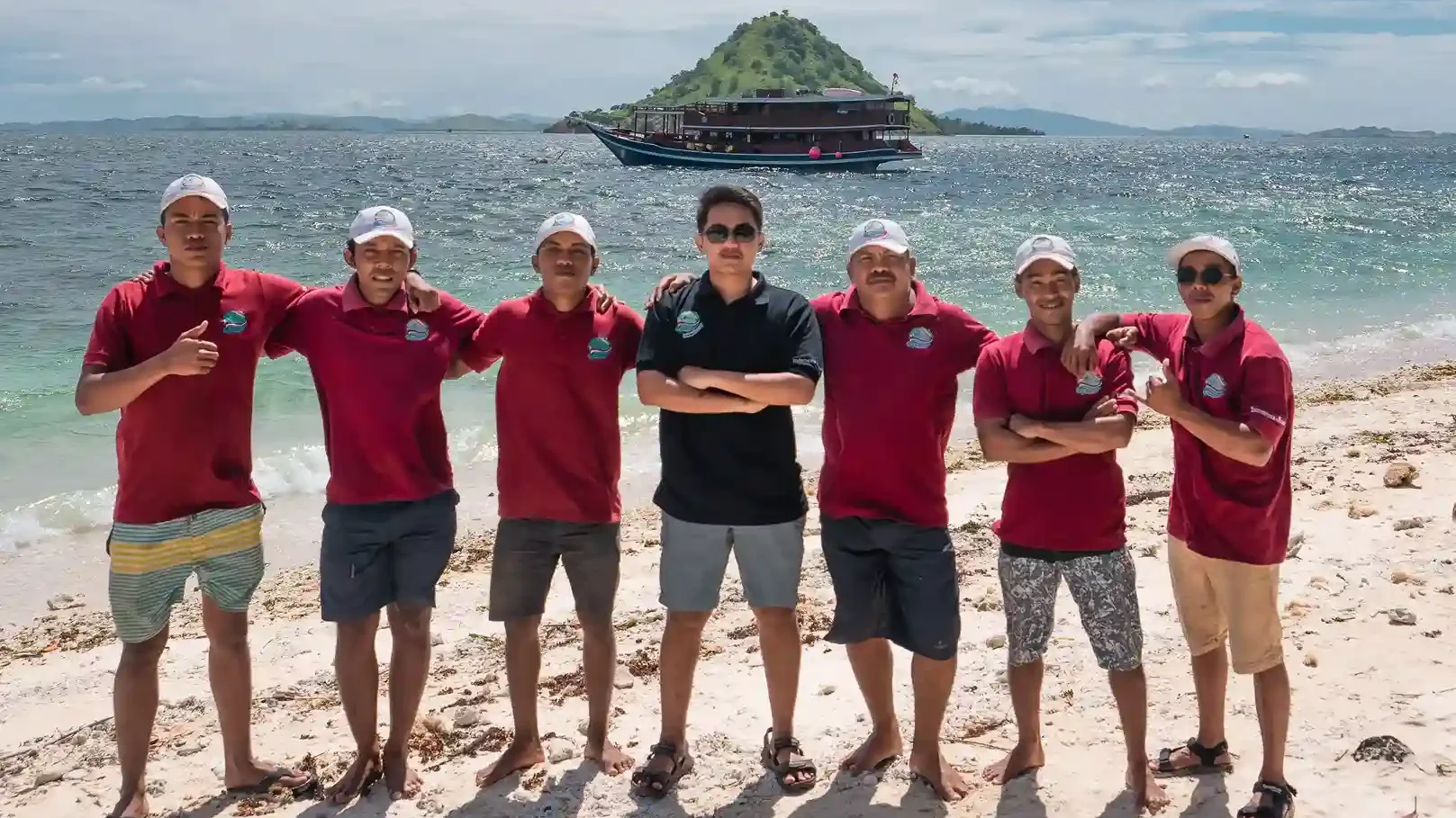
Short answer: Tipping the crew on a Komodo liveaboard is customary but genuinely optional. The usual practice is one shared amount at the end of the trip — commonly framed as roughly five to ten percent of the cruise fare — handed to the cruise director or placed in a communal tip box for the whole crew. Nothing is added to your invoice automatically.
Last updated: August 16, 2026
Is tipping expected on a Komodo liveaboard?
Indonesia is not a strong tipping culture in everyday life: warungs, taxis and shops do not expect it, and restaurants that want a service charge simply add one to the bill. Liveaboard diving is the exception — an international niche where the habit arrived with the guests.
The honest framing, then, is that tipping is a convention rather than an obligation, and your fare is complete without it. What it recognises is a crew ratio you meet on no other kind of holiday: a phinisi carrying a dozen guests runs with a captain, engineer, cook, deck crew, tender drivers and dive guides, from before your first briefing until long after the last tanks are rinsed.
A tip should sit on top of a proper wage, never in place of one. How the crew is employed, and how tips are split, are fair questions to ask before you book, and any operator worth sailing with will answer them plainly.
Komodo Luxury – a registered Indonesian PT (PT Komodo Bahari Nusantara, KBLI 79120) under Juara Holding Group Limited – is one fleet that will set out its crew arrangements on request. Its trip structures are listed on the Komodo Luxury liveaboard page.
How much do guests usually tip the crew?
The most portable rule of thumb in liveaboard diving worldwide, and the one most Komodo guests use, is a percentage of the cruise fare — generally between five and ten percent for the whole party. Guests who prefer a flat figure think in terms of an amount per person per day, scaled to the boat.
Rather than fixating on a number, weigh what actually moves it:
- Length of trip. A weekend sailing and an eight-night crossing are different amounts of work for the same crew.
- Boat standard. A percentage rule scales itself to the fare. On a tight budget, a modest tip given sincerely is received well — see our budget Komodo liveaboard page.
- Crew effort. Tenders to Castle Rock at dawn, gear hauled up a swim ladder in current, three cooked meals a day at sea.
Because the tip is calculated against the fare, it helps to know where your trip sits. Our Komodo liveaboard price guide explains how fares are built, and the inclusions page shows what is already covered, so you are not tipping to cover something already paid for.
Should you tip into a shared box or tip individuals?
On the great majority of Komodo boats, tips are pooled. A box or envelope goes to the cruise director, and the total is divided among everyone on board — sometimes equally, more often in shares weighted by role and seniority.
Pooling exists for a good reason. Guests think of the dive guides, because they are the ones in the water. The people who make the trip possible are often invisible: the engineer keeping the compressor running, the cook working a hot galley in a swell, the deckhand moving tanks at five in the morning.
Individual tipping still has a place. If a guide talked you through your first drift dive or found the frogfish you had chased all week, a discreet separate envelope is normal. Ask the cruise director first, though — some boats pool everything by policy.
When is the right moment to hand over the tip?
The last night on board, or the final morning before you step off in Labuan Bajo. The timing is deliberate: tipping at the start reads as an attempt to buy service, and good crews find it uncomfortable.
Most boats keep it simple — an envelope and a short thank-you at the final dinner, when the crew is introduced by name. If you have an early flight, settle it the evening before rather than in the rush of disembarkation. Our Komodo liveaboard booking guide covers what else to ask before you pay a deposit.
Which currency should you bring for tipping?
Indonesian rupiah is the least troublesome option: crew spend it in Labuan Bajo the same day, with no exchange step and no loss on conversion. Carry mixed denominations so you are not forced to round awkwardly.
US dollars and euros are accepted, but with a catch that surprises first-time visitors: Indonesian money changers are strict about condition. Torn, marked or older-series notes are often refused or exchanged at a poorer rate, so bring clean, recent, large-denomination bills.
- There are no ATMs inside Komodo National Park, and boats run on cash for extras.
- Labuan Bajo’s machines are the last reliable stop and can run dry on busy high-season weekends. Withdraw a day early, not an hour before boarding.
- Some operators can arrange a bank transfer into a crew fund. Ask in advance — it is not universal.
Budget the tip alongside the other cash items. Ranger and entry charges are paid separately from your fare, as explained on our Komodo National Park fees and permits page.
Does a private charter change the etiquette?
The etiquette is identical; only the arithmetic changes. On an open trip the crew receives contributions from every party on board, so your share reflects that. On a private charter the whole pool comes from your group alone — which is why a percentage frame travels better than any fixed figure, whether you sail on a shared Komodo open trip or a private yacht charter.
What if the service was not what you expected?
Tipping is discretionary, so you may give less or nothing at all, and you owe nobody an explanation. But withholding quietly is rarely useful: a pooled tip penalises the cook and the engineer for something that happened on the dive deck.
Speak up during the trip instead — raise it with the cruise director while there is still time to fix it, then put it in writing afterwards if it was not resolved. Anything touching safety, from briefings to tender handling and gas, should be raised immediately; our page on crew safety standards sets out what a properly run boat does as routine. Clear feedback changes how a boat operates. A silent envelope does not.
Frequently asked questions
Is tipping mandatory on a Komodo liveaboard?
No. It is a widely followed convention among international liveaboard guests, not a charge. Nothing is added to your bill automatically, and a professional crew’s service does not depend on it.
Do I tip the dive guide separately from the rest of the crew?
Usually not — most Komodo boats pool tips across the entire crew. A private envelope for a guide who went well beyond the job is fine, but ask the cruise director first, since some boats pool individual gifts by policy.
Can I tip in US dollars or euros instead of rupiah?
Yes, both are accepted, but rupiah is easier for the crew because it needs no exchange. If you bring foreign notes, make sure they are clean, recent and undamaged — money changers here routinely reject worn notes.
Is there an ATM in Komodo National Park?
No. The last reliable cash machines are in Labuan Bajo, and they can be emptied on peak-season weekends. Withdraw what you need for tips, drinks, nitrox and park charges before you board.
Should first-time divers tip differently?
No, the same convention applies. Beginners use more of the guides’ attention on check dives and current briefings, which many acknowledge, but there is no separate rule for them.