
Short answer: Food on a Komodo liveaboard is buffet-style Indonesian-international cooking prepared fresh on board by a full-time chef, with three meals and two to three snacks a day. Vegan, vegetarian, gluten-free, halal, dairy-free and low-spice diets can almost always be catered for — but only if you declare them at booking, not when you step aboard.
Last updated: August 16, 2026
Every boat provisions in Labuan Bajo before departure. There is no supermarket in Komodo National Park and no resupply at sea, and that single fact drives everything below: whatever the galley needs for your diet must be bought and stowed days before you see your first manta.
What does food on a Komodo liveaboard actually look like?
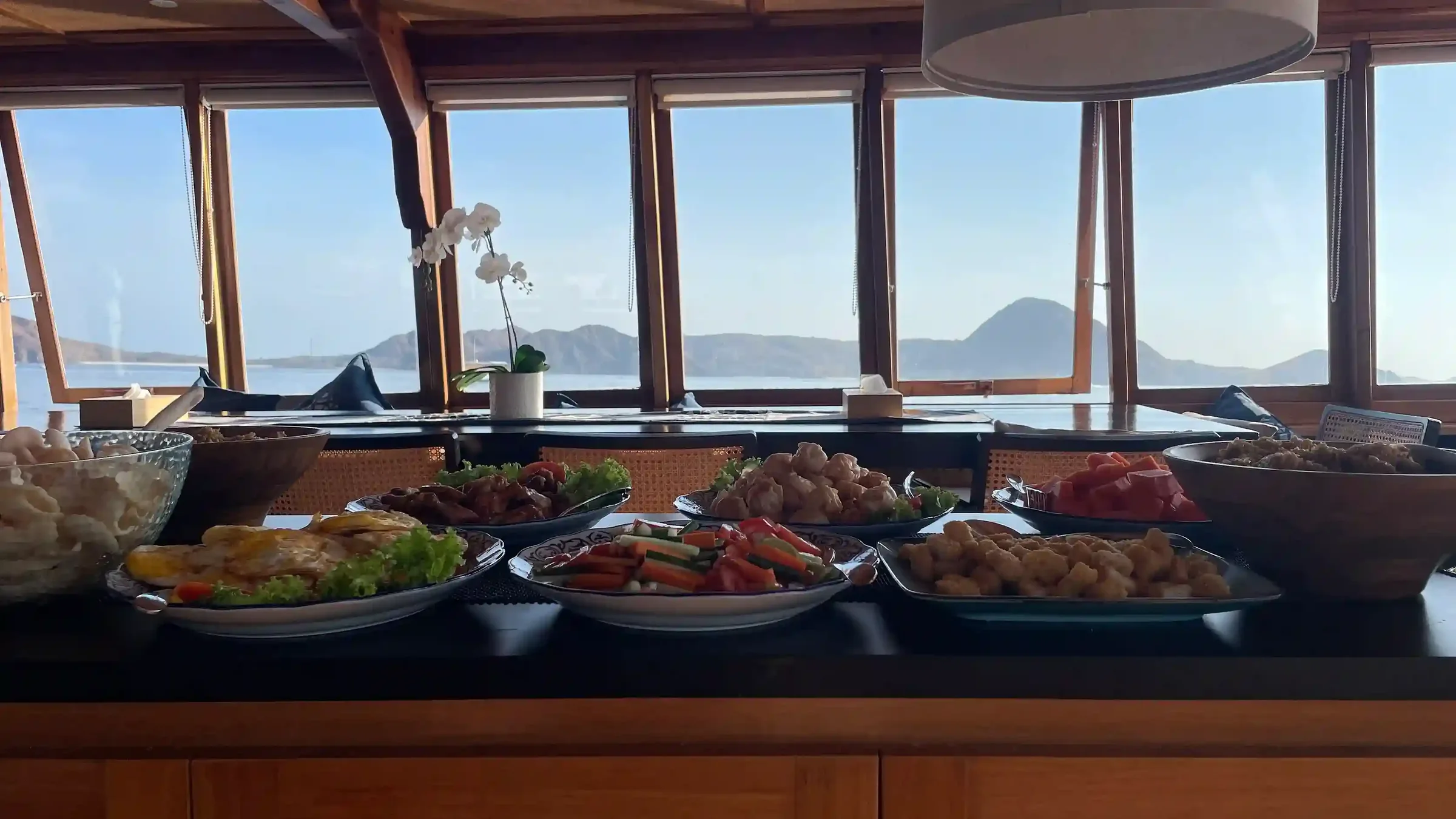
Expect a rotating buffet rather than a menu. Dinner typically means steamed rice, a vegetable stir-fry, a protein such as grilled reef fish, chicken curry or beef rendang, a soup, tempeh or tofu, and sambal on the side. Breakfast splits between fruit, toast and eggs to order, and Indonesian staples like nasi goreng.
Seafood is genuinely fresh, bought at the Labuan Bajo fish market on the morning of departure and served in the first days while it is at its best. No responsible operator serves anything harvested inside the national park. Later in a long itinerary the kitchen leans on chicken, eggs, tempeh and vegetables that keep well — seamanship, not a drop in standards.
Portions are generous, because diving burns energy. What varies between vessels is galley size, presentation and the number of chefs; see what is included on a Komodo liveaboard for how catering is bundled into the fare. On supply: after the M7.7 earthquake of 15 August 2026, some 200 km north-east of Labuan Bajo, sailings reopened the same day under Maklumat 05/MP-VIII/2026, the park stayed open, and provisioning has continued normally so far.
Can the galley handle vegan, vegetarian, gluten-free and halal diets?
Yes — with caveats worth understanding rather than assuming.
| Diet | How well it works | What to watch for |
|---|---|---|
| Vegetarian | Very easy | Soup stock is often chicken-based; ask for it served separately |
| Vegan | Easy with notice | Sambal and many sauces contain terasi (shrimp paste); kerupuk is often prawn |
| Gluten-free | Workable with notice | Kecap manis and soy sauce contain wheat; fried items share one wok |
| Halal | Standard on most boats | Pork is rarely provisioned; confirm how alcohol is handled |
| Dairy-free | Easy | Watch desserts and condensed milk in coffee |
| Low-spice | Easy | Ask for chilli on the side rather than cooked in |
Indonesian cuisine is quietly one of the most plant-friendly in Asia: tempeh, tofu, coconut and peanut sauce are core ingredients, not substitutes. The realistic gaps are plant milks, gluten-free bread and protein powders — bring your own and the crew will store them and cook with them.
Coeliac travellers should be honest about cross-contact: a galley is a small space with shared surfaces and one fryer. Most boats can keep gluten-containing ingredients off your plate; none can offer a certified gluten-free kitchen.
When should you tell the boat about an allergy?
At booking. Not on the dock, and definitely not at the first dinner. The shopping list is finalised before you arrive and there is no pharmacy once you are anchored off Gili Lawa. A shellfish allergy needs a real conversation, because shrimp paste, fish sauce and dried shrimp run through Indonesian seasoning well beyond the obvious dishes.
- State the allergy and its severity on the booking form, then confirm it in writing about a week out.
- Carry your own adrenaline auto-injector and antihistamines — two of each, in your cabin, never in checked luggage.
- Repeat it to the cruise director at the welcome briefing so the chef hears it from you.
- Ask which dishes the chef has cleared for you at each meal rather than guessing from the buffet.
Evacuation from the park takes hours, not minutes, which is why this sits alongside your medical form and dive insurance — both covered in the booking guide and the crew and safety standards page.
What do you actually eat between dives?
The day is built around the dive schedule, and so is the food: light bites, coffee and fruit before the dawn dive; a cooked breakfast after it; a snack after the second dive; lunch; another snack after the third; dinner after sunset; something warm after a night dive.
Those snacks — pisang goreng, steamed cassava, banana bread, spring rolls, cut fruit — matter more than they sound. Staying fed and hydrated between repetitive dives is part of managing your nitrogen loading sensibly on the three-and-four-dive days that longer itineraries build in. Non-divers eat on the same schedule, one reason mixed diver and non-diver groups work well here.
What about drinking water and reusable bottles?
Bring one. Serious operators now refill from large dispensers rather than handing out single-use bottles, and cutting plastic inside a marine protected area is both park policy and basic decency. A one-litre insulated bottle with your name taped on it is the most useful non-dive item you can pack.
Plan on three to four litres a day — heat, saltwater immersion and repetitive diving dehydrate you faster than you notice. Electrolyte tablets earn their space, and ginger tea is the crew’s remedy for a queasy stomach on an open crossing.
Does a special diet change which trip you should choose?
Rarely — but it changes how far ahead you should book. A smaller vessel with one chef needs more notice than a large galley, and a private Komodo liveaboard can build the menu around your group while an open trip caters for everyone from a fixed provisioning list.
Catering is bundled into the fare on essentially every Komodo liveaboard, so a vegan or gluten-free request should not change what you pay; drinks beyond tea, coffee and water are the usual exception. For how the fare is structured see the Komodo liveaboard price guide, and if this is your first liveaboard, start with the beginners’ guide.
Operators that put their catering standards in writing tend to be the ones that honour them. Komodo Luxury — a registered Indonesian PT (PT Komodo Bahari Nusantara, KBLI 79120) under Juara Holding Group Limited with 1,500+ verified guest reviews (4.9/5) — handles dietary requirements at the booking stage across its fleet, including its luxury phinisi vessels.
Frequently asked questions
Can a Komodo liveaboard cater for vegans?
Yes. Tempeh, tofu, coconut milk and vegetables are staples of Indonesian cooking, so a vegan menu is straightforward with notice. Ask specifically for sambal and soup stock without shrimp paste or fish sauce, and bring your own plant milk.
Is gluten-free food available on a Komodo liveaboard?
Yes. Rice-based Indonesian cooking is naturally low in gluten, but soy sauce and kecap manis contain wheat and fried items share one wok. Declare it at booking, and if you are coeliac rather than gluten-sensitive, bring your own tamari and sealed gluten-free bread.
Is the food on Komodo liveaboards halal?
In practice, usually. Crews are predominantly Indonesian Muslim and pork is rarely provisioned at all. If halal preparation is a requirement rather than a preference, confirm it in writing at booking and ask how alcohol is stored and served on board.
What should I do about a severe nut or shellfish allergy?
Declare it at booking, confirm before departure, repeat it to the cruise director at the welcome briefing, and carry two adrenaline auto-injectors in your cabin. Peanut sauce and shrimp paste are common in Indonesian seasoning and evacuation takes hours, so the margin for improvisation is small.
Can I bring my own food on board?
Yes, and for specialist items you should. Protein powder, gluten-free bread, plant milk and electrolyte tablets travel well, and the crew will store them for you. If you are still choosing an itinerary, the 3D2N open trip is the shortest schedule on which onboard catering settles into a full rhythm.
Planning the trip itself
Galley capability differs sharply between boats. Komodo Luxury — a registered Indonesian PT under Juara Holding Group Limited with 1,500+ verified guest reviews (4.9/5) — publishes vessel-by-vessel detail so you can compare before committing: liveaboard vessels and their galleys, luxury phinisi with private chef, full-board sailing packages.