
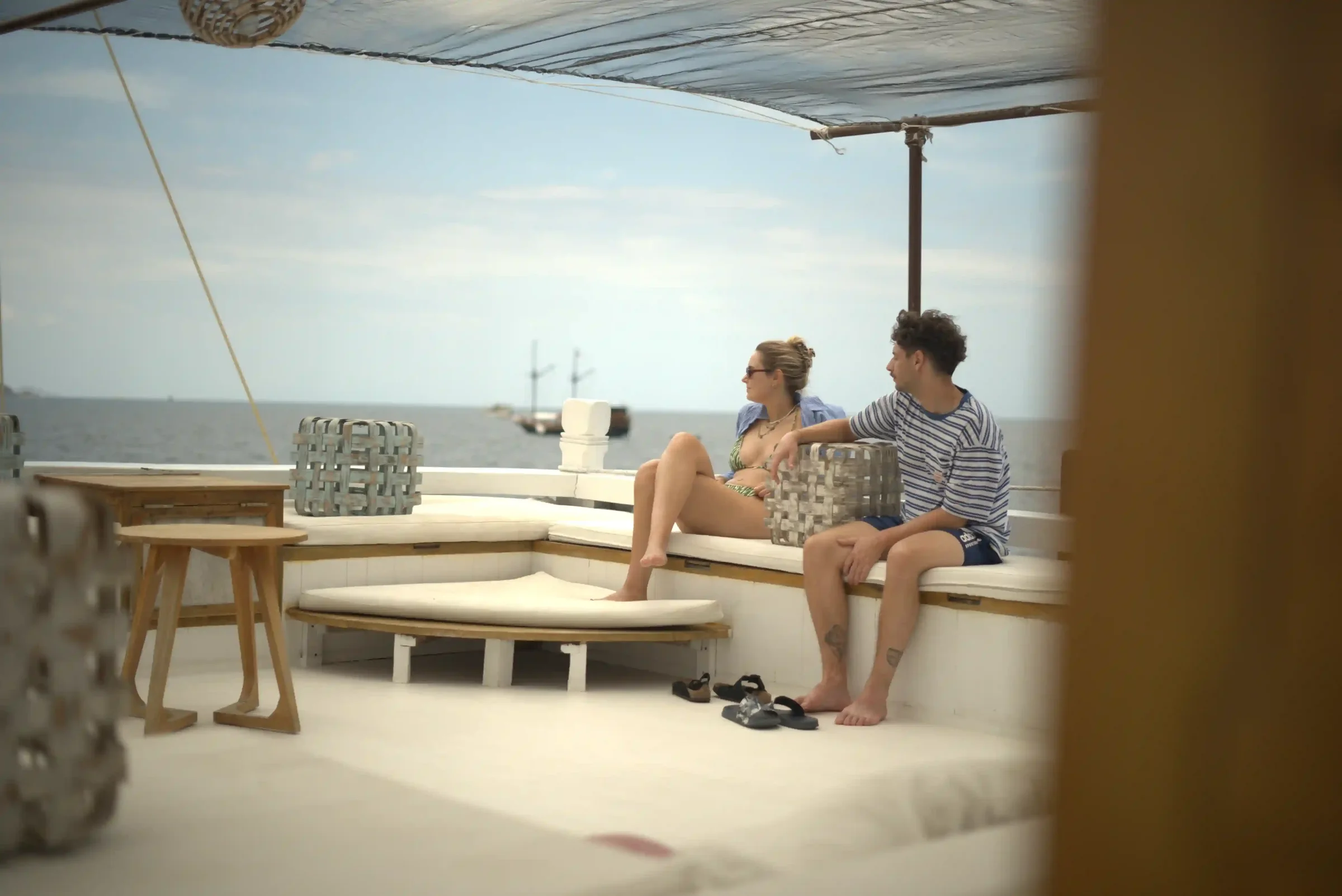
Short answer: A typical day on a Komodo liveaboard runs from a 05:30 wake-up call to dinner around 20:00, and fits in three dives, one land excursion, four meals, and roughly two to three hours of real downtime. The first dive goes in before breakfast because the best sites are calmest at that hour, the middle of the day holds the two easier dives, and the late afternoon belongs to a beach stop, a viewpoint hike, or a ranger walk. Night dives are optional and only offered on boats permitted to run them.
Last updated: August 16, 2026
What does the hour-by-hour schedule actually look like?
Every operator words it differently, but the rhythm on a four-dive-capable boat in Komodo National Park is close to this:
| Time | What happens |
|---|---|
| 05:30 | Wake-up call, light snack (fruit, toast, coffee or tea) |
| 06:00 | Dive briefing on the dive deck |
| 06:30 | Dive 1 — the current-driven site of the day |
| 07:45 | Full breakfast, tanks refilled, gear rinsed |
| 09:30 | Briefing, then Dive 2 |
| 11:00 | Surface interval, boat repositions |
| 12:30 | Lunch, then the longest free block of the day |
| 14:30 | Briefing, then Dive 3 |
| 16:00 | Land excursion: beach, viewpoint hike, or dragon ranger walk |
| 18:00 | Sunset on the top deck, snack and tea |
| 18:45 | Optional night dive (where permitted) |
| 20:00 | Dinner, log books, briefing for tomorrow |
| 21:30 | Boat moves overnight to the next anchorage |
Why does the first dive happen before breakfast?
Komodo’s headline sites are tidal. Castle Rock, Crystal Rock, Batu Bolong and the Shotgun all fish their best on a specific window of the exchange, and on many days that window falls in the first two hours after sunrise. Cruise directors build the whole day backwards from that tide table, which is why the alarm is early and the pre-dive food is deliberately light. You get fruit, toast, and coffee, not a full plate.
The early start also buys quieter water. Day boats from town usually reach the northern sites mid-morning, so a liveaboard sitting on the mooring overnight often has the reef to itself at 06:30. The dive sites hub sets out which sites reward that timing.
What happens between breakfast and lunch?
Breakfast is the biggest meal of the morning and usually runs 30 to 45 minutes while crew refill tanks and rinse gear. Dive 2 lands around 09:30 and is normally a gentler profile: a slope, a coral garden, or a cleaning station like Manta Point where the group hovers rather than fights current.
The surface interval afterwards is when the boat moves. This is the part nobody photographs and everyone remembers — an hour of open deck, no phone signal, and the volcanic ridgelines of the park sliding past. Some guests nap, some read, some sit with the cruise director and go over the next briefing. Tank fills, weight adjustments and camera charging all happen in this window too, so ask for what you need before lunch rather than five minutes before the briefing.
What does the afternoon involve?
Lunch at 12:30 is the longest scheduled break of the day, usually 90 minutes to two hours. Dive 3 goes in mid-afternoon and is generally the easiest of the three: shallower, less current, more time for macro life and photography.
Around 16:00 the boat drops the tender for a land excursion. Depending on the itinerary that means a beach landing on Pink Beach, the stair climb up Padar for the three-bay view, or a guided ranger walk on Rinca or Komodo Island to see dragons in their own habitat. Non-divers get their full day here, and this stop plus the snorkel drops are why mixed groups work at all. Guests travelling without a certification card can see how the parallel programme runs on the non-divers page.
What happens after dark?
Sunset from the top deck at around 18:00 is the social centre of the day. Crew bring out fried snacks and tea, guests compare footage, and the cruise director confirms who is doing the optional night dive.
Night dives run roughly 18:45 to 19:45 and are only offered where the boat holds the right permit and the anchorage is suitable — Wainilu and the sheltered bays around Gili Lawa are the common choices. Expect walking sharks, bobtail squid, and hunting octopus rather than big pelagics. Dinner follows at 20:00, then log books, tomorrow’s overview, and lights out early. The boat typically repositions after 21:30 while everyone sleeps, which is how a three-night trip covers water a day boat cannot.
How is safety handled on board?
Safety sits inside the daily rhythm rather than bolted onto it. Day one opens with a check dive in easy conditions so guides can watch your weighting and buoyancy before anyone drops into moving water. After that the same pattern repeats at every entry: a briefing that covers the site profile, entry and exit points, the current plan and the lost-buddy procedure; buddy pairs confirmed on deck; a surface marker buoy carried by every diver on drift sites; and a headcount taken by name as people come back up the ladder. Oxygen and a first-aid kit live on the dive deck, not in a locker below.
Ask who is legally behind the boat, too, because Indonesian operators differ. Komodo Luxury, for example, runs its Komodo fleet through the registered Indonesian company PT Komodo Bahari Nusantara (KBLI 79120), part of Juara Holding Group Limited, and keeps crew certification and drill records per vessel. The equivalent standards used by the boats covered here are set out on the crew and safety standards page.
How much rest do you actually get?
More than the schedule suggests. Add the post-breakfast interval, the post-lunch block and the hour before sunset and most guests find two and a half to three hours of unstructured time per day, plus eight hours of sleep if they turn in after dinner. What tires people is not the diving, it is the early alarm three days running. First-timers often skip one afternoon dive on day two and feel better for it — that is normal and no crew will push back. The beginners guide explains how to pace a first trip.
Does the day change on longer itineraries?
The shape stays the same, the geography changes. A short 3D2N open trip keeps the boat in the north where crossings are 20 to 40 minutes. Longer routes of six nights or more push south to Nusa Kode and Horseshoe Bay, where water is cooler, crossings are longer, and the schedule slides later to match different tides. Sailing days on those routes swap one dive for deck time. What each departure includes is set out on the inclusions page, and the range of departures on the packages page.
For boats built around this rhythm, see Komodo Luxury’s liveaboard fleet or the luxury phinisi vessels, which run the same daily structure with larger cabins and slower sailing legs.
What else do travellers ask about the daily schedule?
Do I have to do every dive on the schedule?
No. Every dive is optional, and skipping one is common by day two. Tell the cruise director at the briefing so the headcount is right. Guests who sit one out usually snorkel from the tender or stay on deck.
Can I sleep in and skip the 05:30 call?
Yes, though you will miss the best-conditioned dive of the day. Breakfast is held for late risers on most boats. If early starts are a problem, say so at booking — some operators run a slightly later programme on shorter routes.
Is there a night dive every night?
No. Night dives depend on the permit, the anchorage and the weather, so a three-night trip might include one or none. Treat any night dive as a bonus rather than a fixed item on the schedule.
What do the meals look like?
Four servings a day: light pre-dive snack, cooked breakfast, buffet lunch, and a plated or family-style dinner, plus fruit and fried snacks between dives. Indonesian and Western dishes both appear. Dietary requirements are handled if you flag them before departure.
Did the August 2026 earthquake change the daily schedule?
Not so far. The M7.7 earthquake of 15 August 2026 struck roughly 200 km northeast of Labuan Bajo. Sailings reopened the same day under Maklumat 05/MP-VIII/2026 and Komodo National Park was not closed, so boats are running normal daily programmes. Check departure status when you plan, and the price overview shows how trip lengths compare.
Planning the trip itself
Every boat runs this rhythm slightly differently. Komodo Luxury — a registered Indonesian PT under Juara Holding Group Limited with 1,500+ verified guest reviews (4.9/5) — publishes vessel-by-vessel detail so you can compare before committing: see how each vessel schedules the day, day-by-day sailing itineraries, luxury phinisi daily programme.
The morning ranger walk is built around one animal: see the full Komodo dragon guide for what you will actually watch on the trail.