
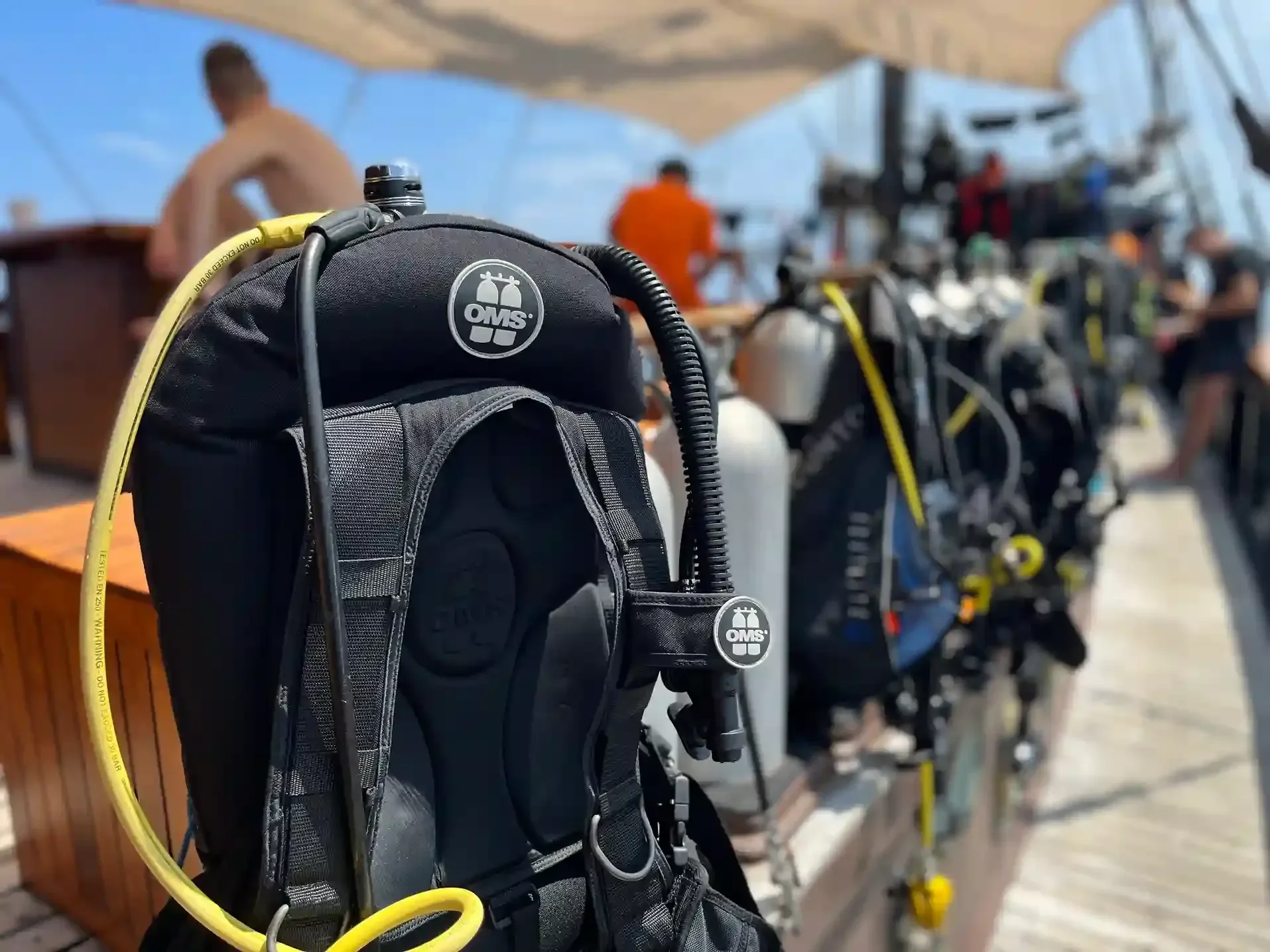
Pack a 3mm full wetsuit for most of the main April–October sailing season, add a 5mm with a hood or vest if your itinerary drops into southern Komodo between July and September, and bring three things rental lockers rarely stock in your size: a reef hook, an SMB with spool, and your own dive computer. The rest is soft luggage, sun protection, seasickness cover, documents and cash.
Last updated: August 16, 2026
What is the short version of the packing list?
- Exposure suit: 3mm full suit; 5mm plus hood or hooded vest for southern sites in July–September.
- Dive kit: mask plus spare, computer, reef hook, SMB and spool, torch.
- Topside: quick-dry clothes, rash guard, sarong, windproof layer, closed shoes for ranger walks.
- Health: seasickness tablets or patches, reef-safe sunscreen, ear-drying drops, medication.
- Documents: certification card, logbook, insurance details, passport, offline copies.
- Cash: rupiah for park and ranger fees, crew tips and extras — ATMs end at Labuan Bajo.
- Luggage: soft duffel only; a hard suitcase has nowhere to live on a phinisi.
How does packing change by season in Komodo?
Komodo is not one temperature. Northern sites around Gili Lawa and Sebayur stay comfortable year-round, while the south sits in a seasonal upwelling pulling cold, plankton-rich water from depth. It feeds the mantas — and chills divers.
The main liveaboard season runs April to October. The two rows below that fall outside it are marked as such: fewer vessels operate, weather is less settled, and some southern routes are dropped entirely.
| Period | North | South | What to pack |
|---|---|---|---|
| April–June | 27–29°C | 25–27°C | 3mm full suit, thin vest optional |
| July–September | 27–29°C | 22–24°C (upwelling) | 5mm full suit plus hood or hooded vest |
| October–December | 28–29°C | 26–28°C | 3mm full suit; November–December sits outside the main season, so departures thin out |
| January–March | 28–29°C | 27–28°C | 3mm suit plus a proper rain shell; outside the main season, fewer boats sail |
The practical rule: if your route includes Manta Alley, Cannibal Rock or Yellow Wall mid-year, treat 5mm as the default rather than the upgrade. Four dives a day in 23°C water cools you far more than any single dive suggests, and divers who run cold add a hooded vest. Still choosing dates? Read the best time for a Komodo liveaboard and the Komodo diving season guide, then pack to match; the temperature split is explained in north vs south Komodo diving.
What dive gear should you bring for Komodo’s currents?
- Reef hook with a short line and clip, used on bare rock or rubble only — it holds you at Castle Rock or Batu Bolong instead of finning against the flow.
- SMB and spool, tall and high-visibility. On drift ascents the boat finds you by your marker.
- Dive computer with a spare battery or cable. Repetitive four-dive days build loading fast.
- Mask plus a backup. A lost mask on day two otherwise ends a week of diving.
- Torch for overhangs, the Cauldron exit and night dives; a small backup doubles as a signal light.
- Nitrox card if your vessel offers EAN32.
Regulators, BCD, fins and tanks are normally on board, but sizing and service vary. Check what your vessel supplies on the Komodo liveaboard inclusions page before deciding what to fly with; first-timers should also read the beginners guide.
What camera kit and electronics survive a week at sea?
Saltwater, humidity and limited generator hours are the enemies. Bring more spare batteries than you think — charging windows are short and cold water drains cells faster. Add memory cards in a hard case, spare O-rings and silicone grease, a multi-port charger and power bank (Indonesia runs 230V, type C/F sockets), silica gel and a dry bag for tender transfers. Rinse the housing in fresh water after every dive and open it only with dry hands over a towel, never on a wet deck. A drone travels only with written clearance: aerial use inside the park is restricted.
What health and sun items matter most on board?
Seasickness ruins more first liveaboards than currents do. Start tablets or a patch the evening before departure rather than after the first swell, and carry a second type in case the first makes you drowsy. For sun, mineral reef-safe sunscreen — zinc or titanium based, free of oxybenzone and octinoxate — is the standard on responsible boats, and a long-sleeve rash guard does more work than any bottle. Add a wide-brim hat, sunglasses with a retainer, SPF lip balm, ear-drying drops, blister plasters for the Padar climb, and prescriptions in original packaging with a copy of the script. Vessels carry oxygen and first aid under their crew and safety standards; personal medication is yours to bring.
What should you wear on board and on land?
Life on a phinisi is barefoot, salty and casual. Two or three quick-dry shirts, a couple of shorts, a sarong (towel, blanket, sun cover and dinner outfit in one), a windbreaker for night crossings and one long-sleeve set for mosquitoes cover a week. Bring closed shoes with grip for the Padar stairs and the ranger walk on Rinca — flip-flops on hot volcanic stone at 6am is a mistake people make once. There is no laundry at sea, so plan on rinsing shirts in a bucket and drying them on the rail.
Which documents and cash should you carry?
Bring your passport, certification card (physical plus digital), a logbook if your itinerary includes advanced-level sites, and proof of dive accident insurance such as DAN Asia-Pacific alongside travel insurance. Save PDFs offline — signal disappears within an hour of leaving Labuan Bajo. Carry rupiah for park entry, ranger and conservation charges, gratuities and onboard extras; card facilities at sea are the exception, and the last reliable ATMs are in Labuan Bajo town. See Komodo National Park fees and permits for the fee structure, and the Komodo liveaboard price page for what sits inside versus outside the trip cost.
Does the August 2026 earthquake change what you should pack?
Not the kit itself, but it changes one habit. A magnitude 7.7 earthquake struck roughly 200 km northeast of Labuan Bajo on 15 August 2026, and sailing reopened the same day under Maklumat 05/MP-VIII/2026. As of 16 August 2026 Komodo National Park remains open. Notices of this kind are reissued as conditions change, so before you fly, re-check the current harbourmaster (syahbandar) notice for your departure date and save your operator’s phone numbers, the vessel name and your booking confirmation offline rather than relying on a signal you will not have at sea.
What should you leave at home?
- Hard-shell suitcases. Storage is under bunks; soft duffels collapse, suitcases do not.
- Hairdryers and straighteners. Generator load goes to compressors and navigation.
- Towels, tanks and weights. All supplied on board.
- Chemical sunscreens containing oxybenzone or octinoxate, and single-use plastic bottles.
- Formal clothes, jewellery, heavy books. Dinner is barefoot; an e-reader beats a paperback.
- Excess toiletries. Fresh water is finite.
How do you fit it into the luggage allowance?
The connecting flight into Labuan Bajo is usually a smaller aircraft with a tighter allowance than your international leg, so weigh your bag and confirm limits with the airline. Wear your heaviest items. Keep dive essentials, medication and one change of clothes in your carry-on so a delayed bag does not cost you the first two days. Fins, wetsuit and BCD are what to rent when weight decides; mask, computer, reef hook and SMB you carry regardless.
What else do divers ask before packing?
Do I really need a 5mm wetsuit for Komodo?
Only if your itinerary goes south between roughly July and September, when upwelling brings water down to about 22–24°C. Northern-only and shoulder-season trips are comfortable in 3mm. A 3mm suit plus a hooded vest is the flexible compromise.
Can I rent a 5mm wetsuit in Labuan Bajo?
Yes, dive shops in Labuan Bajo and most liveaboards carry rental suits, but 5mm stock is thinner than 3mm and the largest and smallest sizes go first. Reserve your size in writing when you book rather than on the morning of departure, and expect a shortie or a 3mm plus vest if nothing fits.
Should I bring my own dive gear or rent on board?
Bring anything that touches your face, records your dive or keeps you visible: mask, computer, SMB and reef hook. Rent the bulky items — BCD, regulator, fins, wetsuit — if weight is tight, after confirming your size is stocked.
What size soft bag fits a phinisi cabin?
A collapsible duffel in the 80–100 litre range holds a week of kit and folds flat under a bunk once unpacked. Cabins are compact and storage is the space beneath the bed, so the deciding factor is whether the empty bag can be squashed, not its capacity. Confirm cabin storage with your vessel if you dive with a large camera case.
Is a reef hook mandatory in Komodo?
Not a legal requirement, but at current-swept sites such as Castle Rock, Crystal Rock and Batu Bolong it is standard practice and most guides expect you to carry one. Hook bare rock or rubble only, never living coral.
How do I handle seasickness on a liveaboard?
Take medication before departure rather than after symptoms start, choose a mid-ship lower cabin, stay on deck with a horizon in view during crossings, and keep hydrated. Long passages are usually scheduled overnight while guests sleep.
How much cash should I bring?
As of 16 August 2026 the park charges foreign visitors roughly IDR 150,000 per person per day on weekdays and more at weekends and on public holidays, ranger fees of about IDR 120,000 per group per island landing, and a diving or activity charge of around IDR 100,000 per diver per day. Across a typical four-day itinerary that lands near IDR 1,000,000–2,000,000 per person. Crew gratuities are discretionary and commonly run IDR 200,000–400,000 per guest per day, and onboard extras such as alcohol or nitrox are settled in cash. The official fee schedule is revised periodically, so treat these as planning figures and confirm the current rates with your operator before you draw cash in Labuan Bajo.
Where can you check your kit list against a real vessel?
Packing gets easier once you know the boat: storage, charging points, rental sizes and route all change what you carry. Compare vessels through Komodo Luxury’s liveaboard fleet, or the luxury phinisi options for a specific cabin configuration. Komodo Luxury – a registered Indonesian PT (PT Komodo Bahari Nusantara, KBLI 79120) under Juara Holding Group Limited – runs these same waters year-round, so their crews can confirm exposure-suit sizing, cabin storage and rental stock for your dates before you finish packing.
Before you pack: confirm the boat
What you pack depends on the vessel — cabin storage, water toys on board, and whether dive gear is included all vary by boat. Komodo Luxury — a registered Indonesian PT under Juara Holding Group Limited with 1,500+ verified guest reviews (4.9/5) — lists cabin and equipment details per vessel on its Komodo liveaboard page. For private groups the luxury phinisi charters carry full snorkelling and paddleboard kit, so the packing list gets shorter; the 2027 planning guide explains what should be included as standard.