Last updated: August 16, 2026
No, you do not need Advanced Open Water to join a Komodo liveaboard — but you do need it for the sites most people come here for. Open Water covers the calmer central and southern dive sites, while Castle Rock, Crystal Rock and Shotgun (The Cauldron) are run as Advanced-level drift dives with roughly 20–30 logged dives expected. Guides confirm your real level on a check dive, not on paperwork.
What certification level do Komodo liveaboards actually require?
There is no single government diving rule for Komodo National Park. Each boat and each guide sets the bar, and those bars cluster tightly. The table reflects what Labuan Bajo liveaboards typically ask for in the 2026 season.
| Your level | Logged dives asked | What you can normally dive |
|---|---|---|
| Non-diver / snorkeller | — | Full surface programme, manta snorkelling, island treks |
| Open Water | 0–20 | Sheltered central and southern sites, shallow reefs, muck sites, gentle slopes to 18 m |
| Advanced Open Water | 20–30 | Most standard itinerary sites, moderate drift and pinnacles to 30 m |
| Advanced + drift experience | 30–50 | North Komodo signature sites: Castle Rock, Crystal Rock, Shotgun, Batu Bolong, Golden Passage |
| Nitrox | — | Never required; useful on 3–4 dive days, offered as an add-on |
Some boats publish a hard minimum; others let the guide decide after seeing you dive. Both are normal. What matters is declaring your real experience at booking, not at the dock. For a cross-check, the Komodo liveaboard programme at Komodo Luxury lists level expectations per itinerary.
Is Open Water certification enough for Komodo?
Yes, for a meaningful part of the park. Open Water divers regularly dive Siaba Besar, Sebayur, Wainilu, Mawan and the shallow sections of Tatawa Besar, plus the manta cleaning stations at Karang Makassar when conditions settle. Wainilu is a slow, shallow critter dive that suits divers still building buoyancy — more on it in our guide to Komodo muck diving.
The honest limitation is not depth. It is current. Komodo sits in a tidal choke point between the Flores Sea and the Indian Ocean, and water moves hard through the northern channels on spring tides. A diver with fifteen holiday dives can be comfortable at Siaba and out of their depth at Castle Rock two hours later. That is why itineraries are built around the least experienced diver, and why mixed-level groups split into separate dinghies — see north vs south Komodo diving.
Which Komodo dive sites require Advanced and drift experience?
These are the sites where operators are least flexible, because a diver who cannot hold position or deploy an SMB in current creates risk for the whole group:
- Castle Rock — exposed pinnacle, negative entry, reef hooks common. Advanced plus current experience is the standard.
- Crystal Rock — similar exposure with a shallower top; still an Advanced-level drift.
- Shotgun / The Cauldron — channel dive with a downcurrent section and a fast flush through the bowl.
- Batu Bolong — narrow ridge with current splitting both sides; buoyancy matters more than the card.
- Golden Passage and The Passage — tidal channels dived on a narrow window.
Full profiles sit on our Komodo dive sites hub, including which sites tolerate a lower experience level on a neap tide.
How many logged dives do you need for a Komodo liveaboard?
Twenty to thirty is the figure you will see most often — a reasonable floor, not a formality. Two conditions matter as much as the number:
- Recency. Many boats want your most recent dive inside the last six to twelve months. If you have been dry longer, book a refresher in Labuan Bajo rather than losing your first day at sea.
- Relevance. Thirty warm shallow dives in a lagoon is not the same preparation as ten in moving water. Guides ask specifically whether you have drifted, used a reef hook, or done a negative entry.
Bring a logbook, paper or app, even if nobody asks. Our crew and safety standards page explains how guide ratios and briefings are built around these declarations.
What happens on the check dive?
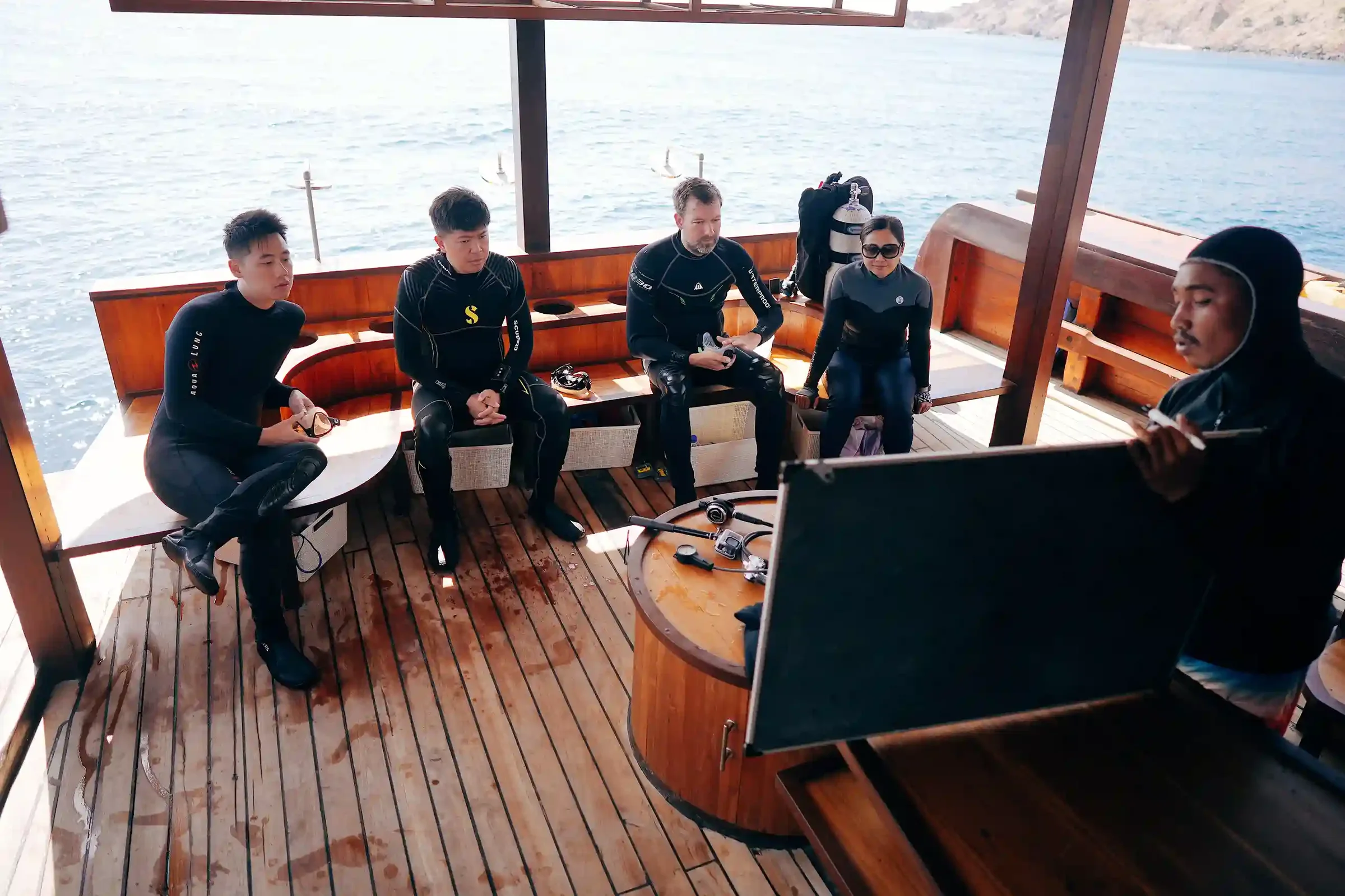
Almost every Komodo liveaboard opens with a check dive at a sheltered site. It is not pass-or-fail. The guide watches weighting, trim, air consumption and how you respond to a signal, then decides which dinghy you join for the week. Be prepared to be reassigned away from a headline site — that is the system working. If your buoyancy is rusty, say so at the briefing rather than discovering it at 25 metres on a pinnacle.
What are your options if you are not certified yet?
- Certify in Labuan Bajo first. Open Water runs three to four days, Advanced two, Nitrox one. Add a buffer day so weather does not eat your course.
- Take a course on board. Some boats carry an instructor. This suits longer itineraries and works poorly on short ones, because course dives consume the same slots as the fun dives.
- Join as a snorkeller. Manta snorkelling at Karang Makassar, Padar, Pink Beach and the dragons are surface activities — see Komodo liveaboard snorkelling and our guide for non-divers.
If you are certified but new, start with Komodo liveaboards for beginners. Course and gear costs usually sit outside the boat fare; ranges are on our Komodo liveaboard price page rather than quoted here, because they move with season and operator.
What documents should you bring?
- Certification card, physical or the digital version in your agency app.
- Logbook or app history, especially if you are near a stated minimum.
- Diver accident insurance — DAN Asia-Pacific or an equivalent policy covering chamber treatment and evacuation.
- Medical statement. If you answer yes to anything on the standard questionnaire, bring a physician’s sign-off from the last twelve months; clearance is hard to arrange from Labuan Bajo.
- Passport, for park registration and the boat manifest.
Operators differ in how strictly they check. Komodo Luxury — a registered Indonesian PT (PT Komodo Bahari Nusantara, KBLI 79120) under Juara Holding Group Limited — verifies certification and insurance at booking rather than at the dock, which is the pattern worth looking for. Their luxury phinisi fleet lists the diving level assumed for each vessel.
Did the August 2026 earthquake change any diving requirements?
No. A magnitude 7.7 earthquake struck on 15 August 2026 roughly 200 km north-east of Labuan Bajo. Sailing reopened the same day under Maklumat 05/MP-VIII/2026, Komodo National Park was not closed, and so far certification, logged-dive and insurance expectations are unchanged. Briefings may carry extra site condition notes — listen for them rather than assuming last season’s profile.
What should you remember before booking?
- Open Water gets you real Komodo diving; Advanced plus drift experience gets you Castle Rock, Crystal Rock and Shotgun.
- 20–30 logged dives is the common minimum, with recency inside six to twelve months.
- The check dive, not the card, decides your site list.
- Certify or refresh in Labuan Bajo before embarkation, with a buffer day.
What else do divers ask about Komodo certification rules?
Can an Open Water diver do a Komodo liveaboard?
Yes. Open Water divers are welcome on most Komodo liveaboards and dive the sheltered central and southern sites within their 18-metre limit. They are usually kept off the strong-current northern pinnacles, and the itinerary is planned around that split.
Do I need Advanced Open Water for Castle Rock and Crystal Rock?
In practice, yes. Both are exposed pinnacles dived in current with negative entries, and operators treat Advanced plus prior drift experience as the working requirement. A guide can still decline based on the check dive.
What is the minimum number of logged dives for Komodo?
Most boats ask for 20–30, and 30–50 for itineraries weighted toward north Komodo. Recency matters too: if your last dive was over a year ago, plan a refresher before boarding.
Do liveaboards accept SSI and NAUI as well as PADI?
Yes. PADI, SSI, NAUI, RAID, CMAS and SDI/TDI cards are all recognised in Komodo, and boats compare equivalent levels rather than agency names. What the guide reads is the level and the logged-dive history behind it, so bring your logbook whichever agency trained you.
Is dive insurance mandatory in Komodo National Park?
The park does not impose its own diving insurance rule, but most liveaboards make diver accident cover a condition of boarding and some ask for the policy number before departure. With the nearest recompression chambers in Bali, cover including chamber treatment and evacuation is worth carrying regardless of who asks for it.
Can I get certified during the liveaboard itself?
On some boats, yes — usually Open Water, Advanced or Nitrox with an instructor aboard. It suits longer itineraries, since course dives use the same slots as recreational ones. Confirm instructor availability before booking.
Is Nitrox certification necessary in Komodo?
Optional but useful. With three to four dives a day, nitrox gives more comfortable surface intervals and bottom time. Most boats offer it as a paid add-on for certified divers.
What happens if the guide says I cannot dive a site?
You are offered an alternative site with the appropriate group. This is standard practice in current-driven destinations. Raise your comfort level at the briefing rather than after the drop.
Not sure which level your route assumes? Compare diving levels route by route on the Komodo liveaboard itineraries and match them against your logbook before committing to dates.