
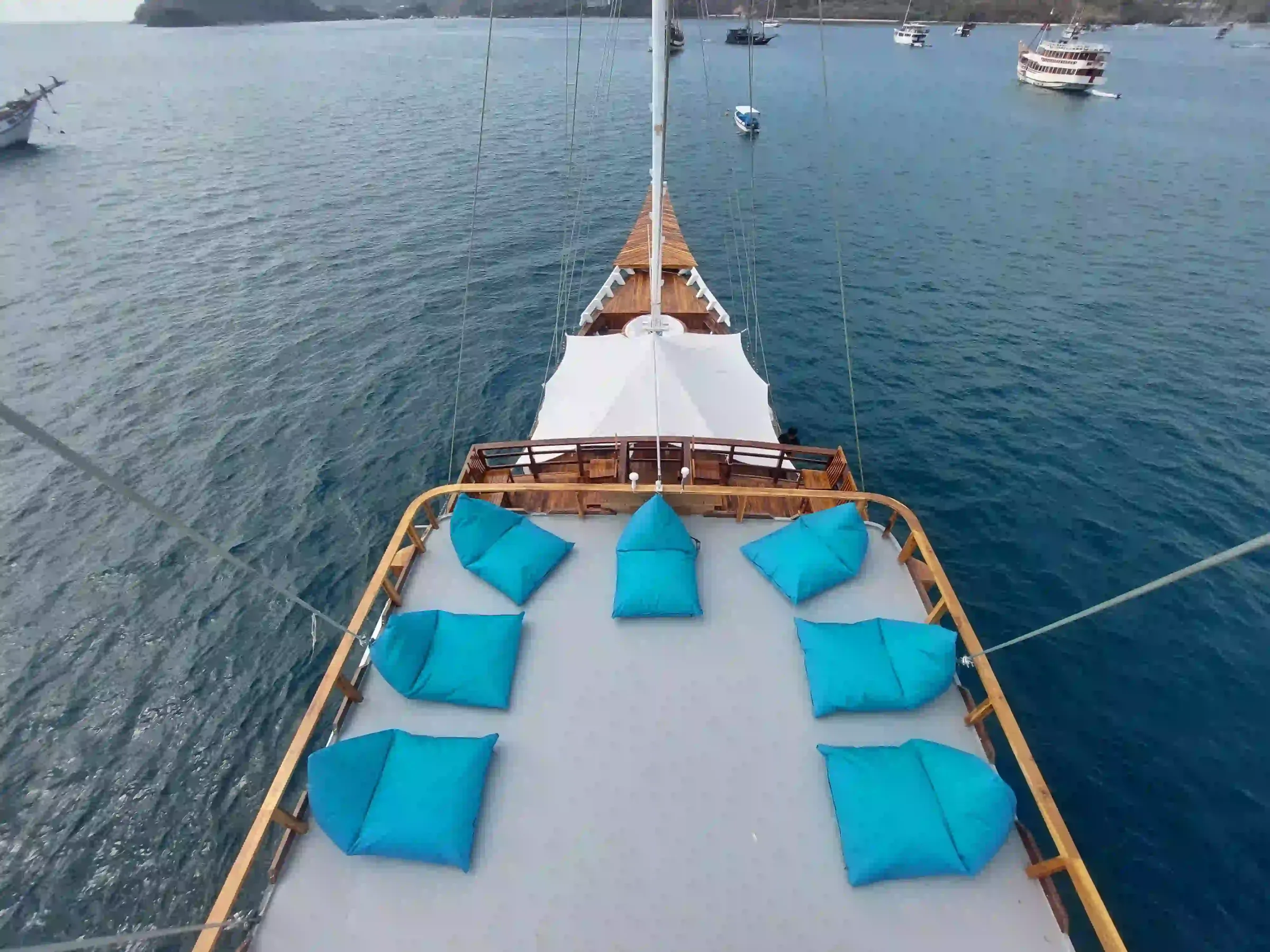
Short answer: no Komodo liveaboard is step-free, and none should be described as wheelchair accessible the way a hotel might be — but travellers with limited mobility do sail Komodo successfully every season when the boat, cabin and itinerary are chosen deliberately. The three hard moments are the stairs between decks, the transfer into a small tender, and climbing back aboard from the water.
Last updated: August 16, 2026
How accessible is a Komodo liveaboard, really?
Most Komodo liveaboards are wooden phinisi, built on a tradition that predates any accessibility standard. That shapes the layout:
- Companionway stairs are steep. Many run at 45–60 degrees — closer to a ladder than a staircase, with narrow treads and one handrail.
- Doorways are narrow with raised sills. Thresholds often sit 10–20 cm above the floor to keep water out. A manual wheelchair usually cannot pass, and below-deck corridors are rarely wide enough to turn one.
- There are no lifts. A few large steel motor yachts have hydraulic platforms; the classic wooden fleet does not.
- The floor moves. Balance that is fine ashore is harder afloat, especially at night.
In practice: a guest who can walk short distances, grip a handrail and manage an assisted step down of 40–60 cm will generally cope well. A guest who cannot transfer out of a wheelchair faces real limits on a shared departure, and a private vessel becomes the honest option, not a luxury upgrade.
Which moments on board are hardest?
Stairs between decks. Cabins sit on lower, main and sometimes upper decks while meals are served above, so a lower-deck cabin means climbing several times a day. Requesting a main-deck cabin at booking removes most of it.
The tender transfer. You do not step onto a pier. You step down from the swim platform into a dinghy rising and falling independently of the mother ship, with two crew steadying it. This is where guests with reduced mobility struggle most, and it repeats daily.
Re-boarding from the water. After a snorkel or dive you climb three to five rungs on the dive platform, often with current pushing you sideways. Wide steps and double handrails matter enormously. Crew can take fins, mask and weights from you first so you climb unencumbered.
Bathrooms. En-suites are compact wet rooms; few have grab rails, almost none a shower seat. A folding shower stool and headtorch help more than expected.
Which boats handle limited mobility better?
Variation across the fleet is real. Look for a cabin on the main deck, level with the dining area and boarding gate; a staircase rather than a ladder, handrails both sides; a wide, low swim platform; a larger tender with low freeboard; a beamier or steel hull, which rolls less; and a high crew-to-guest ratio.
Newer builds in the luxury Komodo liveaboard yacht category score better on every point, designed with wider decks and gentler stairways. If you need the schedule itself to flex — a later start, a longer surface interval, a skipped landing — a private Komodo liveaboard or a private yacht charter in Komodo is the only reliable way to get it. On a shared departure the itinerary belongs to the group.
Can you skip the Padar hike and still enjoy the trip?
Yes. Padar’s viewpoint trail is several hundred uneven steps and packed-earth slope with no shade — the least accessible stop in the park. Skipping it costs one photograph, not the trip; guests routinely watch sunrise from the anchorage.
The other land stops vary. Rinca (Loh Buaya) is usually the most manageable dragon-viewing option, with an elevated boardwalk section and a short ranger-guided loop on relatively even ground. Komodo Island (Loh Liang) offers a short trek on a dirt trail, less even than Rinca. Pink Beach means a wet landing onto soft sand, harder to cross than it looks. Manta Point and the reef stops are entered from the water, so mobility ashore is irrelevant.
Many guests with limited mobility find the in-water portions the easiest part of the trip. Our page on Komodo liveaboard snorkeling covers entry technique, and the non-diver options explain a trip without tanks. Review the Komodo island hopping stops and mark which you intend to sit out before you sail.
What should you ask an operator before booking?
Send these in writing. A serious operator answers all of them without hedging:
- Which cabins are on the main deck, and can one be held for me?
- How many steps to the dining deck — stair or ladder?
- How high is the step into the tender, and how many crew assist?
- Does the boarding ladder have wide steps and handrails both sides?
- How high are the sills at my cabin and bathroom doors?
- Can the itinerary omit Padar and substitute a reef stop?
- What is the crew-to-guest ratio, and who is trained in assisted transfers?
- What must I declare medically, and what documentation is needed?
Work through them alongside the Komodo liveaboard booking guide, and check inclusions before comparing anything on cost — ranges are set out on the Komodo liveaboard price page. Komodo Luxury — a registered Indonesian PT (PT Komodo Bahari Nusantara, KBLI 79120) under Juara Holding Group Limited — handles mobility requests at the enquiry stage rather than at the gangway.
What about medical support and emergencies at sea?
Be realistic about geography. Central Komodo anchorages sit two to four hours from Labuan Bajo, and the nearest recompression chamber is in Bali. That distance does not make the trip unwise; it makes preparation non-negotiable. Carry medication in your cabin, bring a written summary of conditions and prescriptions, and take insurance that explicitly covers evacuation from remote Indonesian waters. Ask about the vessel’s oxygen kit, communications and crew first-aid training — set out under crew safety standards. On regional conditions: the M7.7 earthquake of 15 August 2026 struck roughly 200 km north-east of Labuan Bajo, sailing reopened the same day under Maklumat 05/MP-VIII/2026, and the national park was not closed — so far, operations have continued normally.
What else do travellers with limited mobility ask?
Can a wheelchair user join a standard Komodo liveaboard?
On a shared departure, only if the guest can transfer out of the chair and manage assisted steps — corridors, doorways and the tender will not accommodate a seated user. The chair can usually be stowed on deck. For full-time wheelchair users, a chartered vessel with a planned route and dedicated crew support is the realistic path.
Which cabin should I request if I have limited mobility?
A main-deck cabin, as close to the dining area and boarding gate as possible, ideally on the side where the tender ties up. Avoid lower-deck cabins reached by ladder, and the forward-most cabin, which pitches most. Say this at enquiry — good cabins are allocated early.
Is the sea calm enough for someone unsteady on their feet?
It varies by month. April to June and September to early November bring the settled conditions that make transfers easiest, while January and February can be rougher. Northern crossings are more exposed than the sheltered southern anchorages.
Do I need a medical certificate to join?
For diving, yes — most operators require a signed medical statement and a physician’s clearance if you answer yes to any condition on the standard form. For snorkelling and cruising there is no formal certificate, but still declare mobility limitations, cardiac conditions and recent surgery so the crew can plan assistance.
Is a shorter trip better than a long one?
Often, yes. A three or four-day itinerary involves fewer tender transfers and ladder climbs than a week at sea, and lets you test how your body responds first. Compare vessels and durations across Komodo Luxury’s liveaboard collection and the luxury phinisi in Komodo.