A Komodo liveaboard is a multi-day boat trip through Komodo National Park where you sleep, eat, dive and cruise from the same vessel, boarding in Labuan Bajo, Flores. Shared open trips start from USD 300 per person (weekday shared cabins from USD 220); private charters start from USD 5,300 per yacht per night and scale to USD 30,000-per-night flagships.
What a Komodo liveaboard is, in practice
A liveaboard removes the daily commute. On a day trip you leave Labuan Bajo harbour after breakfast and burn ninety minutes to two hours each way before you see a dragon or drop on a reef. On a liveaboard the boat repositions overnight while you sleep, so you wake up already anchored off Padar for the sunrise hike, or already moored over the dive site before the current builds. That single difference is why the format dominates the park: Komodo’s best moments — dawn on Padar, slack tide at Castle Rock, mantas at Karang Makassar, a night dive off Siaba — sit hours apart by sea, and only a boat that moves while you rest can string them together.
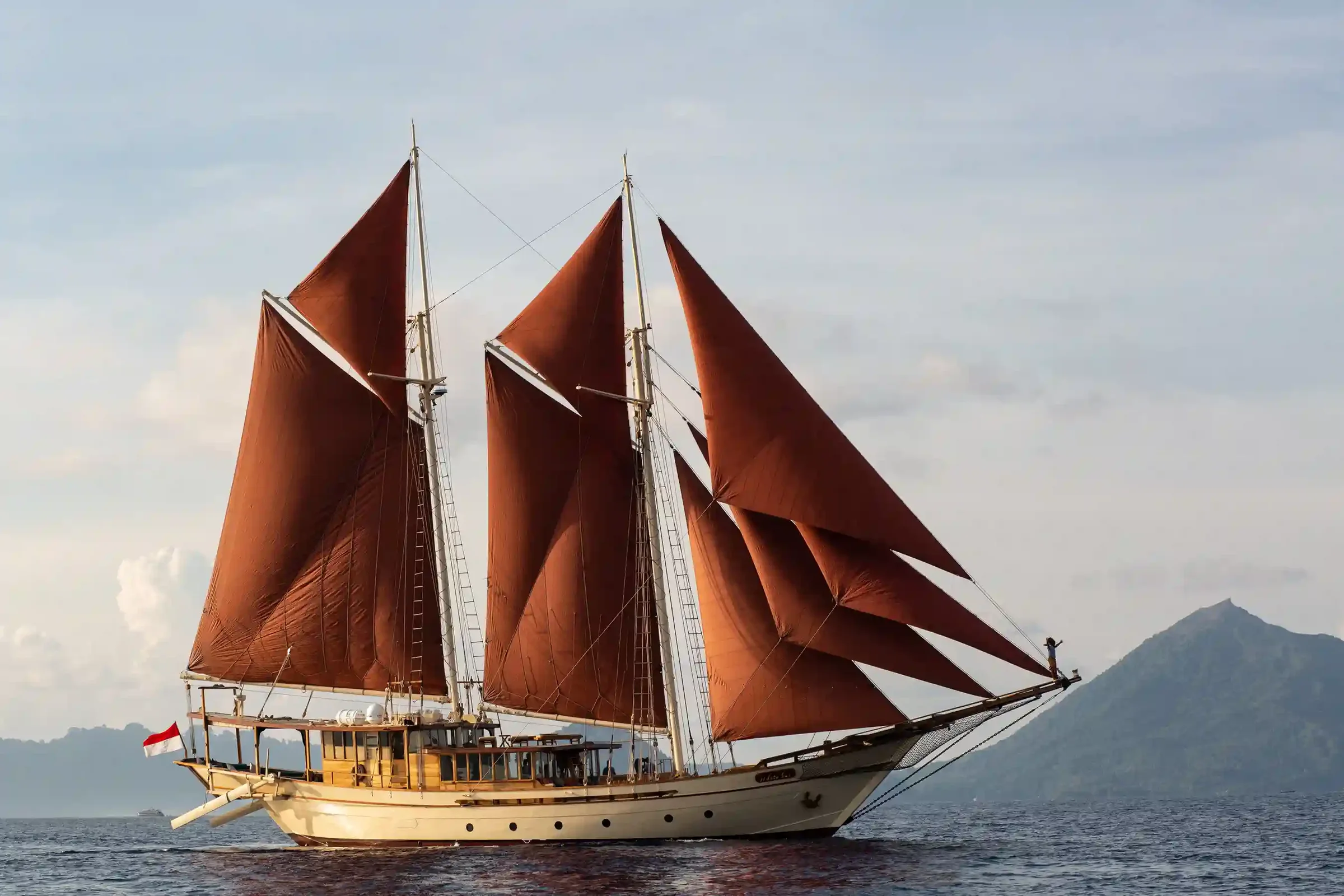
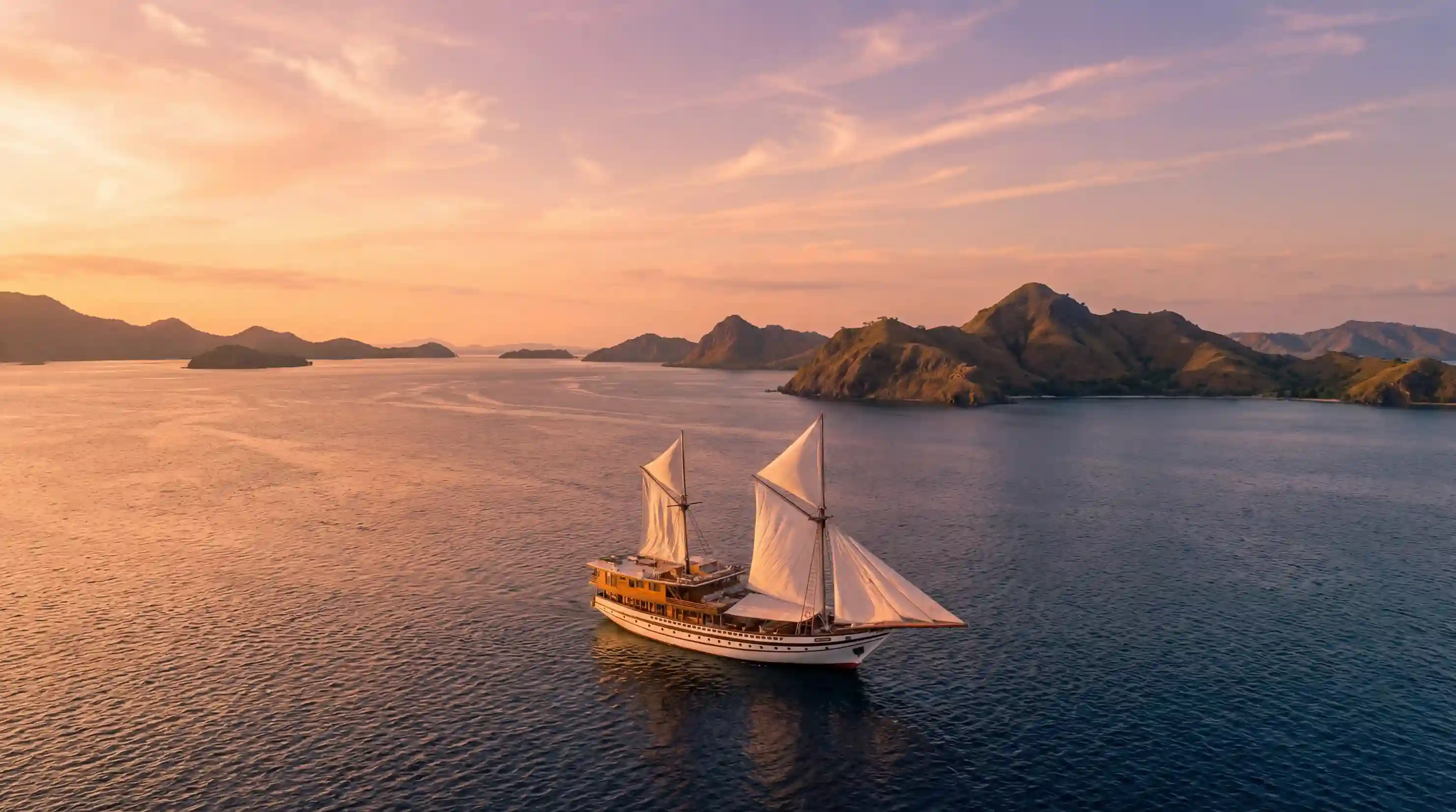
Most vessels here are traditional Indonesian phinisi — wooden two-masted schooners built in South Sulawesi, refitted with air-conditioned en-suite cabins, proper galleys and, on dive-focused boats, compressors and full dive decks. Modern motor yachts and speedboats operate alongside them. We are a Komodo-specialist charter desk operated by Komodo Luxury, sailing this park since 2015 with 9 owned phinisi and access to more than 200 vetted partner yachts, so the ladder below reflects boats we actually place guests on, not scraped listings.
What a day on board looks like
The rhythm is the same across the fleet, whatever the price tier. The boat moves at night or over lunch; you wake at anchor. A typical middle day: sunrise hike on Padar before the heat, breakfast underway, a morning snorkel or dive at Taka Makassar or Manta Point, lunch on deck while the boat repositions, the ranger-guided dragon walk on Komodo or Rinca in the afternoon, then a swim off Pink Beach before sunset. Dive-focused itineraries swap the land stops for two or three boat dives timed to slack tide, because the guides schedule around the tide tables rather than the clock — dives shift by an hour at short notice, and that is competence, not disorganisation. Evenings are dinner, a route briefing for tomorrow, and a sky with no light pollution in any direction.
Meals are cooked on board — Indonesian and Western menus as standard, with dietary requirements handled if you flag them at booking. Cabins on anything from deluxe class upward are air-conditioned with private bathrooms; on budget open-trip boats, check the cabin spec before you pay, because fan-cooled shared cabins still exist at the bottom of the ladder and they are exactly why those trips cost USD 220.
Komodo liveaboard boat types and classes: the real price ladder
Komodo pricing is a ladder, not one number. At the bottom, a shared cabin on an open-trip departure; at the top, a 78-metre private flagship. Every figure below is an operator-direct starting rate in USD.
| Tier | What you get | Starting rate (USD) |
|---|---|---|
| Open trip (shared) | Cabin on a scheduled group departure; 3D2N is the flagship format | From 300 pp per voyage (300–850 by cabin; weekday shared cabins from 220) |
| Day trip | Shared speedboat from Labuan Bajo, no overnight | 90 pp per day; private speedboat 680–800 per boat |
| Deluxe class | Private whole-boat charter, comfortable AC cabins | From 1,550 per night on smaller phinisi; full-size deluxe whole-boat from 3,250 per night |
| VIP class | Larger cabins, better crew ratio, upgraded menus | From 1,800 per night |
| VVIP class | Top-end phinisi with suite-grade cabins and hotel-level service | 3,800–27,000 + VAT per night |
| Entry-luxury private charter | The most-booked private tier for couples and small groups | From 5,300 per yacht per night |
| Flagships | Komodo Signature (78.2 m, 10 suites, 20 guests); Komodo Prestige (66 m, 8 suites, 16 guests) | Signature from 30,000; Prestige from 25,000 per night |
A few named boats anchor the tiers in something concrete: Jinggo Janggo, a 22-metre phinisi, charters from USD 1,800 per night; Almadira, the honeymoon boat, from USD 3,400 per night with a 2D1N package around USD 4,900; Anne Bonny from USD 3,800 per night with signature packages from USD 5,900; wellness charters with onboard practitioners from USD 5,900 per night. On the shared side, Malca Voyages takes up to 21 guests with triple-share cabins at USD 330. The very top of the market — the Lamima and Prana tier — runs past USD 35,000 per night. Full rate tables and season notes sit on the Komodo liveaboard price page.
Route and boarding: fly to Labuan Bajo, not a Bali port
Every Komodo liveaboard boards in Labuan Bajo, the harbour town on the western tip of Flores. There is no liveaboard departure from Bali’s ports — the standard routing is a direct flight from Bali (DPS) to Komodo Airport, Labuan Bajo (LBJ), about 1 hour 15 minutes, with one-way fares typically USD 40–80 and multiple airlines daily. We ticket the flight together with the sailing so the dates always match, and the airport-to-harbour transfer takes about 15 minutes.
Two variations exist. Guests who want the whole journey handled as one itinerary can take the Bali to Komodo liveaboard package — private hotel pickup in Bali, flight, transfer and boarding on a single invoice, from USD 5,000 per person on the 3D2N core and from USD 8,000 per person on the best-selling 7D6N. And sailors who prefer to cross by sea can board at Kayangan Harbor on the Lombok to Komodo liveaboard crossing, a 4D3N shared route from USD 425 per person — the one genuine alternative to flying in.
How many days do you need? Durations from 1 day to 11D10N
Three days and two nights is the shortest trip that covers the icons — Padar, Pink Beach, the dragon trek, Manta Point — without feeling rushed. Divers pushing for the southern sites should plan five nights or more. Here is how the private-charter maths works at the entry-luxury rate of USD 5,300 per night, alongside the shared options:
| Duration | Format | Worked total (USD) |
|---|---|---|
| 1 day | Shared speedboat day trip | 90 per person |
| 3D2N | Open trip, shared cabin | From 300 per person (220 weekday shared) |
| 3D2N | Private charter, entry-luxury | 10,600 per yacht (2 nights × 5,300) |
| 4D3N | Private charter, entry-luxury | 15,900 per yacht |
| 7D6N | Private charter, entry-luxury | 31,800 per yacht |
| 9D8N | Private charter, entry-luxury | 42,400 per yacht |
| 11D10N | Private charter, entry-luxury | 53,000 per yacht |
Divide the yacht total by your group and the picture changes fast: eight friends on a 4D3N entry-luxury charter pay just under USD 2,000 each for a private boat, crew and chef — less than many resort packages, with the park outside the cabin window. The 3D2N group format is detailed on the Komodo liveaboard open trip 3D2N page, and the itinerary guide maps what each extra night actually adds, stop by stop.
Open trip vs private charter: which format fits?
| Factor | Open trip (shared) | Private charter |
|---|---|---|
| Price basis | Per person, from USD 300 (220 weekday) | Per yacht per night, from USD 3,250 (deluxe) / 5,300 (entry-luxury) |
| Departure dates | Fixed schedule, join a group | Any date you choose |
| Itinerary control | Set route; the boat votes, not you | Fully yours — linger at Padar, skip a stop, add a night dive |
| Group | Up to ~21 mixed guests depending on vessel | Only your party |
| Best value for | Solo travellers, couples on a budget | Families, groups of 6+, honeymoons, divers with a site wishlist |
| Cabin choice | Priced by cabin class (300–850) | Whole boat — every cabin is yours |
| Typical booking | 3D2N flagship format | 3D2N to 11D10N |
The crossover point sits around six guests: below that, shared cabins usually win on cost; above it, a private deluxe phinisi often costs less per head and removes every compromise. Private trips are operated by PT Komodo Bahari Nusantara, the licensed entity behind the fleet.
What is included on board?
Standard inclusions across the fleet: cabin accommodation, all meals and snacks, drinking water, tea and coffee, snorkelling gear, dinghy transfers, guide services and the full crew. Dive-focused boats add tanks and weights. Standard exclusions: national park and ranger fees, port fees, dive equipment rental, nitrox, alcohol, marine insurance and crew tips.
The exclusions are where budgets go wrong — real money paid at the boarding desk rather than in the booking email. The largest line is the Komodo National Park ticket, estimated at USD 40 per international guest and confirmed at booking, since park pricing is set by the authorities and does change. Flights (USD 40–80 each way DPS–LBJ) are the other add-on to plan for if you are not on a bundled package.
When to sail: seasons in one paragraph
Komodo liveaboards run year-round. The dry season from April to October brings the calmest crossings and the clearest northern water, with July to September the peak window — book earliest for those dates. December through February is wetter and rougher, but plankton blooms lift manta activity and the boats are quieter, which suits photographers and travellers who value space over sunshine. Water temperature splits the park: northern sites sit around 27–29°C, while southern itineraries run thermoclines into the low twenties and need a thicker suit. Month-by-month detail is on the best time for a Komodo liveaboard guide.
Who a Komodo liveaboard suits
- Divers. The park’s northern current sites — Castle Rock, Crystal Rock, Shotgun — and the far south are only realistic from a liveaboard that positions at slack tide. Three boat dives per full day is the fleet standard, with an optional night dive. Certification thresholds, site profiles and dive-boat specifics are on the liveaboard diving Komodo page.
- Snorkelers and non-divers. Mixed groups are normal. Snorkelers follow the same dinghy schedule at surface-friendly sites — Manta Point, Taka Makassar, Pink Beach — plus the land stops every itinerary shares. See the Komodo liveaboard snorkeling programme.
- Families. A private deluxe or VIP charter gives children their own cabins, a chef who adapts menus, and a schedule that bends around nap times. The family liveaboard page covers age guidance and cabin layouts.
- Honeymooners. Almadira runs dedicated couple charters from USD 3,400 per night, and the 2D1N honeymoon package sits around USD 4,900. Details on the Komodo honeymoon package page.
- Budget and luxury extremes. Cost-focused travellers should start with the budget Komodo liveaboard options; those at the other end of the ladder, with the luxury Komodo liveaboard fleet or a fully private Komodo liveaboard charter.
How to choose the right boat
Five things separate a good Komodo boat from a cheap one, and none of them show in the hero photo:
- Guide-to-guest ratio. Four guests per guide is the working maximum in current. Ask for the number, not a marketing phrase.
- Tender count. Two dinghies means the group splits and nobody waits on the surface, and land stops load faster.
- Itinerary honesty. A two-night trip claiming the far southern sites is selling a route it cannot sail. Check distances against the nights.
- Safety kit. Oxygen, life rafts, radio and a crew drilled on them. Our crew and safety standards guide lists what to verify.
- Cabin position. Lower-deck cabins run cooler and quieter; some master cabins sit above the engine. Ask for the deck plan.
If you want a shortlist instead of a checklist, the best Komodo liveaboard 2027 ranking compares specific vessels tier by tier, and the operator’s full inventory is browsable on the Komodo Luxury liveaboard collection.
How to book a Komodo liveaboard
The single most useful number we can give you: the median booking lead across our guests is 74 days. Peak-season departures (July–September) and named cabins on popular boats sell well before that. The process is simple:
- Fix dates first, boats second. Availability drives everything; a flexible traveller with fixed dates books better boats than a picky one who waits.
- Choose the format. Shared open trip under six travellers; private charter at six or more, or whenever itinerary control matters.
- Message the desk. WhatsApp +62 811-3823-875 or email [email protected] with dates, group size and whether you dive. You get real availability and a written quote, not a form response.
- Get two things in writing before paying: the day-by-day itinerary for your specific dates, and exactly what the rate excludes (park ticket, equipment, tips).
On the operator side: Komodo Luxury has run this fleet since 2015, holds a 4.9/5 average across roughly 1,530 reviews, and carries TripAdvisor Travelers’ Choice awards for 2024, 2025 and 2026 — worth knowing in a harbour where boats appear and vanish between seasons. Scheduled group departures are listed on the open trip sailing schedule.
Komodo liveaboard FAQ
How much does a Komodo liveaboard cost?
Shared open trips run from USD 300 per person per voyage (weekday shared cabins from USD 220, cabin classes up to 850). Private charters start at USD 3,250 per night for a deluxe whole-boat and USD 5,300 per night at entry-luxury, scaling through VIP and VVIP classes to flagships at USD 25,000–30,000 per night.
Where do Komodo liveaboards depart from?
Labuan Bajo, on Flores. You fly Bali (DPS) to Komodo Airport (LBJ) in about 1 hour 15 minutes — USD 40–80 one way — and board 15 minutes from the airport. No liveaboard boards at a Bali port; the only sea alternative is the Lombok crossing from Kayangan Harbor.
How many days should a first Komodo trip be?
3D2N covers the icons — Padar, Pink Beach, the dragon trek and Manta Point — and is the most-booked format. Divers who want the southern sites, or anyone who hates a packed schedule, should book 5 nights or more.
Can non-divers join a Komodo liveaboard?
Yes, and most boats carry mixed groups. Snorkelers see mantas at the same sites divers do, and every itinerary includes land stops — Padar, Pink Beach and the ranger-guided dragon walk — that need no certification at all.
What is not included in the rate?
Komodo National Park fees (estimated USD 40 per international guest, confirmed at booking), port and ranger fees, dive equipment rental, nitrox, alcohol, insurance and crew tips. Flights are extra unless you book a bundled Bali-to-Komodo package.
How far ahead should I book?
Our median booking lead is 74 days. For July–September departures, specific cabins or the honeymoon and flagship boats, book three to five months out. Shoulder-season shared cabins can sometimes be confirmed within two to three weeks.
Next step
Start from the Komodo Island Liveaboard homepage if you want the full site map, or go straight to the decision that matters: dates and format. Send both on WhatsApp to +62 811-3823-875 and ask for live availability in your window — the answer usually takes minutes, and it turns this page’s ladder into a real quote for your group.