
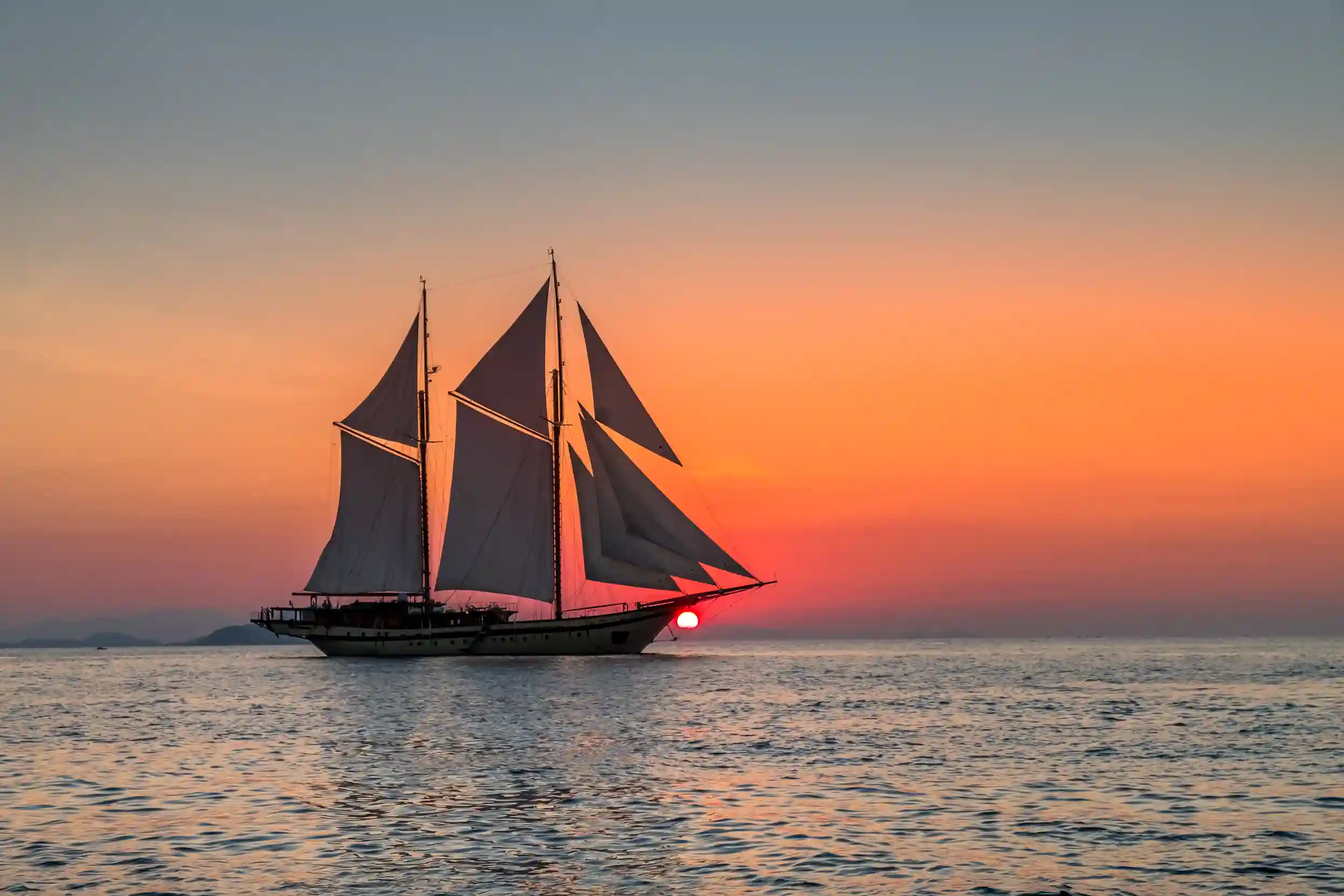
The Passage is a current-swept channel between Komodo Island and Gili Lawa Darat, dived as an exhilarating drift at 5–30 metres. Expect white-tip and grey reef sharks, passing manta rays, eagle rays and rich macro. Strong tidal currents make it an Advanced Open Water site, best dived on the incoming tide.
Few dive sites in Komodo National Park pack as much into a single tank as The Passage. Squeezed between the northern tip of Komodo Island and the twin islets of Gili Lawa Darat and Gili Lawa Laut, this narrow strait funnels the entire Flores Sea through a corridor barely a few hundred metres wide. The result is a nutrient-charged drift that draws pelagics, reef sharks and one of the densest macro concentrations in the park — all in the same dive. At komodoislandliveaboard.com, running Komodo liveaboards since 2015 as part of Komodo Luxury, we have timed hundreds of Passage dives around the tides, and it remains a guest favourite on every northern itinerary.
Why The Passage Is a Signature Komodo Dive
What makes The Passage special is its split personality. Drop on the Komodo Island wall and you ride a wall of colour — soft corals, sea fans and schooling fusiliers pinned in the current. Cross into the sheltered lee behind Gili Lawa and the terrain flattens into black-sand slopes and coral bommies where the macro life takes over. It is genuinely two dives in one, which is why we often schedule it as the first descent of a north-Komodo day before crews continue to Castle Rock and Crystal Rock.
- Grey reef and white-tip sharks patrolling the current line, often 4–8 on a single drift
- Manta rays and spotted eagle rays cruising through on stronger tides
- Macro treasures — frogfish, nudibranchs, ornate ghost pipefish, blue-ringed octopus on the sand
- Turtles, giant trevally and dogtooth tuna hunting the reef edge
- Boulder gardens and swim-throughs that break the current and shelter reef fish
The Passage Dive Site Specs
| Detail | The Passage |
|---|---|
| Location | Channel between Komodo Island & Gili Lawa Darat, North Komodo NP |
| Depth range | 5–30 m (best action 10–22 m) |
| Dive type | Drift dive, occasional negative entry |
| Current | Moderate to strong, tidal — dived on slack or incoming |
| Visibility | 10–25 m (best May–October) |
| Water temp | 26–29°C north; can drop to 22°C on upwellings |
| Certification | Advanced Open Water + 30 logged dives recommended |
| Best season | Dry season Apr–Nov; peak Jul–Sep |
Reading the Currents
The Passage is not a site to freelance. Currents here reverse with the tide and can accelerate to 2–3 knots at full flow, sometimes with down-currents near the boulders. Our cruise directors dive it on the transition, usually the incoming tide, so guests drift from the exposed Komodo wall into the protected macro slope rather than being swept the wrong way. A reef hook and a surface marker buoy are mandatory, and every guest is briefed on staying below the reef contour when the flow picks up. This is why we hold the line at Advanced Open Water for The Passage and the other north sites — see our dive requirements and safety FAQ for the full checklist.
Where The Passage Fits in a Komodo Liveaboard Itinerary
The Passage sits inside Komodo’s legendary northern cluster, so it is almost always paired with the park’s heaviest-hitting drift sites in a single day of diving. A typical big-north day aboard a Komodo Island liveaboard looks like this:
| Dive | Site | Highlight |
|---|---|---|
| 1 | The Passage | Drift, reef sharks, macro slope |
| 2 | Castle Rock | Schooling trevally, shark action on the plateau |
| 3 | Crystal Rock | Pinnacle, soft coral, pelagic hunting |
| 4 | Gili Lawa (night) | Spanish dancers, hunting lionfish |
Because these sites are current-driven, sailing on a liveaboard rather than commuting from Labuan Bajo lets us hit each one at its ideal tidal window — something day boats simply cannot do. Guests wanting the full arc of the park usually combine the north with the manta stations further south; our guide to diving Manta Point and Manta Alley covers those southern cleaning stations. If you are weighing trip length, our 3D2N vs 4D3N durations comparison shows exactly how many Passage-calibre dives each itinerary delivers.
Rates: Diving The Passage Aboard komodoislandliveaboard.com
All departures begin in Labuan Bajo (LBJ), a short flight from Bali or Jakarta. Note that Komodo National Park entry is IDR 650,000 per person under the 1,000-diver daily quota introduced in April 2026 — we secure permits in advance so your slot on the north sites is guaranteed.
| Option | Duration | Price (per person) |
|---|---|---|
| Shared cabin — 3D2N | 3 days / 2 nights | from IDR 3,550,000 |
| Shared cabin — 4D3N | 4 days / 3 nights | IDR 6,900,000–12,500,000 |
| Private charter — 3D2N | whole yacht | from IDR 52,000,000 |
| Private charter — premium 4D3N | whole yacht | up to IDR 280,000,000 |
- Certified divemaster guiding (max 4 guests per guide on north sites)
- Full-board meals, air-conditioned cabins, tanks, weights and dhoni tender
- Nitrox available — strongly recommended for repetitive drift diving
- Airport transfers in Labuan Bajo and park permits arranged
How to Book
Reserving is simple: message our dive desk on WhatsApp, confirm your dates and cabin, and secure the booking with a 50% deposit. The balance is due 14 days before departure (H-14). Because the north quota fills fastest in the July–September peak, we recommend booking 6–10 weeks ahead if The Passage and Castle Rock are on your must-dive list.
Frequently Asked Questions
How strong are the currents at The Passage in Komodo?
Currents run moderate to strong, reaching 2–3 knots at peak tidal flow with occasional down-currents near the boulder fields. We dive it on the incoming tide or slack so the drift carries you from the Komodo wall into the sheltered macro slope. A reef hook and SMB are required.
Do I need Advanced Open Water to dive The Passage?
Yes. We recommend Advanced Open Water certification plus around 30 logged dives for The Passage and all north Komodo sites, because of the strong drift conditions. Newer divers can still enjoy calmer southern and central sites in the same itinerary.
What will I see diving The Passage?
Expect grey reef and white-tip sharks along the current line, passing manta and eagle rays, turtles and schooling fish on the wall, plus dense macro — frogfish, nudibranchs and ghost pipefish — on the black-sand slope behind Gili Lawa.
When is the best time to dive The Passage?
The dry season, April to November, offers the clearest water and calmest surface conditions, with July to September the peak for shark and manta action. Visibility typically runs 10–25 metres, and water temperatures sit between 26–29°C in the north.