
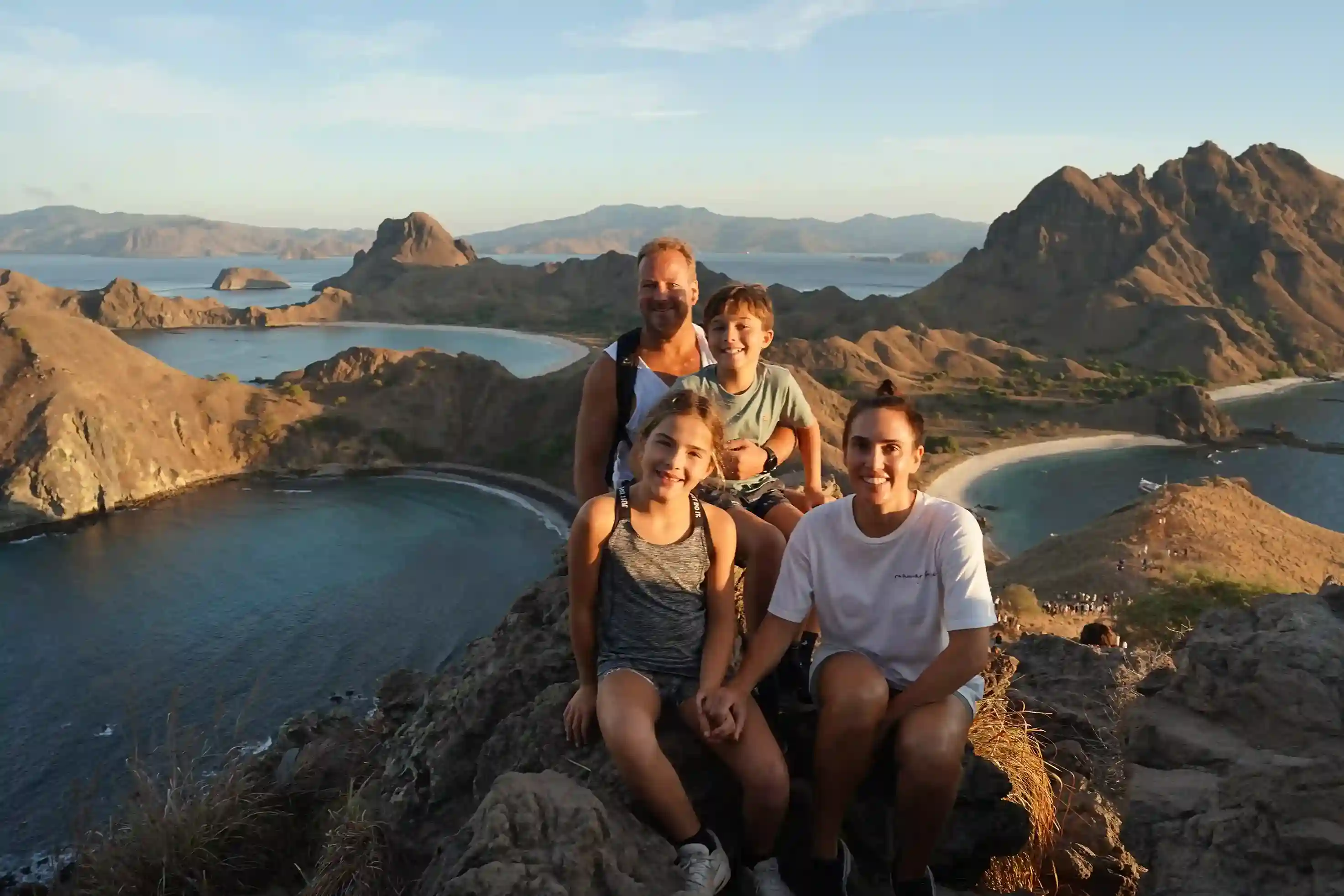
Teens and young kids experience a Komodo liveaboard very differently. Teens (roughly 12+) can dive, snorkel independently, and join full itineraries; younger kids (under 10) are usually snorkeling- and beach-focused, with shorter activity blocks, closer supervision, and cabin setups built around nap schedules rather than dive briefings.
Why the Age Gap Changes the Whole Trip
Families researching a komodo liveaboard often assume “family-friendly” means one fixed itinerary works for every age. It doesn’t. A 14-year-old with an Open Water certification and a 6-year-old who has never worn a mask need almost opposite versions of the same trip — different water time, different supervision levels, different cabin logistics, and different definitions of “fun.” Our broader family-friendly Komodo liveaboard guide covers the full spectrum of family trip planning; this piece narrows in on the specific gap between traveling with teens and traveling with young children, since that’s the split that trips up most first-time family bookers.
The short version: teens can largely be folded into a standard adult itinerary with a few adjustments. Young kids need the itinerary rebuilt around them — shorter dive-day blocks, calmer anchorages, and a crew briefed specifically on what a 5-to-9-year-old can and can’t handle on a moving boat.
Teens vs Young Kids: What Actually Differs Onboard
Before booking, it helps to see the practical differences side by side rather than guessing which category your family falls into.
| Factor | Teens (roughly 12–17) | Young Kids (roughly 4–11) |
|---|---|---|
| Diving eligibility | Can typically dive once certified; many operators set a practical minimum around 12 for Komodo’s currents | Generally snorkel or shallow, supervised confined-water intro only |
| Daily activity pace | Can join full adult dive schedule (2–3 dives/day) | Needs shorter blocks with rest breaks between activities |
| Independence level | Can move around the boat, join briefings solo, socialize with other guests | Needs a parent or guardian within arm’s reach near water and railings |
| Boredom risk | Real risk if not engaged — teens disconnect fast from adult-paced trips | Low risk if activities are hands-on; boredom shows up as restlessness, not disengagement |
| Cabin fit | Can share a twin cabin near friends or siblings | Usually needs to be adjacent to or inside the parents’ cabin |
| Best trip length | 3–5 nights works well; longer trips suit strong swimmers/divers | Shorter trips (2–3 nights) reduce fatigue and homesickness |
The pattern is consistent: teens need engagement, young kids need structure. Both need a crew that has actually planned for children onboard rather than treating a family booking the same as a group of adult divers.
A Day Aboard With Teens
On a typical sailing day, a teen who dives or snorkels confidently follows a schedule close to the adult itinerary, with room to opt out of anything that feels too intense.
- Early wake-up, light breakfast. Teens join the same pre-dive briefing as adult guests, listening for site-specific notes on current and depth.
- Morning dive or snorkel session. Certified teens dive alongside a guide in a small group; non-divers snorkel the same site from the surface.
- Midday transit and free time. This is when teens tend to disengage if there’s nothing to do — deck games, journaling prompts, or a photography challenge fill the gap well.
- Afternoon shore excursion. A trek to a viewpoint like Padar Island gives teens a physical activity that isn’t water-based, which breaks up the day.
- Second dive or snorkel, late afternoon. Energy is usually highest here — a good slot for a teen’s first slightly more advanced site if the guide agrees.
- Sunset on deck, dinner, downtime. Teens often gravitate toward the bow at sunset and toward each other at dinner — mixed-age group trips work better for teens than solo family charters, since they get peer company.
A Day Aboard With Young Kids
The same day looks structurally different for a 5-to-9-year-old, built around shorter bursts of activity and predictable downtime.
- Later, slower wake-up. Young kids don’t need the full dive briefing — a simplified version (“stay near mom, hold the rope, watch for the flag”) covers what matters.
- Short shallow-water session. Thirty to forty-five minutes in calm, shallow water near the boat, with a parent or crew member always within reach, works better than a full open-water excursion.
- Rest and snack break. Young kids tire faster in saltwater and sun than adults expect — build in downtime before they ask for it.
- Beach time, not a trek. A gentle sandy stretch like Pink Beach gives kids room to play without the elevation or heat exposure of a full island hike.
- Nap or quiet indoor time. Boats with a shaded saloon area make this far easier than ones without — ask about it when booking.
- Early dinner, early bedtime. Young kids on a boat schedule tend to run on an earlier clock than the adults — plan meals accordingly rather than fighting it.
Planning a family trip and want an itinerary built around your kids’ actual ages, not a generic template? The 3D2N Komodo Liveaboard share-cabin open trip is bookable directly through Komodo Luxury Open Trip — live schedules and cabin availability. WhatsApp +62 811 3823 875 or email [email protected].
Cabin Arrangements for Families
Cabin layout is where the teen-vs-young-kid split shows up most concretely when you’re actually booking. Families traveling with young children almost always need a cabin configuration where the kids sleep in the same room as a parent — either a family cabin with a double bed plus a single or bunk, or two adjoining cabins with a connecting door. Families with teens have more flexibility: a teen can often take a twin-share cabin near the parents’ cabin rather than inside it, especially on a trip of three nights or fewer.
Whichever configuration you need, confirm it before paying a deposit rather than after boarding — not every boat in a mixed open-trip fleet carries a true family cabin, and availability on popular sailing dates can be limited. If you’re deciding between a shared open trip and a private charter, the Komodo liveaboard price guide breaks down the cost difference, since a private charter gives you full control over cabin assignment in a way a share-cabin open trip cannot.
Keeping Teens Engaged, Not Bored
Teen boredom on a liveaboard is almost always a pacing problem, not a content problem — Komodo National Park has plenty for teens to do, but a trip that moves at an adult diver’s pace can leave a non-diving or newly-certified teen with long stretches of nothing. The fix is giving teens ownership of at least one activity block per day: letting them lead a snorkel group, hand them an underwater camera, or pair them with the dive guide for gear setup. Teens who dive tend not to get bored at all — two or three dives a day at sites across the park is enough stimulation on its own. It’s the non-diving teen, or the one waiting to turn the minimum certification age, who needs the extra planning.
Discover Scuba–style introductory sessions in calm, shallow water are a common way to bridge that gap for teens who are close to certification age but not quite there — ask your operator whether this is offered on your specific sailing, since it varies by boat and by trip length.
Activities Built for Young Kids
Young kids don’t need a packed schedule — they need a few activities repeated in short, low-pressure bursts. The best-performing options on a family sailing tend to be shallow snorkeling from the swim platform with a parent, beach time on gentle sand rather than rocky shoreline, simple marine-life spotting games (count the starfish, find a clownfish), and quiet deck time with books or drawing during the adult dive sessions. Skip anything that requires sustained focus or physical stamina — a full Komodo dragon trek on Komodo or Rinca Island, for instance, is better suited to kids old enough to walk the full ranger-guided route comfortably and follow safety instructions without constant reminders, since trekking there requires a licensed park ranger and staying on the marked trail at all times.
Safety Supervision Ratios
Two different supervision systems apply on a family Komodo liveaboard, and it’s worth understanding both. Onboard, crew-to-guest ratios for diving typically run tighter than 1:4 for certified divers, with young non-diving children supervised directly by a parent or guardian rather than counted into the crew ratio at all — no liveaboard crew, however attentive, substitutes for a parent’s direct supervision of a young child near open water. Ashore, Komodo National Park itself enforces a mandatory ranger system for any dragon-trekking activity, with a standard ratio of one ranger per group of up to five visitors — this applies to the whole group, adults and kids together, and independent trekking without a ranger is not permitted anywhere in the park.
For families, the practical takeaway is simple: ask your operator directly how many crew are dedicated to water activities versus hospitality, and don’t assume a “family-friendly” label means dedicated child supervision beyond a parent’s own presence.
Choosing the Right Trip Format for Your Family
If your family spans both age groups — a teenager and a young child on the same trip — the honest answer is that a private charter usually solves more problems than a shared open trip, since it lets you set the pace, skip activities that don’t suit the younger child, and add extra water time for the teen without negotiating with other guests’ preferences. Families with only teens, or only young kids, tend to do well on the standard 3D2N Komodo liveaboard open trip, provided you flag your children’s ages at booking so the crew can plan accordingly. Either way, the single biggest factor in a smooth family trip isn’t the boat — it’s whether the operator actually asks about your kids’ ages before you sail, not after.
Frequently Asked Questions
Minimum age for diving?
PADI and SSI junior certification programs technically start around age 10, but many operators — including ours — set a higher practical minimum, often around 12, for open-water diving in Komodo’s currents, which can be stronger than a training environment. Confirm your operator’s specific age policy and each diver’s certification level when you book, since it can vary by boat and by dive site within the same itinerary.
Are teens bored onboard?
Not usually, if the trip gives them an active role rather than a passenger seat on an adult-paced itinerary. Diving or snorkeling teens stay engaged through the activity itself; non-diving teens do best when given ownership of something — photography, gear setup, leading a snorkel group — rather than long unstructured downtime between adult dive sessions.
Activities for young kids?
Shallow, parent-supervised snorkeling from the swim platform, gentle beach time, simple marine-life spotting games, and quiet deck activities during adult dive blocks work best. Skip anything requiring sustained physical stamina, like a full island trek, unless your child is genuinely ready for a ranger-guided walk over uneven terrain in tropical heat.
Cabin arrangements for families?
Families with young children typically need a cabin where kids sleep in the same room as a parent, either a family cabin with mixed bedding or two adjoining cabins with a connecting door. Families with teens have more flexibility and can often book a nearby twin-share cabin instead. Confirm the exact configuration at booking, since not every boat in a shared-trip fleet carries a true family layout.
Safety supervision ratio?
Onboard diving typically runs tighter than a 1:4 guide-to-diver ratio, while young non-diving children are supervised directly by a parent rather than counted into crew ratios. Ashore, Komodo National Park requires one ranger per group of up to five visitors for any dragon-trekking activity, applying to the whole family group together, with independent trekking not permitted anywhere in the park.
Ready to sail with the whole family? The 3D2N Komodo Liveaboard share-cabin open trip is bookable directly through Komodo Luxury Open Trip — live schedules and cabin availability. WhatsApp +62 811 3823 875 or email [email protected].