
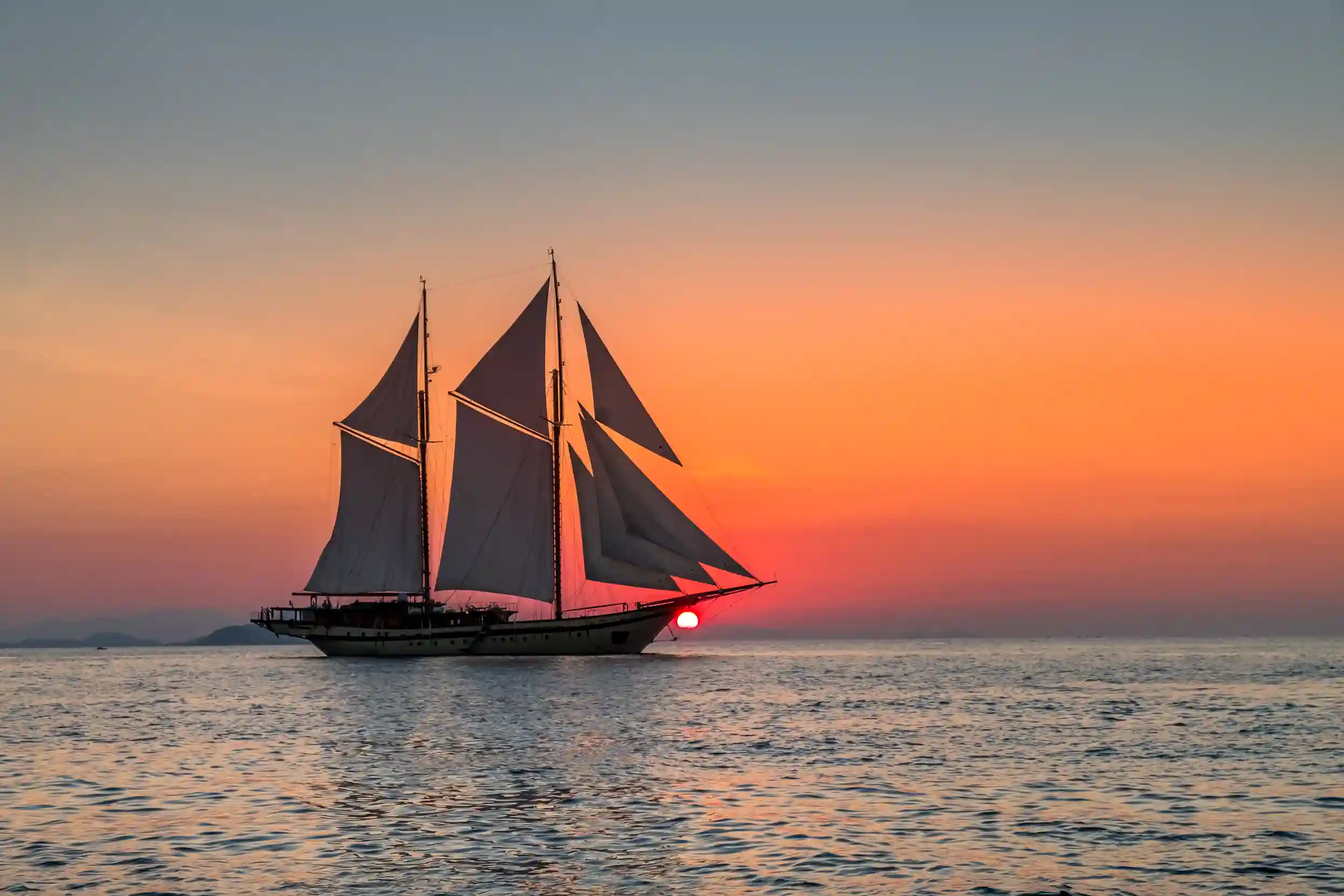
Choose a Komodo liveaboard if you want manta rays, strong-current drift diving, Komodo dragon treks, and easy access via direct flights to Labuan Bajo on a shorter budget. Choose Raja Ampat if reef biodiversity and macro critters matter more than big animals, you have 7+ days, a bigger budget, and don’t mind flying via Sorong. Many serious divers eventually do both.
Komodo Liveaboard vs Raja Ampat Liveaboard: At a Glance
Both are Indonesian liveaboard destinations, both sit inside the Coral Triangle, and both regularly appear on “best diving in the world” lists — which is exactly why they get compared so often and explained so rarely. They are not interchangeable. Komodo National Park and Raja Ampat sit roughly 1,500km apart, have different marine ecosystems, different access routes, and reward different kinds of travelers. The table below is the short version; the sections after it explain why.
| Factor | Komodo | Raja Ampat |
|---|---|---|
| Gateway city | Labuan Bajo (direct flights from Bali, Jakarta) | Sorong (connecting flights via Jakarta or Makassar, then boat) |
| Signature marine life | Manta rays, strong pelagic action, nutrient-rich currents | Coral and reef-fish diversity, macro critters, pygmy seahorses |
| Topside draw | Komodo dragons, savanna hills, Padar viewpoint, Pink Beach | Karst islands (Wayag, Piaynemo), remote village culture |
| Typical trip length | 3–11 nights, with strong 3D2N and 4D3N options | 7–12 nights typical; shorter trips are less common |
| Diving difficulty | Moderate to strong currents, especially in the South zone | Variable — calm lagoons alongside strong tidal channels |
| Relative cost | Generally lower entry point, especially share-cabin open trips | Generally higher, driven by remoteness and transit time |
| Best for | First-timers, manta seekers, mixed diver/non-diver groups | Experienced divers, underwater photographers, biodiversity chasers |
What Each Destination Is Actually Known For
Komodo National Park: Dragons, Manta Rays, and Dramatic Topside Scenery
Komodo National Park is the only place on Earth where you can trek to see wild Komodo dragons in the morning and drift with manta rays in the afternoon — that combination of topside wildlife and underwater action is what sets it apart from almost every other liveaboard destination. A komodo liveaboard stitches together three distinct zones: a calmer Central zone near Labuan Bajo good for beginners and snorkelers, a North zone around Gili Lawa known for strong, exhilarating drift dives, and a South zone around Manta Alley and Cannibal Rock where cooler, nutrient-rich water pulls in the big animals. Topside, the park delivers some of the most photographed landscapes in Indonesia: the striped hills of Padar Island, the pink-tinted sand of Pink Beach, and the ranger-guided dragon treks on Rinca and Komodo Island — trekking here is only permitted with a licensed park ranger, at roughly one ranger per five visitors, and independent trekking is never allowed.
Raja Ampat: Coral Triangle Biodiversity and Remote Reef Systems
Raja Ampat sits at the western tip of West Papua and is widely regarded by marine biologists as one of the most species-dense reef systems anywhere on the planet — the coral and reef-fish counts here are consistently cited as the benchmark for the entire Coral Triangle. The diving experience is different in character from Komodo: rather than one or two headline “big animal” sites, Raja Ampat rewards divers who slow down and look closely, with dense soft-coral walls, pygmy seahorses, wobbegong sharks resting on coral heads, and — in a handful of shallow muck sites — the endemic walking (epaulette) sharks found almost nowhere else. Topside, the region is defined by the karst limestone islands of Wayag and Piaynemo, whose lookout viewpoints over turquoise lagoons have become some of the most recognizable images in Indonesian tourism. It is a quieter, more remote experience — fewer boats, fewer other travelers, and noticeably longer transit to get there.
Diving Comparison: Currents, Visibility, and Marine Life
The single biggest practical difference between the two is what the currents are doing and what they bring with them. Komodo’s currents are driven by the Indonesian Throughflow funneling between the Sumba and Flores seas — this is what makes the South zone (Manta Alley, Cannibal Rock, Torpedo Alley) so productive for manta rays and pelagic life, but it also means several of the park’s best sites are genuinely strong-current dives better suited to Advanced-certified or drift-experienced divers. Raja Ampat’s currents are more localized and tidal, driven through narrow channels like Dampier Strait — some sites run gentle enough for open water divers and snorkelers, while others rip through hard enough that dive guides time entries to the tide table down to the minute.
| Dive profile | Komodo | Raja Ampat |
|---|---|---|
| Current strength | Moderate (Central/North) to strong (South zone) | Gentle to very strong, site-dependent and tide-dependent |
| Water temperature | Noticeably cooler in the South zone (upwelling) | Generally warmer and more consistent year-round |
| Headline animal | Manta rays at Manta Alley and Manta Point / Karang Makassar | Manta rays at Manta Sandy, plus wobbegongs and walking sharks |
| Best for | Pelagic encounters, drift diving, mixed skill-level groups | Reef biodiversity, macro photography, patient critter-spotting |
Neither destination is “harder” across the board — both have easy sites and demanding sites in the same itinerary, which is exactly why a briefing from an experienced dive guide before every dive matters more than the destination’s reputation. If your priority is a higher chance of a big-animal encounter on a shorter trip, Komodo’s named dive sites concentrate that action more predictably. If your priority is spending forty minutes staring at one coral head finding three different pygmy seahorse species, Raja Ampat rewards that patience in a way few other places can.
Getting There: Access and Logistics Compared
Access is where the two destinations diverge the most — and it has a direct effect on both cost and how many days you actually spend diving versus traveling.
Reaching a Komodo Liveaboard
- Fly into Labuan Bajo. Direct flights run from Bali (Denpasar) and Jakarta, typically 1.5–2.5 hours, several times daily.
- Board the same or next day. Most operators, including open-trip departures, board directly from Labuan Bajo harbor, often the same afternoon you land.
- Dive from day one. Because the Central zone sites sit close to port, many itineraries fit in a dive or snorkel session on the first afternoon.
- Return to Labuan Bajo for onward flights. Trips are timed to disembark by mid-morning on the final day, leaving time to connect to a same-day flight.
Reaching a Raja Ampat Liveaboard
- Fly into Sorong. There are no direct international flights — most travelers connect through Jakarta or Makassar, adding a full day of transit each way.
- Transfer to the boat or Waisai. Depending on the operator, you either board directly from Sorong harbor or take a further ferry/speedboat to Waisai on Waigeo Island.
- Sail out to the dive grounds. The best-known sites (Dampier Strait, Misool, Wayag) are often several hours’ sailing from the initial embarkation point, so day one is frequently a travel day rather than a dive day.
- Reverse the whole route home. Build in a buffer night in Sorong or Jakarta before an international connection — missed connections here are far costlier to fix than in Labuan Bajo.
In practical terms, a first-time visitor to Komodo can be diving within hours of landing; a first-time visitor to Raja Ampat should budget an extra travel day on each end of the trip. That single difference is often the deciding factor for travelers with under 10 days of total vacation time.
Cost Comparison: Which Is More Affordable?
As a rule, Komodo liveaboards have a lower entry price point than Raja Ampat liveaboards, and the gap is structural rather than seasonal. Labuan Bajo has direct flight access, a larger pool of competing operators, and shorter transit distances between dive sites — all of which push prices down, especially on share-cabin open trips like a 3D2N Komodo liveaboard. Raja Ampat’s remoteness works the other way: longer flights, fewer large-scale operators, longer sailing distances between anchorages, and a smaller pool of boats competing for the same guests all push average trip costs higher, even before accounting for the extra hotel night most travelers need in Sorong or Jakarta.
This doesn’t mean Komodo is universally “cheap” or Raja Ampat universally “expensive” — both destinations run the full range from budget share-cabin trips to fully private luxury charters. But if budget is the primary constraint and you’re choosing between the two, Komodo’s shorter, more competitively priced itineraries generally stretch further. For exact current pricing by duration and cabin type, see the full Komodo liveaboard price guide — always confirm rates directly with the operator, since both destinations see seasonal pricing shifts.
Trip Length: How Many Days Does Each Destination Need?
Komodo scales down more gracefully than Raja Ampat. A 3D2N or 4D3N Komodo trip is a genuinely complete experience — Central zone diving, Padar, Pink Beach, and a dragon trek all fit comfortably into a long weekend. Stretching to 5D4N or 7D6N adds the North and South zones, including Manta Alley, without feeling rushed.
Raja Ampat rewards longer commitments. Because so much of the trip is sailing time between remote anchorages, a 4-night Raja Ampat trip will genuinely see fewer sites and feel more compressed than a 4-night Komodo trip covering similar ground. Most experienced operators recommend 7 nights minimum to properly cover Dampier Strait and Misool, and serious divers or photographers often push to 10–12 nights to add Wayag in the north. If your available vacation time is under a week, Komodo’s shorter itineraries are simply the better match for the destination’s geography.
Ready to sail? If Komodo is the fit for your dates and budget, the 3D2N Komodo Liveaboard share-cabin open trip is bookable directly through Komodo Luxury Open Trip — live schedules and cabin availability. WhatsApp +62 811 3823 875 or email [email protected].
Can You Combine Komodo and Raja Ampat in One Trip?
Yes, but it takes real planning. The two destinations are not adjacent — Sorong to Labuan Bajo is not a short hop, and there’s no liveaboard route that sails directly between them. Most divers who do both treat them as two separate trips within the same broader Indonesia itinerary: a Komodo liveaboard of 4–7 nights, then a domestic flight (usually routed through Jakarta or Bali) to Sorong for a second Raja Ampat liveaboard of 7+ nights. Trying to compress both into a single two-week trip is possible but leaves little slack for weather delays or flight disruptions, which are not uncommon on the Sorong route. If this is a once-in-a-lifetime Indonesia dive trip and time allows, doing both back-to-back — rather than trying to force one boat to cover both regions — is the approach most repeat visitors settle on.
Which Should You Choose? A Decision Framework by Traveler Type
- First-time liveaboard guest, under 5 days available: Komodo. Shorter itineraries, easier access, and a complete experience even at 3D2N.
- Non-diver or snorkeler traveling with a diving partner: Komodo. The Central zone offers strong snorkeling, and topside activities like dragon trekking and Padar give non-divers plenty to do between dives.
- Manta ray as the top priority: Either works — Manta Alley and Manta Point in Komodo, Manta Sandy in Raja Ampat — but Komodo’s manta sites are easier to reach on a shorter trip.
- Underwater photographer chasing macro and critter diversity: Raja Ampat, if you have 7+ nights and the budget for the longer transit. It is genuinely the deeper well for macro subjects.
- Budget-conscious traveler or group: Komodo, particularly a share-cabin open trip, which absorbs less transit cost and offers more competitively priced operators.
- Honeymoon or special-occasion trip with 10+ days available: Consider both, back-to-back — Komodo’s dramatic scenery and manta encounters first, Raja Ampat’s remote karst islands and reef diversity second.
- Family with mixed ages and dive levels: Komodo. Shorter transit, milder Central-zone conditions, and topside variety make it the more forgiving destination for a group with different comfort levels.
Frequently Asked Questions
Is Komodo or Raja Ampat better for diving?
Neither is objectively “better” — they reward different priorities. Komodo is stronger for pelagic encounters, manta rays, and drift diving in a shorter, more accessible trip. Raja Ampat is stronger for coral and reef-fish biodiversity and macro photography, but requires more travel time and typically a longer, costlier itinerary to do properly.
Which is cheaper, Komodo or Raja Ampat liveaboard?
Komodo liveaboards generally start at a lower price point than Raja Ampat liveaboards. Direct flights to Labuan Bajo, shorter sailing distances, and more competing operators keep Komodo’s entry-level trips — especially share-cabin open trips — more affordable than the longer, more remote itineraries typical of Raja Ampat.
Can I do both Komodo and Raja Ampat in one trip?
Yes, but treat them as two separate liveaboard legs connected by a domestic flight (usually via Jakarta or Bali), not one continuous voyage — there is no direct liveaboard route between the two. Most travelers who combine them budget at least 12–14 days total to avoid rushing either leg.
Which is better for beginners, Komodo or Raja Ampat?
Komodo is generally the more beginner-friendly starting point. Its Central zone offers calmer conditions suitable for newer divers and snorkelers, shorter trip lengths let first-timers try a liveaboard without a long commitment, and access via Labuan Bajo is faster and simpler than the Sorong route into Raja Ampat.
Does Raja Ampat have manta rays like Komodo?
Yes — Raja Ampat has its own well-known manta ray site at Manta Sandy near Arborek, alongside Komodo’s Manta Alley and Manta Point / Karang Makassar. Sighting reliability varies by season and site conditions at both destinations, so ask your operator about current manta activity when booking.
Still deciding? If a Komodo liveaboard fits your dates, our team can walk you through itinerary and duration options or the full list of stops covered on each trip. WhatsApp +62 811 3823 875 or email [email protected] — part of the Komodo Luxury network (1,500+ verified guests across Google and TripAdvisor, TripAdvisor Travelers’ Choice 2025 and 2026 on the Komodo Luxury listing), with nearly four decades of combined team experience running Komodo waters. The 3D2N share-cabin open trip is bookable directly through Komodo Luxury Open Trip.
The Raja Ampat side of the comparison is ranked in this best Raja Ampat liveaboard guide.