Komodo Liveaboard FAQ — Part 1: Basics, Company, Price, Planning & Season
Your Quick Answers Before You Book
Ten categories, one page: jump to Basics, Company & Comparisons, Price, Trip Planning, Season, Safety, Family & Solo Travel, Booking, Onboard Life, or Diving using the tabs below.
Every answer is condensed to the essentials, with a link through to the full guide whenever you want more detail.
This is Part 1 of our FAQ hub, covering everything we’ve written so far — a Part 2 with additional categories is planned but not live yet.
Komodo Liveaboard FAQ
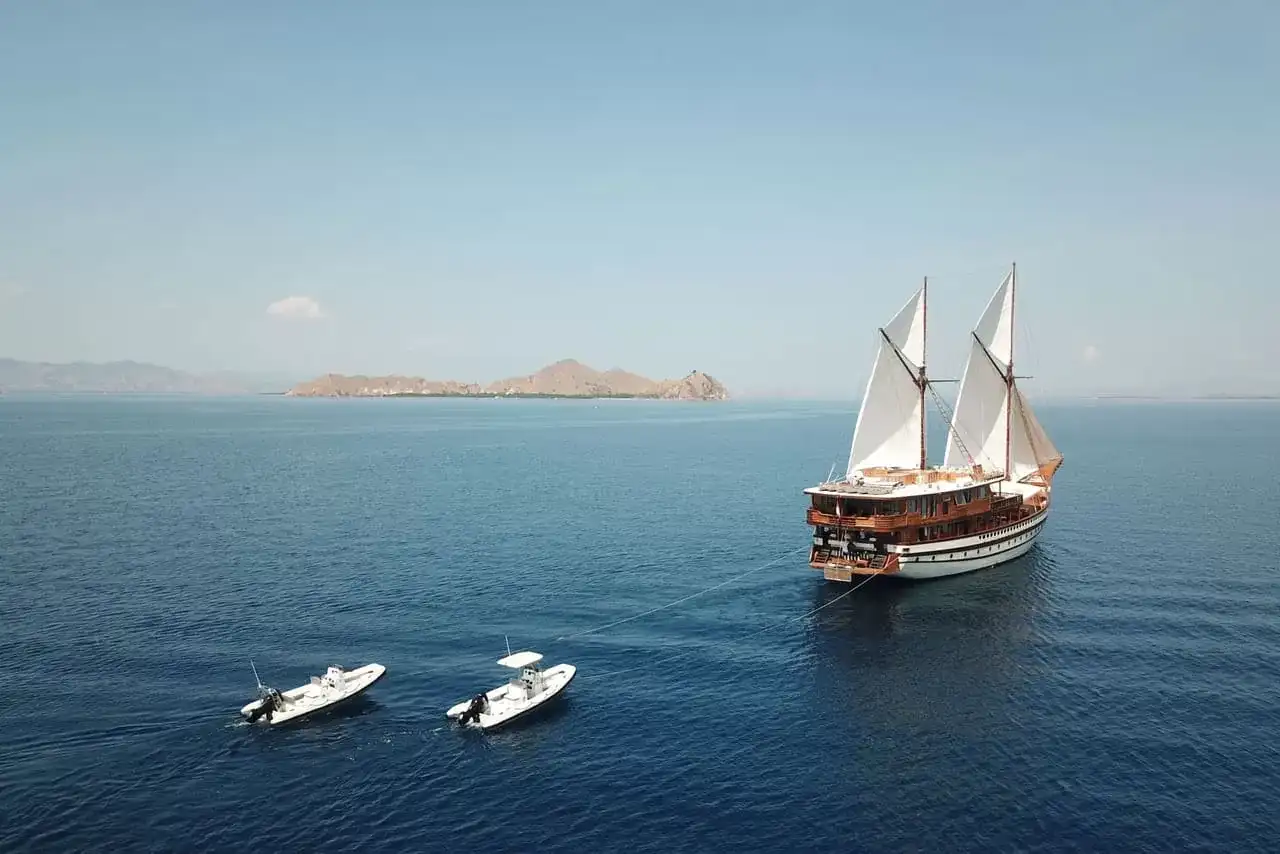
A multi-night boat trip through Komodo National Park where you sleep aboard a phinisi — a traditional Indonesian schooner — instead of returning to a hotel each night. Trips run 1–11 nights and combine diving or snorkeling, Padar Island, Pink Beach, and ranger-guided dragon trekking in one voyage. See our complete definition guide for the full breakdown.
Cabin accommodation, all onboard meals and drinking water, guided dives or snorkel sessions, ranger-guided dragon trekking, and stops at Padar Island and Pink Beach. Alcohol, extra gear rental, nitrox, and sometimes the park entrance fee are itemized separately — see our price guide for the full breakdown.
You board in Labuan Bajo, get a cabin and safety briefing, then follow a fixed daily rhythm — dive, eat, sail, repeat — anchoring overnight in sheltered bays. Crew handle navigation, permits, and park registration while ranger-guided treks and named dive or snorkel stops fill each day until you disembark back in Labuan Bajo.
A liveaboard keeps you sleeping aboard for multiple nights, reaching the far North and South zones — including Manta Alley and Cannibal Rock — that a same-day return can’t cover. A day trip visits 1–3 sites near Labuan Bajo and returns you to a hotel each evening.
With 3+ days in Labuan Bajo, a 3D2N open trip is the better choice — unhurried trekking, sunrise on Padar, and more named sites per day. Under 48 hours, a day trip or private charter still covers the highlights without the overnight commitment.
Most itineraries visit Komodo Island and Rinca for dragon trekking, Padar Island for the sunrise viewpoint hike, and Kalong Island for the dusk bat-colony flyout, plus snorkel or dive stops at Pink Beach, Manta Point, and other named sites depending on trip length. See our destinations hub for the full list.
Most itineraries include either Komodo Island (Loh Liang) or Rinca (Loh Buaya) for dragon trekking, and some longer trips visit both. Confirm which specific island your itinerary covers, since shorter trips often trek only one.
Yes — a sunrise hike up Padar’s ridge viewpoint for the three-bay panorama is a near-universal stop on trips of any length, usually scheduled before the day-trip fleet arrives. It’s included as standard on our 3D2N open trip.
Three days and two nights (3D2N) covers the central park loop — Padar, Pink Beach, Manta Point, dragon trekking — well for first-timers. Reaching South Komodo’s Manta Alley and Cannibal Rock needs 5–7 nights or more.
There’s no single “best” — it depends on your days and priorities. First-timers with 3-4 days do well on the 3D2N open trip; divers wanting both North and South Komodo should look at 5D4N or longer.
There’s no single universal “best” — look for an operator that names its captain’s licensing (BNSP, STCW), its dive lead’s certification (PADI/SSI), a written inclusions list, and reviews across more than one platform. See our how to choose an operator guide for the full framework.
Reliability shows up in specifics: a licensed BNSP captain, STCW-trained crew, life jackets and a working VHF radio on every departure, and a clear weather-cancellation policy. An operator who answers with names and certifications, not just reassurance, is typically the more reliable choice.
Rather than chasing a single “best reviewed” operator, cross-check Google and TripAdvisor for any company you’re considering, weighting recent reviews more heavily. The Komodo Luxury network — which we operate within — has 5,000+ Google reviews and a TripAdvisor Travelers’ Choice recognition spanning 2023–2025.
A 3D2N share-cabin open trip with PADI-certified guides and Discover Scuba options is generally the best entry point, covering Padar, Pink Beach, dragon trekking, and Central Komodo diving without requiring certification. Book directly through our 3D2N open trip.
A private full-charter phinisi with en-suite private cabins, a customizable itinerary, and dedicated crew suits travelers who prioritize privacy and comfort. See our luxury Komodo liveaboard guide for what the price difference buys.
A share-cabin open trip, typically 3D2N, offers the strongest value — a proper cabin, full meals, and the complete itinerary, just shared with other guests. See our budget Komodo liveaboard guide.
Follow a 7-step framework: verify captain and crew credentials, confirm dive leadership certification, check safety equipment, read multi-platform reviews, get inclusions in writing, match the boat tier to your priorities, and confirm deposit/cancellation terms. Full detail in our how to choose an operator guide.
Budget/share-cabin trips pair you with other guests in a shared cabin on a fixed 3D2N departure. Mid-range usually means a private cabin with modest extra comfort; luxury means a full private charter with en-suite cabins and a customizable itinerary at the highest price point.
Komodo generally wins on access and cost — direct flights to Labuan Bajo, shorter sailing distances, a complete trip even at 3D2N. Raja Ampat rewards reef biodiversity but needs 7+ days and a longer transit. Full comparison in our Komodo vs Raja Ampat guide.
Yes, for different reasons — Bali’s land-based day boats don’t require an overnight stay and suit a short stopover. A Komodo liveaboard is worth the extra commitment if you want manta rays, dragon treks, and remote South Komodo sites a Bali day boat can’t reach.
A 3D2N share-cabin open trip typically starts around $1,200–$1,800 per person; 4D3N–5D4N runs roughly $1,600–$2,600; 7D6N and longer starts around $2,800–$4,800+. See our full price guide for current rates.
For the most-booked format — a 3D2N share-cabin open trip — expect roughly $1,200–$1,800 per person, twin-share. Confirm the live rate for your dates on the 3D2N open trip page.
A share-cabin 3D2N open trip is the most affordable stay-aboard format, generally starting around $1,200 per person. A group day trip (no overnight) is cheaper still, roughly $75–$150, but doesn’t reach South Komodo or include a relaxed dragon trek.
Mostly all-inclusive: cabin, meals, drinking water, guided dives or snorkeling, ranger-guided trekking, life jackets, a safety briefing, and the Padar/Pink Beach stops are standard. Most itineraries also bundle park entrance and ranger permit fees — confirm this at booking.
Alcohol, dive gear rental beyond the basics, nitrox, underwater photography add-ons, crew gratuities, and airport transfers are the most commonly excluded items and quoted separately. See our price guide for a full included-vs-extra breakdown.
On most itineraries, park entrance fees are bundled into the quoted price and itemized on your invoice — your operator prepays them through the SiORA system, so there’s no gate charge on arrival. Always confirm this when comparing operators.
Yes — conservation and environmental contribution fees are typically bundled into the trip price alongside the park entrance fee, prepaid through SiORA. See our park fees and permits guide for the full structure.
Diving access fees inside the park’s marine boundary are usually included for diving-focused itineraries, but scuba gear rental and a certified dive guide are often quoted separately on share-cabin open trips. Confirm what’s bundled for your specific sailing.
For most travelers with 3+ days, yes — you trade a higher price for dawn access to Padar before the crowds, unhurried dragon trekking, and 2-3x more named sites than a single day trip. Full breakdown in our is it worth it guide.
Day trips cover Padar, Pink Beach, and a compressed dragon trek well for a tight schedule. A liveaboard becomes necessary if you want South Komodo’s Manta Alley and Cannibal Rock, sunrise on Padar, or more than 2-3 sites per day.
Confirm what’s included versus extra, check the operator’s crew credentials and safety equipment, understand the deposit and weather-cancellation policy, and match the boat tier to your priorities. Our how to choose an operator guide walks through the full checklist.
Ask who the captain is and what license they hold, who leads diving and their certification, what safety equipment is aboard, exactly what’s included versus extra, the deposit and weather-refund policy, and how many guests and crew will be on your departure.
Yes — flights into Komodo Airport (LBJ) can face weather delays, and boarding is typically the same or next morning after arrival, so a buffer day reduces the risk of missing your boat if your inbound flight is disrupted.
Technically yes on some schedules, since many open trips board the same afternoon guests land — but it’s risky given possible flight delays and fixed boarding times. Arriving a day ahead is the safer, recommended approach.
Collect luggage at Komodo Airport, take a pre-arranged transfer or taxi roughly 10–15 minutes into town, check in with your operator at the harbor, then board for the safety briefing before departure. Confirm your exact pickup arrangement when you book.
It varies — on many share-cabin open trips the transfer is a bookable add-on rather than standard; private charters more often build it in. Always confirm this line item before you travel.
Most operators can hold non-essential luggage at their office or a partner hotel in Labuan Bajo while you’re aboard, since cabin storage is limited — pack a soft duffel for onboard use and leave your main suitcase behind. Ask your operator about this when you confirm your booking.
April–June or September–November — the dry-season shoulder months — combine 20–30m visibility, moderate crowds, and calmer seas than peak July–August. December–March brings thinner crowds and softer prices but lower visibility. Full breakdown in our best time guide.
It depends on your priority — North and Central Komodo dive best April–October; South Komodo (Manta Alley, Cannibal Rock) peaks October–December. Shoulder months (April–June, September–November) balance good conditions, lower prices, and thinner crowds.
Yes — June sits in the shoulder-to-peak transition, with North and Central Komodo at their most reliable, 20–30m visibility, and crowds noticeably lighter than July–August. Sea temperature runs a comfortable 25–26°C.
Conditions-wise, yes — excellent 20–30m visibility in the North and Central park. But it’s peak season: the strongest winds, highest fares, and busiest anchorages of the year, so book 4-6 months ahead.
Yes for visibility — the coolest, windiest month but with excellent North/Central clarity at 20–30m. Like July, expect peak-season crowds and premium pricing.
Yes, and it’s a smart transition month — North/Central visibility stays strong while South Komodo’s upwelling season begins building toward its October–December peak. Crowds remain high through September before easing into October.
Dry season (roughly May–October) brings little rain, stronger trade winds, and the most stable diving conditions in the North and Central park. Air temperatures typically run 25–32°C, cooling slightly during the windy July–August stretch.
Milder than most of tropical Indonesia, since Komodo sits in a dry savanna climate zone — expect short, often late-afternoon showers rather than sustained rain, warmer temperatures, and softer photography light. Weather-only trip cancellations are rare.
There’s no single season — Central Komodo (Karang Makassar/Manta Point) peaks November–February, driven by monsoon plankton blooms; South Komodo (Manta Alley) peaks October–December, driven by seasonal upwelling. See our manta ray season guide for the full breakdown.
The two main hubs are Karang Makassar (Manta Point) in Central Komodo, a shallow cleaning-station reef, and Manta Alley in South Komodo near Nusa Kode, a cooler, more current-exposed site — with sightings clustering in different months at each.
Yes — reputable operators run licensed vessels with BNSP-certified captains, STCW-trained crew, and PADI/SSI dive guides who brief every dive on current strength and exit points. Dragon trekking is always with an armed park ranger, never independently.
Yes — crew give a full safety briefing before the first dive or snorkel, cover life-jacket and muster procedures on day one, and pace the itinerary so newcomers acclimatize before stronger-current sites like Castle Rock. Our operator guide covers what to check.
Yes — non-divers snorkel instead of dive at every stop, join the dragon trek with the same ranger-led group, and can relax onboard during dive sessions, with a spotter always in the water or on the tender. See our snorkeling page for details.
Captains monitor forecasts daily and will re-route, delay departure, or shelter in a calmer bay if conditions turn rough — passenger safety takes priority over the printed itinerary. Phinisi-style vessels are built for these waters and ride swell better than speedboats.
Some do, particularly on open-water crossings between Labuan Bajo and southern sites or the Sape Strait passage — most guests feel it only on the first day. For most it’s a mild, queasy hour rather than a trip-ruining ordeal; mid-ship cabins pitch less than bow cabins if you’re prone to it.
Stay on deck in fresh air and watch the horizon rather than going below, eat something light before departure, and stay hydrated. Request a mid-ship cabin when booking, since it pitches less than bow or stern rooms.
Bring your preferred over-the-counter option from home — dimenhydrinate (Dramamine), meclizine, or scopolamine patches are most common, since selection in Labuan Bajo is limited. Take it 30–60 minutes before departure, and check with your doctor first if you dive, since some sedating antihistamines are best avoided.
Short hops within the same bay are usually calm; the longer transits — between North and South Komodo, or through the Sape Strait — can have noticeable swell and are where most seasickness happens. If weather turns bad, the captain adjusts the route in real time rather than skipping days entirely, and no dive proceeds if the guide judges conditions unsafe.
Yes, with sensible precautions — constant supervision near the swim deck and tenders, snorkel vests for younger children, and a briefing on boat-specific rules. Most operators don’t set a strict minimum age for the boat itself, though diving agencies set their own minimum diving ages. See our family-friendly planning page.
Yes — crew are used to hosting solo travelers of all backgrounds, cabins lock from the inside, and shared spaces are supervised throughout. Many solo women choose a share-cabin trip specifically because it puts them among a group. See our solo traveler’s guide.
Very much suited to solo travelers — a share-cabin open trip like our 3D2N open trip is priced per person, pairs you with same-gender cabinmates, and includes a built-in social group, avoiding the cost of booking an entire boat alone.
Most are, though the experience differs from a resort — shared spaces, early dive-day starts, and a moving itinerary rather than a fixed pool. 3–4 night itineraries mixing diving, snorkeling, dragon trekking, and beach time work well for kids old enough to join those activities. Read more on our family-friendly page.
Boarding the boat itself typically has no strict minimum age, but scuba diving does — PADI and SSI set 10 as the minimum for Junior Open Water certification, with Bubblemaker programs available from age 8 in shallow, controlled conditions.
Couples usually prefer a private double or twin cabin, available on both mid-range open trips and our luxury charters. A 3–4 night itinerary hits the highlight sites without a long time commitment — ideal for honeymoons or short getaways.
Look for a boat with private family cabins or adjoining rooms, a shaded common deck, and an itinerary weighted toward snorkeling, beach stops, and the dragon trek rather than back-to-back technical dives. A 3D2N or 4D3N trip usually suits families best.
On a share-cabin open trip, no — you’re booked per person into a shared same-gender cabin at the standard rate. If you’d rather have a cabin to yourself, most operators offer a private-cabin upgrade for an additional fee.
A 50% down payment secures your booking, with the balance due no later than 30 days before departure. Booking a year ahead? A 30% deposit confirms the charter, a further 20% is due 120 days out, and the remainder is due 30 days before departure.
No — cancellations made at any time before departure forfeit 100% of the total payment, which is non-refundable. Payments cannot be rescheduled or transferred to another trip, though you may nominate a replacement person to take your place.
Cancellations made at any time before departure—30 days or less, or more—forfeit 100% of the total payment, which is non-refundable. There is no tiered refund by notice given; the policy is flat regardless of timing.
In force majeure cases—natural disasters, adverse weather, civil unrest, disease outbreaks, government regulations, or flight cancellations—the trip may be changed or canceled without a refund. We are not responsible for losses or inconvenience caused by such uncontrollable events.
No later than 30 days before departure. For bookings made a year in advance, a further 20% is due 120 days before the trip, with the remaining balance due 30 days before departure.
Bank transfer. All bank charges related to payments are borne by the sender, and the amount we receive must exactly match the amount on your invoice. Once onboard, carry cash (rupiah) for crew tips and incidentals, since card facilities aren’t available at sea.
2–4 months ahead is a safe window for peak season (June–September and the December holidays), when popular boats and cabin categories sell out first. Shoulder-season trips (April–May, October) can often be booked with less lead time.
Sometimes, especially in shoulder season or for share-cabin open trips filling remaining spots on a scheduled departure. Peak-season private charters and specific cabin categories are far less likely to have last-minute availability.
On a share-cabin open trip, yes — you’re paired with other guests of the same gender in a twin or bunk cabin, each with their own bed and storage space, which is how the per-person pricing works. If you’d rather not share, most boats offer a private-cabin upgrade for an additional cost.
Yes — most boats offer private cabin categories alongside shared options, ranging from standard doubles to premium suites on luxury vessels. Private cabins cost more per person but suit couples, families, or solo travelers who prefer their own space.
Yes, all meals are included in the standard package — breakfast, lunch, dinner, and snacks between dives, prepared onboard by the galley crew. Drinking water is included; alcoholic drinks are usually a separate add-on.
Most operators can accommodate vegetarian, vegan, and common allergy requests if flagged at booking — Indonesian cuisine’s plant-based staples (rice, vegetables, tempeh, tofu) make this straightforward. Notify the operator a few days before departure.
Yes, throughout the trip, typically in refillable bottles or a water station rather than single-use plastic, in line with most operators’ plastic-reduction policies in the park. Bring a reusable bottle if you have one.
Usually not — it’s either purchased onboard as an add-on or bring-your-own depending on the operator’s policy. Non-alcoholic drinks (water, coffee, tea, juice) are typically included. Confirm the policy for your specific boat.
Rarely, and where it exists it’s limited — most of the park route is well outside mobile signal range. Some vessels offer satellite internet as a premium add-on; expect to be largely offline during the trip.
Tipping is customary and appreciated but not mandatory — a common guideline is a per-day, per-guest amount pooled and shared among the crew, paid in cash rupiah at the end of the trip. Ask your operator for a suggested range when you book.
Reef-safe sunscreen, a light rash guard, quick-dry clothing, motion-sickness medication, a dry bag for electronics, cash in rupiah, and any personal dive gear you prefer to use rather than rent. See our full packing list for a complete checklist.
No — you can join as a snorkeler without any certification (see our snorkeling page). To dive, at minimum an Open Water certification is required, with stronger-current sites recommended for Advanced Open Water divers or higher.
Open Water lets you dive many of Komodo’s calmer North and Central sites, but stronger-current locations like Castle Rock, the Cauldron/Shotgun passage, and the southern sites are generally recommended for Advanced divers with drift-dive experience. Guides make the final call per site based on your logged experience and the day’s conditions.
Yes, at specific sites — Komodo sits in a channel between two seas, and sites like Castle Rock and the Cauldron/Shotgun passage are known for fast, sometimes unpredictable currents requiring drift-diving technique. Other sites, especially in North Komodo, are far calmer. Guides assess current strength before every dive.
Many multi-night itineraries include at least one night dive, commonly at sites known for nocturnal critter activity like Gili Banta. Availability depends on your specific itinerary — confirm whether it’s included or offered as an add-on.
Yes, full gear rental — BCD, regulator, wetsuit, mask, fins, and dive computer — is available on most boats for divers who don’t travel with their own equipment, usually priced per item or as a full-set package.
Absolutely — non-divers snorkel at every site the divers visit, join the dragon trek, and enjoy the same beach stops at Padar and Pink Beach. Mixed groups of divers and snorkelers are the norm, not the exception.
Yes — Manta Point and Manta Alley are prime snorkel spots where mantas often feed near the surface, no diving required. North/Central activity peaks November–February while the southern aggregation peaks October–December, so ask which itinerary aligns with your dates.
On many boats, yes, usually as a paid add-on for certified nitrox divers, extending bottom time on repetitive dive days. Availability varies — not every vessel carries a nitrox setup, so confirm cost and whether you need a certification card.
Not when done correctly — trekking is mandatory with an armed park ranger at all times, and independent trekking is never permitted. Rangers know dragon locations and behavior and will reroute the group if a dragon is too close to the trail.
Moderate — a steep, stepped climb of roughly 20–30 minutes each way to the main viewpoint, with no technical difficulty but real elevation gain in tropical heat. Most reasonably fit travelers, including families with older kids, manage it comfortably with water and a slower pace.